Lu Lianghua, Yan Yongdong, Yang Bin, Xiao Zhihui, Feng Xing, Wang Yuqing, Ji Wei, Mize Maximillion, Hao Chuangli, Chen Zhengrong
Department of Neonatology, Children's Hospital of Soochow University, Suzhou, 215003, China.
Department of Respiratory Disease, Children's Hospital of Soochow University, Suzhou, 215003, China.
BMC Infect Dis. 2015 Oct 15;15:431. doi: 10.1186/s12879-015-1155-x.
This study was designed to explore the epidemiological and clinical profiles of respiratory syncytial virus (RSV) infection in neonates from the Suzhou area of China, taking into consideration how climate factors influence disease.
From 2010 to 2014, nasopharyngeal aspirates (NPA) collected from hospitalized neonates with lower respiratory tract infections (LRIs) were screened for seven common respiratory viruses including RSV by direct immunofluorescence assay. Human bocavirus, human metapneumovirus, and mycoplasma pneumoniae were detected by polymerase chain reaction.
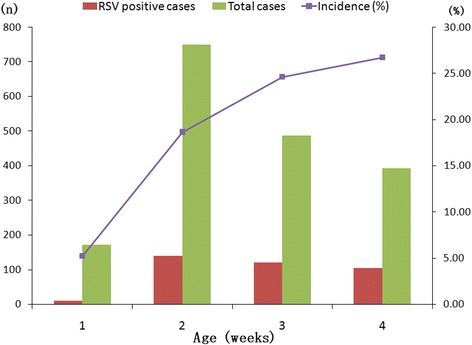
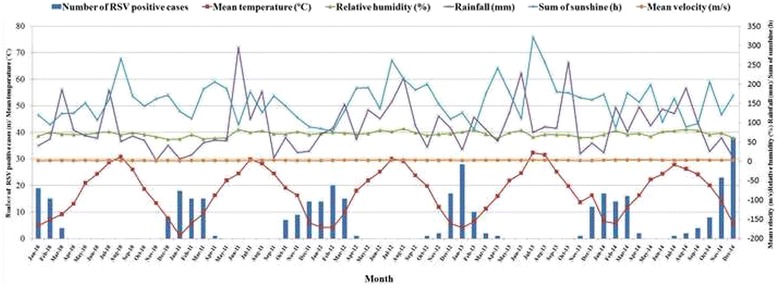
Of the 1803 hospitalized neonates analyzed, 20.74 % were found to be infected with RSV. Interestingly, 30 subjects were identified as being coinfected with other viruses. The rate of RSV infection was highestduring thewinter and early spring seasons; however, infection was negatively associated with monthly mean temperature (rs = -0.821, P < 0.0001), total rainfall (rs = -0.406, P = 0.002), and sum of sunshine (rs = -0.386, P = 0.001). Monthly mean temperature was the only independent factor associated with RSV activity, as determined using multivariate regression analysis. Compared with non-RSV neonates, neonates with RSV infection presented more frequently with tachypnea,moist rales, and abnormal chest X-rays requiring supplemental oxygen and extended hospitalization postpartum. Neonatal admittance into the NICU was determined based on prematurity and coinfection with other viruses; two independent risk factors for RSV disease, as determined by multivariate logistic analysis.
Important as a major cause of LRIs in hospitalized neonate, we found that the subtropical climate of the Suzhou area was associated with RSV activity. The identified risk factors ofsevere disease in neonates with RSV infection should be taken into consideration when implementing disease health interventions.
本研究旨在探讨中国苏州地区新生儿呼吸道合胞病毒(RSV)感染的流行病学和临床特征,并考虑气候因素对疾病的影响。
2010年至2014年,采用直接免疫荧光法对住院的下呼吸道感染(LRI)新生儿的鼻咽抽吸物(NPA)进行七种常见呼吸道病毒筛查,包括RSV。通过聚合酶链反应检测人博卡病毒、人偏肺病毒和肺炎支原体。
在分析的1803例住院新生儿中,20.74%被发现感染RSV。有趣的是,30名受试者被确定为同时感染其他病毒。RSV感染率在冬季和早春季节最高;然而,感染与月平均温度(rs = -0.821,P < 0.0001)、总降雨量(rs = -0.406,P = 0.002)和日照总和(rs = -0.386,P = 0.001)呈负相关。多元回归分析确定月平均温度是与RSV活动相关的唯一独立因素。与非RSV感染的新生儿相比,RSV感染的新生儿更常出现呼吸急促、湿啰音和胸部X线异常,需要产后补充氧气和延长住院时间。新生儿入住新生儿重症监护病房(NICU)是根据早产和与其他病毒的合并感染确定的;多元逻辑分析确定这是RSV疾病的两个独立危险因素。
作为住院新生儿LRI的主要原因,我们发现苏州地区的亚热带气候与RSV活动有关。在实施疾病健康干预措施时,应考虑已确定的RSV感染新生儿严重疾病的危险因素。