Cano Florencia, Rapiteanu Radu, Sebastiaan Winkler G, Lehner Paul J
Cambridge Institute for Medical Research, University of Cambridge, Cambridge Biomedical Campus, Hills Road, Cambridge CB2 0XY, UK.
Laboratory of Lymphocyte Signalling and Development, Babraham Institute, Cambridge CB22 3AT, UK.
Nat Commun. 2015 Oct 16;6:8670. doi: 10.1038/ncomms9670.
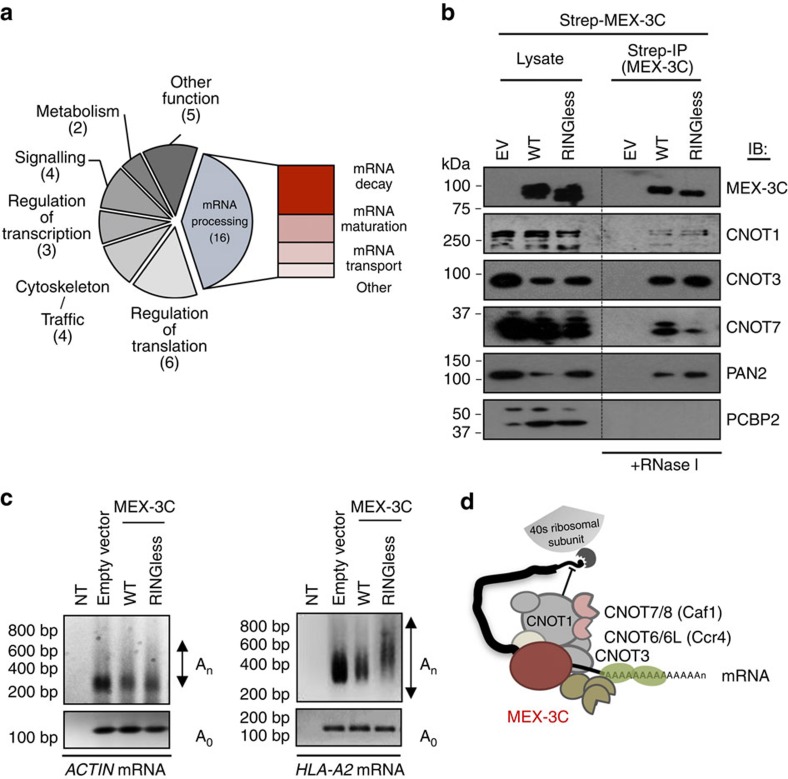
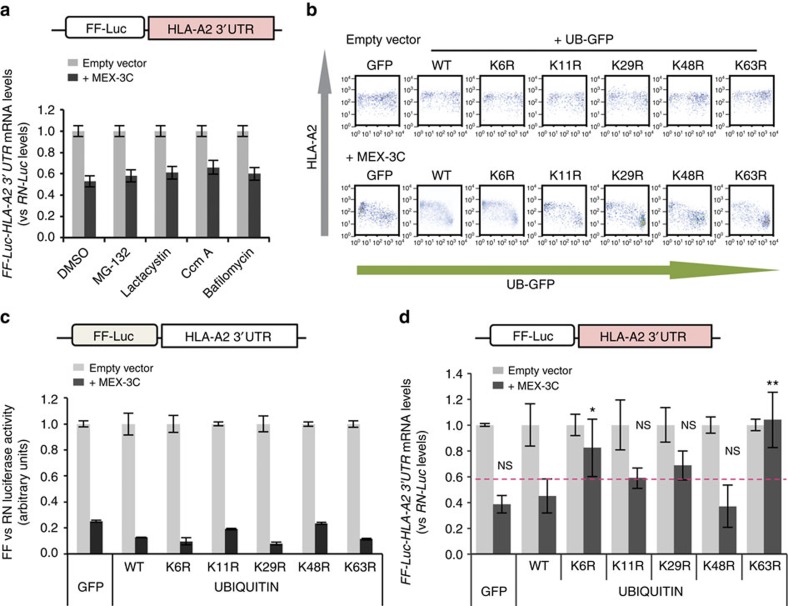
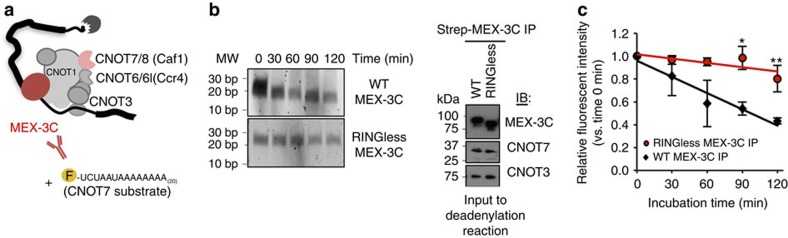
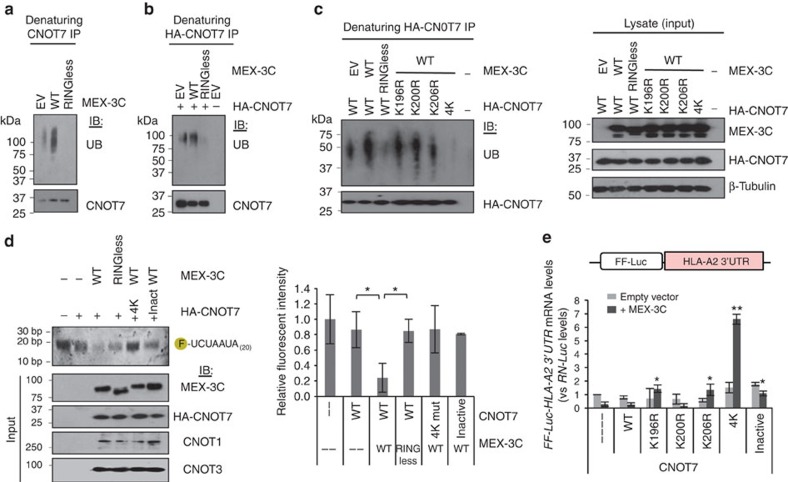
The regulation of protein and mRNA turnover is essential for many cellular processes. We recently showed that ubiquitin--traditionally linked to protein degradation--directly regulates the degradation of mRNAs through the action of a newly identified family of RNA-binding E3 ubiquitin ligases. How ubiquitin regulates mRNA decay remains unclear. Here, we identify a new role for ubiquitin in regulating deadenylation, the initial and often rate-limiting step in mRNA degradation. MEX-3C, a canonical member of this family of RNA-binding ubiquitin ligases, associates with the cytoplasmic deadenylation complexes and ubiquitinates CNOT7(Caf1), the main catalytic subunit of the CCR4-NOT deadenylation machinery. We establish a new role for ubiquitin in regulating MHC-I mRNA deadenylation as ubiquitination of CNOT7 by MEX-3C regulates its deadenylation activity and is required for MHC-I mRNA degradation. Since neither proteasome nor lysosome inhibitors rescued MEX-3C-mediated MHC-I mRNA degradation, our findings suggest a new non-proteolytic function for ubiquitin in the regulation of mRNA decay.
蛋白质和mRNA周转的调控对许多细胞过程至关重要。我们最近发现,传统上与蛋白质降解相关的泛素,通过新鉴定的一类RNA结合E3泛素连接酶的作用,直接调控mRNA的降解。泛素如何调控mRNA衰变仍不清楚。在此,我们确定了泛素在调控去腺苷酸化中的新作用,去腺苷酸化是mRNA降解的起始步骤,通常也是限速步骤。MEX-3C是该RNA结合泛素连接酶家族的一个典型成员,它与细胞质去腺苷酸化复合物结合,并使CCR4-NOT去腺苷酸化机制的主要催化亚基CNOT7(Caf1)泛素化。我们确立了泛素在调控MHC-I mRNA去腺苷酸化中的新作用,因为MEX-3C对CNOT7的泛素化调控其去腺苷酸化活性,且是MHC-I mRNA降解所必需的。由于蛋白酶体和溶酶体抑制剂均不能挽救MEX-3C介导的MHC-I mRNA降解,我们的发现表明泛素在调控mRNA衰变中具有一种新的非蛋白水解功能。