
炎症对心脏修复的益处并非持久:来自肥大细胞植入的证据。
The cardiac repair benefits of inflammation do not persist: evidence from mast cell implantation.
作者信息
Shao Zhengbo, Nazari Mansoreh, Guo Lily, Li Shu-Hong, Sun Jie, Liu Shi-Ming, Yuan Hui-Ping, Weisel Richard D, Li Ren-Ke
机构信息
Division of Cardiovascular Surgery, Toronto General Research Institute, University Health Network, Toronto, ON, Canada.
Division of Cardiac Surgery, Department of Surgery, University of Toronto, Toronto, ON, Canada.
出版信息
J Cell Mol Med. 2015 Dec;19(12):2751-62. doi: 10.1111/jcmm.12703. Epub 2015 Oct 16.
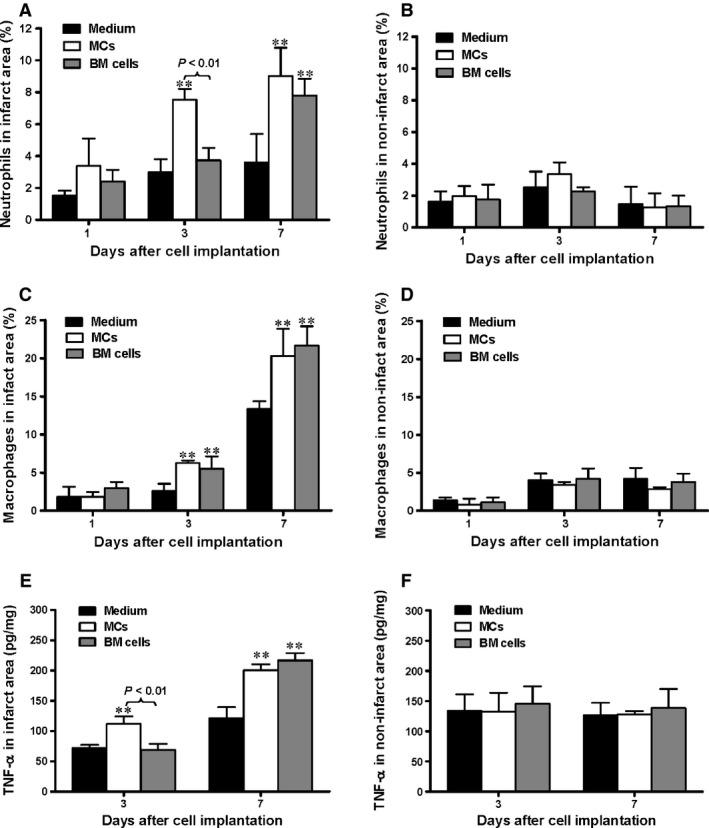
Multiple mechanisms contribute to progressive cardiac dysfunction after myocardial infarction (MI) and inflammation is an important mediator. Mast cells (MCs) trigger inflammation after MI by releasing bio-active factors that contribute to healing. c-Kit-deficient (Kit(W/W-v) ) mice have dysfunctional MCs and develop severe ventricular dilatation post-MI. We explored the role of MCs in post-MI repair. Mouse wild-type (WT) and Kit(W/W-v) MCs were obtained from bone marrow (BM). MC effects on fibroblasts were examined in vitro by proliferation and gel contraction assays. MCs were implanted into infarcted mouse hearts and their effects were evaluated using molecular, cellular and cardiac functional analyses. In contrast to WT, Kit(W/W-v) MC transplantation into Kit(W/W-v) mice did not improve cardiac function or scar size post-MI. Kit(W/W-v) MCs induced significantly reduced fibroblast proliferation and contraction compared to WT MCs. MC influence on fibroblast proliferation was Basic fibroblast growth factor (bFGF)-dependent and MC-induced fibroblast contractility functioned through transforming growth factor (TGF)-β. WT MCs transiently rescue cardiac function early post-MI, but the benefits of BM cell implantation lasted longer. MCs induced increased inflammation compared to the BM-injected mice, with increased neutrophil infiltration and infarct tumour necrosis factor-α (TNF-α) concentration. This augmented inflammation was followed by increased angiogenesis and myofibroblast formation and reduced scar size at early time-points. Similar to the functional data, these beneficial effects were transient, largely vanishing by day 28. Dysfunctional Kit(W/W-v) MCs were unable to rescue cardiac function post-MI. WT MC implantation transiently enhanced angiogenesis and cardiac function. These data suggest that increased inflammation is beneficial to cardiac repair, but these effects are not persistent.
多种机制导致心肌梗死后进行性心脏功能障碍,炎症是一个重要的介质。肥大细胞(MCs)在心肌梗死后通过释放有助于愈合的生物活性因子引发炎症。c-Kit缺陷(Kit(W/W-v))小鼠的MCs功能失调,心肌梗死后会出现严重的心室扩张。我们探讨了MCs在心肌梗死后修复中的作用。从小鼠骨髓(BM)中获取野生型(WT)和Kit(W/W-v)的MCs。通过增殖和凝胶收缩试验在体外检测MCs对成纤维细胞的影响。将MCs植入梗死的小鼠心脏,并使用分子、细胞和心脏功能分析评估其效果。与WT相比,将Kit(W/W-v)的MCs移植到Kit(W/W-v)小鼠中并不能改善心肌梗死后的心脏功能或瘢痕大小。与WT的MCs相比,Kit(W/W-v)的MCs显著降低了成纤维细胞的增殖和收缩。MCs对成纤维细胞增殖的影响依赖于碱性成纤维细胞生长因子(bFGF),且MCs诱导的成纤维细胞收缩功能通过转化生长因子(TGF)-β发挥作用。WT的MCs在心肌梗死后早期短暂地挽救了心脏功能,但骨髓细胞植入的益处持续时间更长。与注射骨髓的小鼠相比,MCs诱导的炎症增加,中性粒细胞浸润和梗死区肿瘤坏死因子-α(TNF-α)浓度升高。这种炎症增强随后在早期时间点伴随着血管生成增加、肌成纤维细胞形成以及瘢痕大小减小。与功能数据相似,这些有益作用是短暂的,在第28天时基本消失。功能失调的Kit(W/W-v) MCs在心肌梗死后无法挽救心脏功能。WT的MCs植入短暂增强了血管生成和心脏功能。这些数据表明,炎症增加对心脏修复有益,但这些作用并不持久。
 Zotero 插件