Bayat Mohammad, Chien Sufan, Chehelcheraghi Farzaneh
Department of Biology and Anatomical Sciences, School of Medicine, Shahid Beheshti University of Medical Sciences, Tehran, Iran.
Price Institute of Surgical Research, University of Louisville, and Noveratech LLC of Louisville, USA.
Biomed Res Int. 2021 Jun 8;2021:5521564. doi: 10.1155/2021/5521564. eCollection 2021.
Cardiovascular disease (CVD) contributes critically to the mortality, morbidity, and economic problem of illness globally. Exercise is a share of everyone's life. Some evidence-based studies have frequently shown a progressive correlation between physical activity and good health.
The effects of daily exercise on cardiomyocyte size, collagen content (fibrosis), and releasing mast cells (MCs') tryptase of the model of myocardial infarction (MI) were assessed.
40 rats were coincidentally spread into sham+inertia (control), sham+exercise, infarction+inertia, and infarction+exercise groups. An experimental model of acute MI was induced in infarction groups. One week after surgery, exercising groups were allowed to an aerobic exercise program for six weeks. At the endpoint of the study, all examinations were performed.
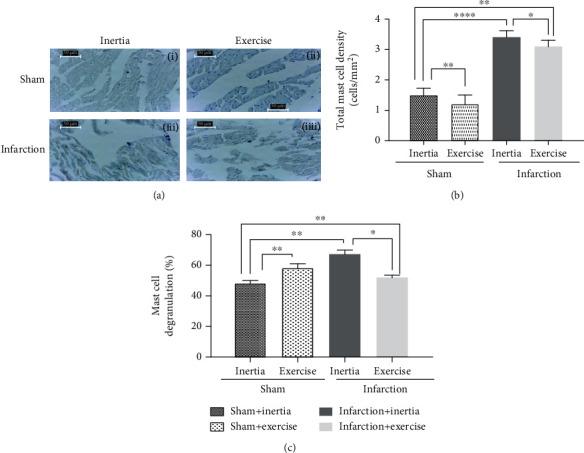
We found lesser fibrosis in sham+exercise and infarction+exercise groups compared to sham+inertia and infarction+inertia groups, respectively ( = 0.023, = 0.001). Also, infarction groups were significantly lower than sham groups ( < 0.05) and the infarction+exercise group was significantly lower than the infarction+inertia group ( < 0.05). The effect of exercise on MCs while increased MC density and degranulation occur at the site of fibrosis, we demonstrated that exercise decreases both total MC density and degranulation in both sham and infarction groups ( < 0.05). Immunohistochemistry examinations were significantly higher expression of MCs' tryptase in infarction groups than sham groups ( < 0.05, < 0.0001).
Exercise improves fibrosis and cardiac function in both healthy and MI rats by inhibiting released MCs' tryptase.
心血管疾病(CVD)是全球死亡率、发病率和疾病经济问题的关键因素。运动是每个人生活的一部分。一些基于证据的研究经常表明身体活动与健康之间存在渐进的相关性。
评估日常运动对心肌梗死(MI)模型中心肌细胞大小、胶原蛋白含量(纤维化)和肥大细胞(MCs)胰蛋白酶释放的影响。
40只大鼠随机分为假手术+惯性组(对照组)、假手术+运动组、梗死+惯性组和梗死+运动组。梗死组诱导急性心肌梗死实验模型。手术后一周,运动组进行六周的有氧运动计划。在研究终点,进行所有检查。
我们发现,与假手术+惯性组和梗死+惯性组相比,假手术+运动组和梗死+运动组的纤维化程度分别较低(P = 0.023,P = 0.001)。此外,梗死组明显低于假手术组(P < 0.05),梗死+运动组明显低于梗死+惯性组(P < 0.05)。运动对MCs的影响,虽然在纤维化部位MC密度增加和脱颗粒发生,但我们证明运动可降低假手术组和梗死组的总MC密度和脱颗粒(P < 0.05)。免疫组织化学检查显示,梗死组MCs胰蛋白酶的表达明显高于假手术组(P < 0.05,P < 0.0001)。
运动通过抑制MCs胰蛋白酶的释放改善健康大鼠和心肌梗死大鼠的纤维化和心脏功能。