Emery Paul, Fleischmann Roy M, Strusberg Ingrid, Durez Patrick, Nash Peter, Amante Eric Jason B, Churchill Melvin, Park Won, Pons-Estel Bernardo, Han Chenglong, Gathany Timothy A, Xu Stephen, Zhou Yiying, Leu Jocelyn H, Hsia Elizabeth C
Leeds Institute of Rheumatic and Musculoskeletal Medicine, University of Leeds, Chapel Allerton Hospital, and NIHR Leeds Musculoskeletal Biomedical Research Unit, Leeds Hospitals NHS Trust, Leeds, UK.
University of Texas and Southwest Medical Center, Dallas, Texas.
Arthritis Care Res (Hoboken). 2016 Jun;68(6):744-52. doi: 10.1002/acr.22759.
To evaluate the safety and efficacy of golimumab through 5 years in adults with active rheumatoid arthritis (RA) who had not previously received methotrexate (MTX).
In the GO-BEFORE study, 637 MTX-naive adult patients with active RA were randomized (1:1:1:1) to placebo + MTX (group 1), golimumab 100 mg + placebo (group 2), golimumab 50 mg + MTX (group 3), or golimumab 100 mg + MTX (group 4). Inadequate responders in groups 1, 2, and 3 entered early escape at week 28 to golimumab 50 mg + MTX, golimumab 100 mg + MTX, or golimumab 100 mg + MTX, respectively; remaining patients in group 1 could cross over to golimumab 50 mg + MTX at week 52. Assessments included the American College of Rheumatology 20%/50%/70% improvement criteria (ACR20/50/70) response, the Disease Activity Score in 28 joints (DAS28) using C-reactive protein (CRP) level, and the modified Sharp/van der Heijde score (SHS). Efficacy was analyzed using an intent-to-treat (ITT) analysis. Pharmacokinetics and immunogenicity were evaluated at selected visits.
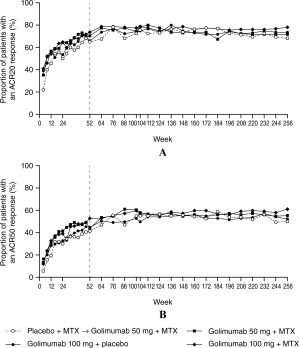
A total of 422 patients completed golimumab treatment through week 256. At week 256, 72.8%, 54.6%, and 38.0% of all patients in the full ITT population (n = 637) had an ACR20/50/70 response, respectively; 84.1% had a good or moderate DAS28-CRP response; and 72.7% had a clinically meaningful improvement in physical function. Radiographic progression was minimal in all treatment groups through week 256, and the overall mean change from baseline in SHS was 1.36. Serum trough golimumab concentrations were approximately dose proportional and maintained through week 256. Antibodies to golimumab occurred in 9.6% of patients through week 256. Infections were the most common type of adverse event (AE); 204 of 616 patients (33.1%) had ≥1 serious AE.
Clinical efficacy with golimumab treatment was maintained through week 256 of the GO-BEFORE trial of MTX-naive RA patients. No unexpected AEs occurred; safety results through 5 years are consistent with earlier reports.
评估戈利木单抗在既往未接受过甲氨蝶呤(MTX)治疗的活动性类风湿关节炎(RA)成人患者中应用5年的安全性和有效性。
在GO-BEFORE研究中,637例未使用过MTX的活动性RA成年患者被随机分为四组(1:1:1:1):安慰剂+MTX(第1组)、戈利木单抗100mg+安慰剂(第2组)、戈利木单抗50mg+MTX(第3组)或戈利木单抗100mg+MTX(第4组)。第1、2和3组中反应不足的患者在第28周提前改用戈利木单抗50mg+MTX、戈利木单抗100mg+MTX或戈利木单抗100mg+MTX;第1组中剩余患者可在第52周交叉使用戈利木单抗50mg+MTX。评估指标包括美国风湿病学会20%/50%/70%改善标准(ACR20/50/70)反应、采用C反应蛋白(CRP)水平的28个关节疾病活动评分(DAS28)以及改良Sharp/van der Heijde评分(SHS)。采用意向性分析(ITT)分析疗效。在选定访视时评估药代动力学和免疫原性。
共有422例患者完成了至第256周的戈利木单抗治疗。在第256周时,全ITT人群(n = 637)中分别有72.8%、54.6%和38.0%的患者达到ACR20/50/70反应;84.1%的患者DAS28-CRP反应良好或中等;72.7%的患者身体功能有临床意义的改善。至第256周,所有治疗组的影像学进展均最小,SHS自基线的总体平均变化为1.36。血清戈利木单抗谷浓度大致与剂量成正比,并维持至第256周。至第256周,9.6%的患者出现了抗戈利木单抗抗体。感染是最常见的不良事件(AE)类型;616例患者中有204例(33.1%)发生≥1次严重AE。
在未使用过MTX的RA患者的GO-BEFORE试验中,戈利木单抗治疗的临床疗效维持至第256周。未发生意外AE;5年的安全性结果与早期报告一致。