Alcayaga-Miranda Francisca, Cuenca Jimena, Martin Aldo, Contreras Luis, Figueroa Fernando E, Khoury Maroun
Laboratory of Nano-Regenerative Medicine, Faculty of Medicine, Universidad de Los Andes, Santiago, 7620001, Chile.
Cells for Cells, Santiago, 7620001, Chile.
Stem Cell Res Ther. 2015 Oct 16;6:199. doi: 10.1186/s13287-015-0192-0.
Sepsis is a clinical syndrome associated with a severe systemic inflammation induced by infection. Although different anti-microbial drugs have been used as treatments, morbidity and mortality rates remain high. Mesenchymal stem cells (MSCs) derived from the bone marrow have demonstrated a partial protective effect in sepsis. Menstrual derived MSCs (MenSCs) emerge as an attractive candidate because they present important advantages over other sources, including improved proliferation rates and paracrine response under specific stress conditions. Here, we evaluate their therapeutic effect in a polymicrobial severe sepsis model.
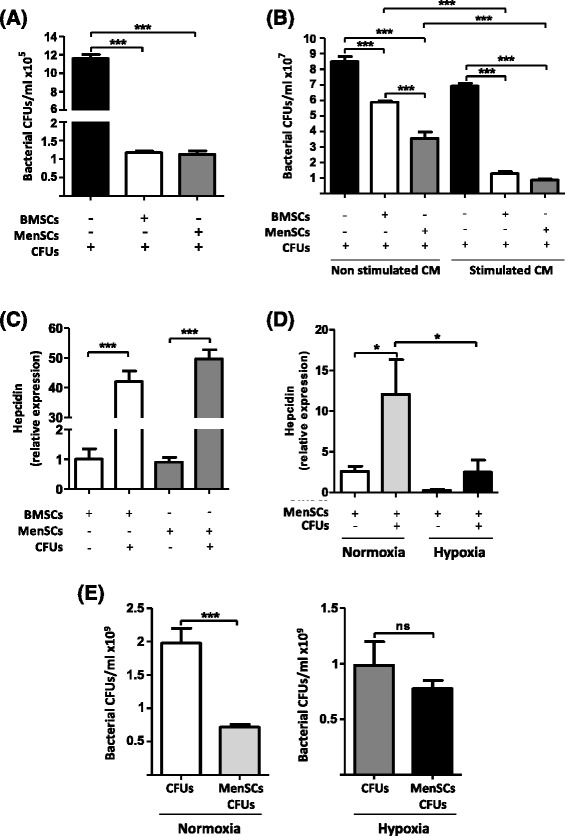
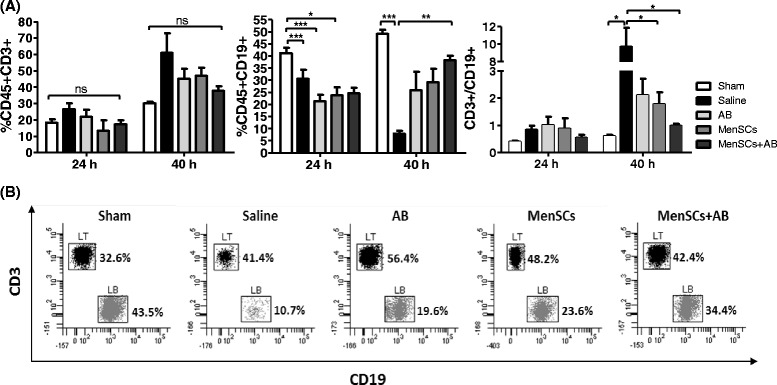
The antimicrobial activity of MenSCs was determined in vitro through direct and indirect bacterial growth assays and the measurement of the expression levels of different antimicrobial peptides (AMPs) by quantitative reverse transcription-polymerase chain reaction. The therapeutic effect of MenSCs was determined in the cecal ligation and puncture (CLP) mouse model. Mice were then treated with antibiotics (AB) or MenSCs alone or in combination. The survival rates and histological and biochemical parameters were evaluated, and the systemic levels of pro- and anti-inflammatory cytokines as well as the response of specific lymphocyte subsets were determined by flow cytometry.
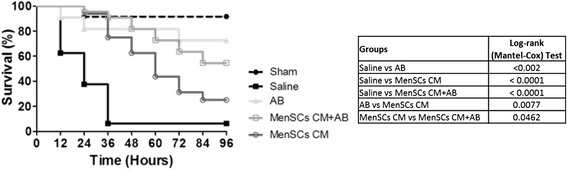
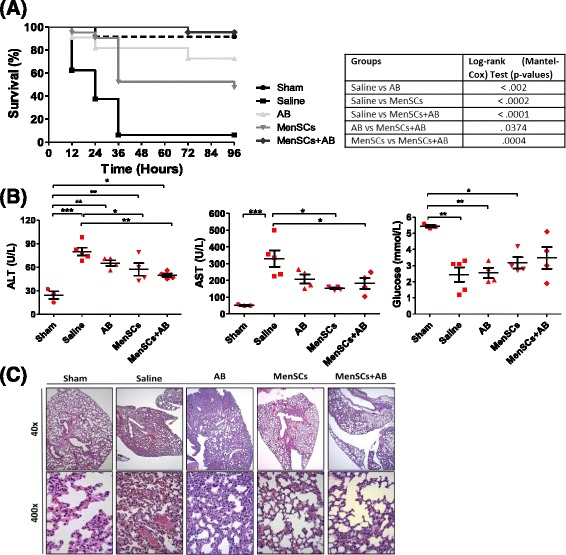
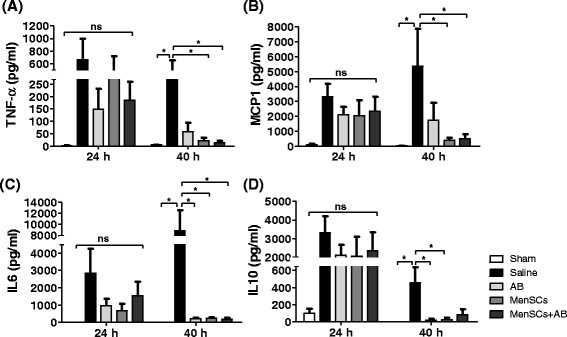
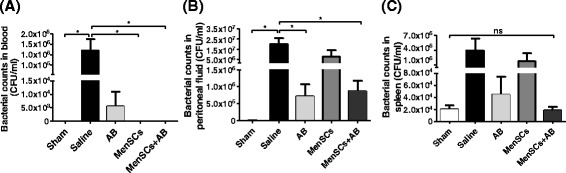
MenSCs exerted an important antimicrobial effect in vitro, mediated by a higher expression of the AMP-hepcidin. In the CLP mouse model, MenSCs in synergy with AB (a) improved the survival rate (95 %) in comparison with saline (6 %), AB (73 %), and MenSCs alone (48 %) groups; (b) enhanced bacterial clearance in the peritoneal fluids and blood; (c) reduced organ injuries evaluated by lower concentrations of the liver enzymes alanine aminotransferase and aspartate aminotransferase; and (d) modulated the inflammatory response through reduction of pro- and anti-inflammatory cytokines without significant loss of T and B lymphocytes.
We conclude that MenSCs in combination with AB enhance survival in CLP-induced sepsis by acting on multiples targets. MenSCs thus constitute a feasible approach for the future clinical treatment of sepsis.
脓毒症是一种与感染引起的严重全身炎症相关的临床综合征。尽管已使用不同的抗菌药物进行治疗,但发病率和死亡率仍然很高。源自骨髓的间充质干细胞(MSC)在脓毒症中已显示出部分保护作用。月经来源的间充质干细胞(MenSC)成为有吸引力的候选者,因为它们相对于其他来源具有重要优势,包括在特定应激条件下提高的增殖率和旁分泌反应。在此,我们评估它们在多微生物严重脓毒症模型中的治疗效果。
通过直接和间接细菌生长测定以及通过定量逆转录 - 聚合酶链反应测量不同抗菌肽(AMP)的表达水平,在体外确定MenSC的抗菌活性。在盲肠结扎和穿刺(CLP)小鼠模型中确定MenSC的治疗效果。然后用抗生素(AB)或单独或联合使用MenSC对小鼠进行治疗。评估存活率、组织学和生化参数,并通过流式细胞术确定促炎和抗炎细胞因子的全身水平以及特定淋巴细胞亚群的反应。
MenSC在体外发挥重要的抗菌作用,由AMP - 铁调素的更高表达介导。在CLP小鼠模型中,MenSC与AB协同作用:(a)与盐水(6%)、AB(73%)和单独的MenSC(48%)组相比,提高了存活率(95%);(b)增强了腹膜液和血液中的细菌清除;(c)通过降低肝酶丙氨酸氨基转移酶和天冬氨酸氨基转移酶的浓度评估,减少了器官损伤;(d)通过减少促炎和抗炎细胞因子来调节炎症反应,而不会导致T和B淋巴细胞显著损失。
我们得出结论,MenSC与AB联合通过作用于多个靶点提高CLP诱导的脓毒症的存活率。因此,MenSC构成脓毒症未来临床治疗的可行方法。