Cohen Kadosh Kathrin, Luo Qiang, de Burca Calem, Sokunbi Moses O, Feng Jianfeng, Linden David E J, Lau Jennifer Y F
Department of Experimental Psychology, University of Oxford, South Parks Road, Oxford, OX1 3UD, UK; Psychology Department, Institute of Psychiatry, King's College London, London SE5 8AF, UK.
School of Life Sciences, Fudan University, Shanghai 200433, PR China; Centre for Computational Systems Biology, Fudan University, Shanghai 200433, PR China.
Neuroimage. 2016 Jan 15;125:616-626. doi: 10.1016/j.neuroimage.2015.09.070. Epub 2015 Oct 22.
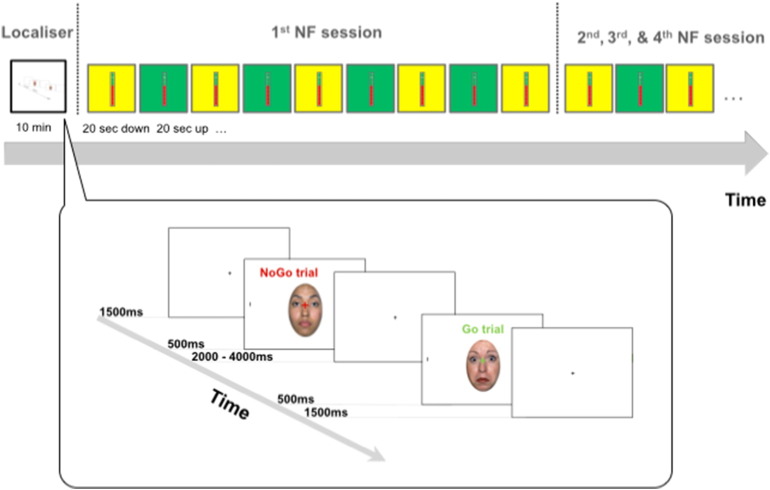
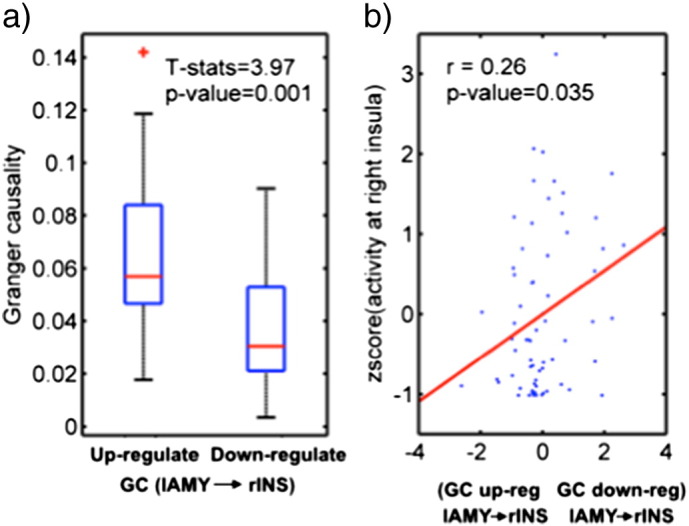
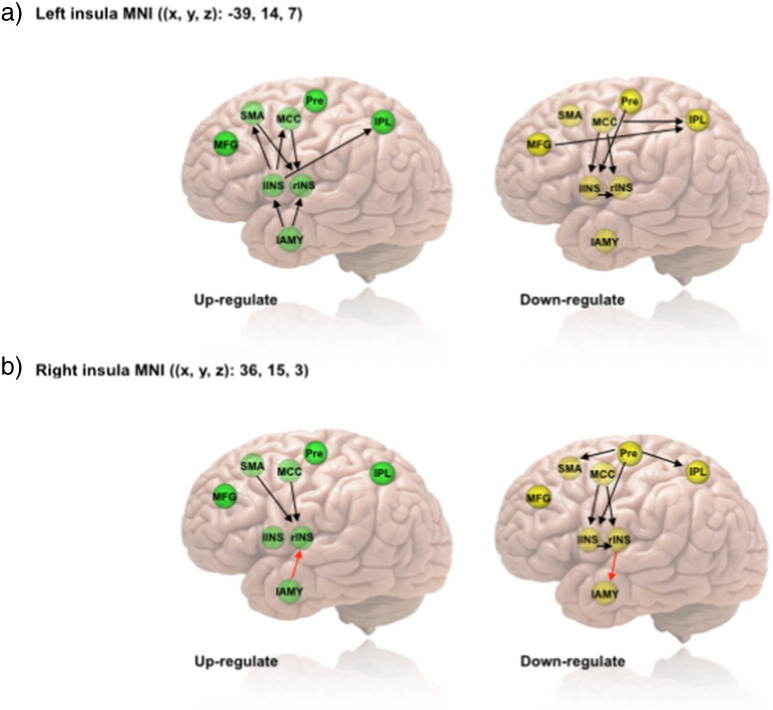
For most people, adolescence is synonymous with emotional turmoil and it has been shown that early difficulties with emotion regulation can lead to persistent problems for some people. This suggests that intervention during development might reduce long-term negative consequences for those individuals. Recent research has highlighted the suitability of real-time fMRI-based neurofeedback (NF) in training emotion regulation (ER) networks in adults. However, its usefulness in directly influencing plasticity in the maturing ER networks remains unclear. Here, we used NF to teach a group of 17 7-16 year-olds to up-regulate the bilateral insula, a key ER region. We found that all participants learned to increase activation during the up-regulation trials in comparison to the down-regulation trials. Importantly, a subsequent Granger causality analysis of Granger information flow within the wider ER network found that during up-regulation trials, bottom-up driven Granger information flow increased from the amygdala to the bilateral insula and from the left insula to the mid-cingulate cortex, supplementary motor area and the inferior parietal lobe. This was reversed during the down-regulation trials, where we observed an increase in top-down driven Granger information flow to the bilateral insula from mid-cingulate cortex, pre-central gyrus and inferior parietal lobule. This suggests that: 1) NF training had a differential effect on up-regulation vs down-regulation network connections, and that 2) our training was not only superficially concentrated on surface effects but also relevant with regards to the underlying neurocognitive bases. Together these findings highlight the feasibility of using NF in children and adolescents and its possible use for shaping key social cognitive networks during development.
对大多数人来说,青春期是情绪动荡的代名词,并且有研究表明,早期在情绪调节方面遇到的困难可能会给一些人带来持续的问题。这表明在发育过程中进行干预可能会减少这些个体的长期负面后果。最近的研究强调了基于功能磁共振成像实时神经反馈(NF)在训练成年人情绪调节(ER)网络方面的适用性。然而,其在直接影响成熟的ER网络可塑性方面的作用仍不明确。在这里,我们使用NF来教导一组17名7至16岁的青少年上调双侧脑岛,这是一个关键的ER区域。我们发现,与下调试验相比,所有参与者在上调试验期间都学会了增加激活。重要的是,随后对更广泛的ER网络内的格兰杰信息流进行的格兰杰因果分析发现,在上调试验期间,自下而上驱动的格兰杰信息流从杏仁核增加到双侧脑岛,从左侧脑岛增加到扣带中部皮质、辅助运动区和顶下小叶。在下调试验期间,这种情况发生了逆转,我们观察到自上而下驱动的格兰杰信息流从中部扣带皮质、中央前回和顶下小叶增加到双侧脑岛。这表明:1)NF训练对上调和下调网络连接有不同的影响,并且2)我们的训练不仅表面上集中在表面效应上,而且在潜在的神经认知基础方面也有相关性。这些发现共同凸显了在儿童和青少年中使用NF的可行性及其在发育过程中塑造关键社会认知网络的可能用途。