Kerr Kara L, Ratliff Erin L, Cohen Zsofia P, Fuller Stormie, Cosgrove Kelly T, DeVille Danielle C, Misaki Masaya, Morris Amanda Sheffield, Bodurka Jerzy
Department of Psychology, Oklahoma State University, Stillwater, OK, United States.
Oklahoma State University Biomedical Imaging Center, Tulsa, OK, United States.
Front Hum Neurosci. 2022 May 26;16:910951. doi: 10.3389/fnhum.2022.910951. eCollection 2022.
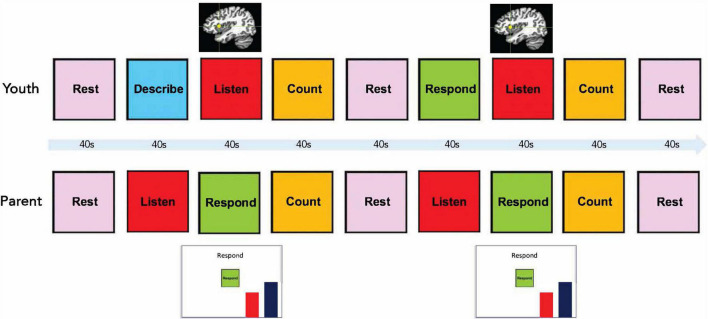
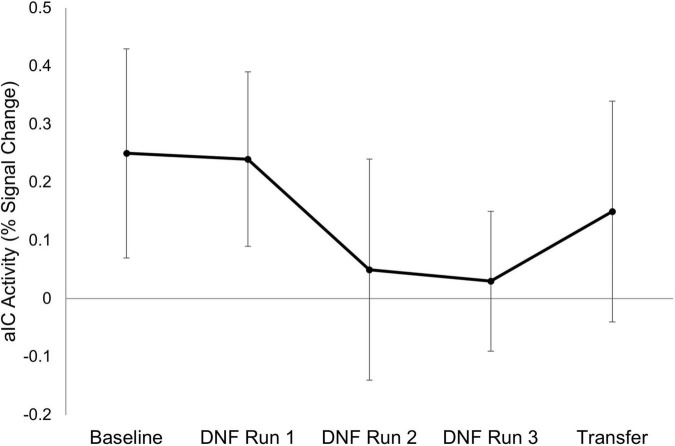
Real-time fMRI (rt-fMRI) neurofeedback can be used to non-invasively modulate brain activity and has shown initial effectiveness in symptom reduction for psychiatric disorders. Neurofeedback paradigms often target the neurocircuitry underlying emotion regulation, as difficulties with emotion regulation are common across many psychiatric conditions. Adolescence is a key period for the development of emotion regulation, with the parent-adolescent relationship providing an important context for learning how to modulate one's emotions. Here, we present evidence for a novel extension of rt-fMRI neurofeedback wherein a second person (the parent) views neurofeedback from the focal participant (adolescent) and attempts to regulate the other person's brain activity. In this proof-of-concept study, mother-adolescent dyads ( = 6; all female) participated in a dyadic neurofeedback protocol, during which they communicated active noise-canceling microphones and headphones. During the scan, adolescents described current emotionally upsetting situations in their lives, and their mothers responded while viewing neurofeedback from the adolescent's right anterior insular cortex (aIC)-a key hub for emotion-related processing. The mother was instructed to supportively respond to her daughter's negative emotions and attempt to downregulate the aIC activity. Mean right aIC activation during each run was calculated for each adolescent participant, and results revealed a downward trend across the session (β = -0.17, = 0.19, Cohen's = 0.03). Results of this proof-of-concept study support further research using dyadic neurofeedback to target emotion-related processing. Future applications may include therapist-client dyads and continued research with parents and children.
[www.ClinicalTrials.gov], identifier [NCT03929263].
实时功能磁共振成像(rt-fMRI)神经反馈可用于非侵入性调节大脑活动,并已在减少精神疾病症状方面显示出初步效果。神经反馈范式通常针对情绪调节的神经回路,因为情绪调节困难在许多精神疾病中都很常见。青春期是情绪调节发展的关键时期,亲子关系为学习如何调节情绪提供了重要背景。在此,我们展示了rt-fMRI神经反馈的一种新扩展的证据,即第二个人(父母)查看焦点参与者(青少年)的神经反馈,并试图调节对方的大脑活动。在这项概念验证研究中,母亲-青少年二元组(n = 6;均为女性)参与了二元神经反馈方案,在此期间他们通过有源消噪麦克风和耳机进行交流。在扫描过程中,青少年描述了他们生活中当前情绪困扰的情况,他们的母亲在查看青少年右前岛叶皮质(aIC)——情绪相关处理的关键枢纽——的神经反馈时做出回应。母亲被指示以支持性的方式回应女儿的负面情绪,并试图下调aIC活动。为每个青少年参与者计算每次运行期间右aIC的平均激活度,结果显示在整个疗程中呈下降趋势(β = -0.17,SE = 0.19,科恩d = 0.03)。这项概念验证研究的结果支持使用二元神经反馈针对情绪相关处理进行进一步研究。未来的应用可能包括治疗师-客户二元组以及与父母和孩子的持续研究。
[www.ClinicalTrials.gov],标识符 [NCT03929263]。