Low Andrea J, Nagot Nicolas, Weiss Helen A, Konate Issouf, Kania Dramane, Segondy Michel, Meda Nicolas, van de Perre Philippe, Mayaud Philippe
London School of Hygiene and Tropical Medicine, United Kingdom.
UMR 1058 University of Montpellier Montpellier University Hospital, France.
J Infect Dis. 2016 Mar 1;213(5):731-7. doi: 10.1093/infdis/jiv495. Epub 2015 Oct 15.
The impact of antiretroviral therapy (ART) on herpes simplex virus type-2 (HSV-2) replication is unclear. The aim of this study was to assess factors associated with cervicovaginal HSV-2 DNA shedding and genital ulcer disease (GUD) in a cohort of women living with human immunodeficiency virus type-1 (HIV-1) in Burkina Faso.
Participants were screened for cervicovaginal HSV-2 DNA, GUD, cervicovaginal and systemic HIV-1 RNA, and reproductive tract infections every 3-6 months over 8 years. Associations with HSV-2 shedding and quantity were examined using random-effects logistic and linear regression, respectively.
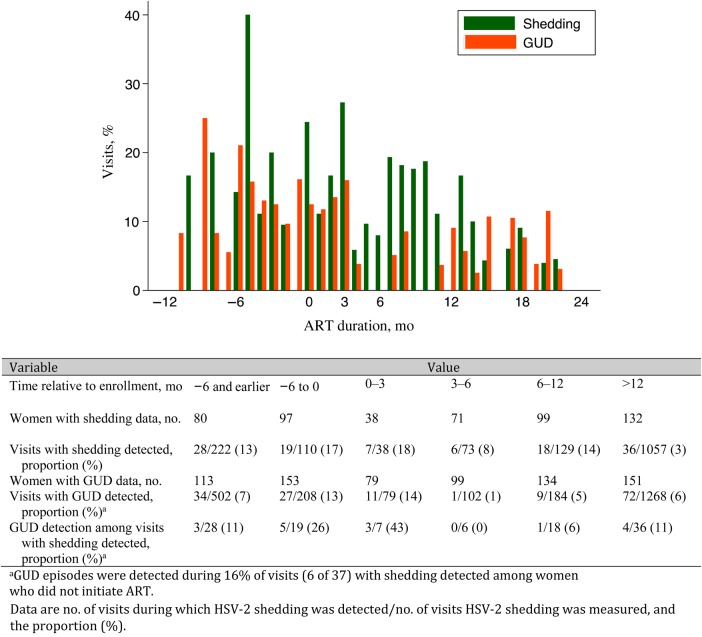
Of the 236 women with data on HSV-2 shedding, 151 took ART during the study period. Cervicovaginal HSV-2 DNA was detected in 42% of women (99 of 236) in 8.2% of visits (151 of 1848). ART was associated with a reduction in the odds of HSV-2 shedding, which declined for each year of ART use (odds ratio [OR], 0.74; 95% confidence interval [CI], .59-.92). In the multivariable model, the impact of ART was primarily associated with suppression of systemic HIV-1 RNA (adjusted OR, 0.32; 95% CI, .15-.67). A reduction in the odds of GUD was also observed during ART, mainly in those with HIV-1 suppression (adjusted OR, 0.53; 95% CI, .25-1.11).
ART is strongly associated with a decrease in cervicovaginal HSV-2 shedding, and the impact was sustained over several years.
抗逆转录病毒疗法(ART)对2型单纯疱疹病毒(HSV-2)复制的影响尚不清楚。本研究的目的是评估布基纳法索一群感染1型人类免疫缺陷病毒(HIV-1)的女性中,与宫颈阴道HSV-2 DNA脱落及生殖器溃疡疾病(GUD)相关的因素。
在8年时间里,每3至6个月对参与者进行宫颈阴道HSV-2 DNA、GUD、宫颈阴道及全身HIV-1 RNA和生殖道感染的筛查。分别使用随机效应逻辑回归和线性回归分析与HSV-2脱落及数量的关联。
在236名有HSV-2脱落数据的女性中,151名在研究期间接受了ART治疗。在8.2%的就诊中(1848次就诊中的151次),42%的女性(236名中的99名)检测到宫颈阴道HSV-2 DNA。ART与HSV-2脱落几率的降低相关,使用ART的每一年,脱落几率都会下降(优势比[OR],0.74;95%置信区间[CI],0.59 - 0.92)。在多变量模型中,ART的影响主要与全身HIV-1 RNA的抑制相关(调整后OR,0.32;95% CI,0.15 - 0.67)。在ART治疗期间,GUD的几率也有所降低,主要发生在HIV-1得到抑制的人群中(调整后OR,0.53;95% CI,0.25 - 1.11)。
ART与宫颈阴道HSV-2脱落的减少密切相关,且这种影响在数年内持续存在。