Kuchipudi Suresh V, Dunham Stephen P, Chang Kin-Chow
School of Veterinary Medicine and Science, University of Nottingham, Sutton Bonington, LE12 5RD, UK.
Genom Data. 2015 Mar 20;4:60-4. doi: 10.1016/j.gdata.2015.03.004. eCollection 2015 Jun.
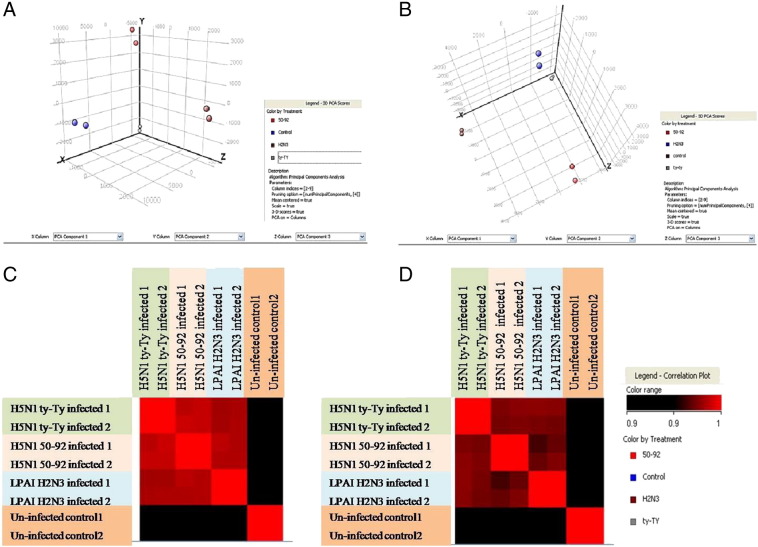
The data described in this article pertain to the article by Kuchipudi et al. (2014) titled "Highly Pathogenic Avian Influenza Virus Infection in Chickens But Not Ducks Is Associated with Elevated Host Immune and Pro-inflammatory Responses" [1]. While infection of chickens with highly pathogenic avian influenza (HPAI) H5N1 virus subtypes often leads to 100% mortality within 1 to 2 days, infection of ducks in contrast causes mild or no clinical signs. The rapid onset of fatal disease in chickens, but with no evidence of severe clinical symptoms in ducks, suggests underlying differences in their innate immune mechanisms. We used Chicken Genechip microarrays (Affymetrix) to analyse the gene expression profiles of primary chicken and duck lung cells infected with a low pathogenic avian influenza (LPAI) H2N3 virus and two HPAI H5N1 virus subtypes to understand the molecular basis of host susceptibility and resistance in chickens and ducks. Here, we described the experimental design, quality control and analysis that were performed on the data set. The data are publicly available through the Gene Expression Omnibus (GEO)database with accession number GSE33389, and the analysis and interpretation of these data are included in Kuchipudi et al. (2014) [1].
本文所述数据与Kuchipudi等人(2014年)发表的题为《高致病性禽流感病毒感染鸡而非鸭与宿主免疫和促炎反应升高有关》的文章相关[1]。高致病性禽流感(HPAI)H5N1病毒亚型感染鸡时,通常会在1至2天内导致100%的死亡率,而相比之下,感染鸭只会引起轻微或无临床症状。鸡的致命疾病发病迅速,但鸭没有严重临床症状的证据,这表明它们的先天免疫机制存在潜在差异。我们使用鸡基因芯片微阵列(Affymetrix)分析了感染低致病性禽流感(LPAI)H2N3病毒和两种HPAI H5N1病毒亚型的原代鸡和鸭肺细胞的基因表达谱,以了解鸡和鸭宿主易感性和抗性的分子基础。在此,我们描述了对数据集进行的实验设计、质量控制和分析。这些数据可通过基因表达综合数据库(GEO)公开获取,登录号为GSE33389,Kuchipudi等人(2014年)[1]中包含了对这些数据的分析和解读。