
布加综合征:一个未被察觉的诊断。
Budd-Chiari Syndrome: an unnoticed diagnosis.
作者信息
Falcão Camila Kruschewsky, Fagundes Gustavo C Freitas, Lamos Gustavo Checolli, Felipe-Silva Aloisio, Lovisolo Silvana Maria, Martines João Augusto, de Campos Fernando Peixoto Ferraz
机构信息
Internal Medicine Department - Hospital das Clínicas - Faculdade de Medicina -Universidade de São Paulo, São Paulo/SP - Brazil .
Anatomy Pathology Service - Hospital Universitário - Universidade de São Paulo, São Paulo/SP - Brazil .
出版信息
Autops Case Rep. 2015 Jun 30;5(2):17-25. doi: 10.4322/acr.2015.009. eCollection 2015 Apr-Jun.
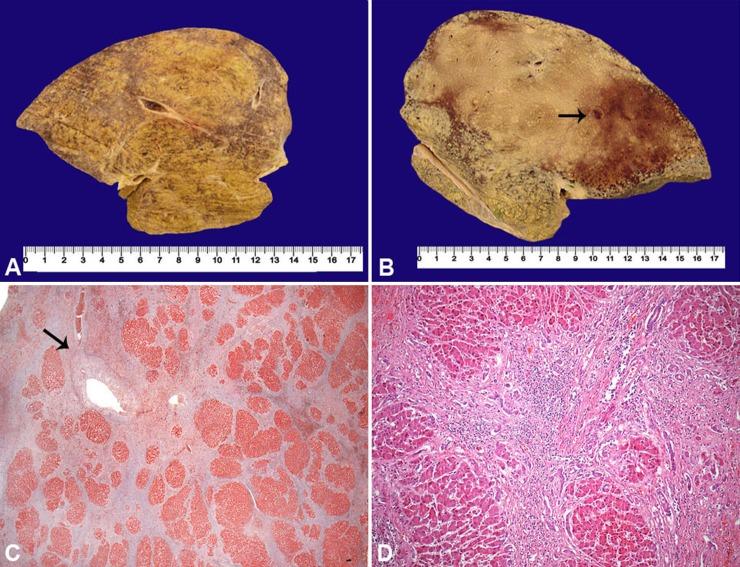
Budd-Chiari syndrome (BCS) encompasses a group of disorders caused by the obstruction to the hepatic venous outflow at the level of the small or large hepatic veins, the inferior vena cava, or any combination thereof. Clinical manifestation of the subacute form is characterized by supramesocolic abdominal discomfort, abdominal distension, fever, and lower limbs edema. Imaging work-up with hepatic Doppler ultrasound and abdominal computed tomography (CT) enables the diagnosis in the majority of cases. Treatment comprises long-term anticoagulation associated with measures that attempt to re-establish the flow in the thrombosed vessel (thrombolysis or angioplasty) or through the venous blood flow bypasses (transjugular intrahepatic portosystemic shunt or surgical bypass); however, the outcome is often dismal. The authors report the case of a 37-year-old woman presenting a 2-month history of dyspeptic complaints and abdominal distention. Fever was present at the beginning of symptoms. The laboratory work-up disclosed mild hepatic dysfunction, and the ultrasound showed evidence of chronic liver disease. Despite a thorough etiologic investigation, diagnosis was missed and, therefore, management could not be directed towards the physiopathogenetic process. The outcome was characterized by portal hypertension and esophageal varices bleeding. The patient died and the autopsy findings were characteristic of BCS, although an abdominal CT, close to death, had showed signs consistent with this diagnosis. The authors highlight the importance of knowledge of this entity, the diagnostic methods, and the multidisciplinary approach. BCS should be considered whenever investigating etiology for chronic or acute hepatopathy.
布加综合征(BCS)是一组由肝小静脉或大静脉、下腔静脉水平的肝静脉流出道梗阻或其任何组合引起的疾病。亚急性型的临床表现以结肠上区腹部不适、腹胀、发热和下肢水肿为特征。肝脏多普勒超声和腹部计算机断层扫描(CT)的影像学检查在大多数病例中可做出诊断。治疗包括长期抗凝以及尝试重新建立血栓形成血管内血流的措施(溶栓或血管成形术)或通过静脉血流旁路(经颈静脉肝内门体分流术或手术旁路);然而,结果往往不佳。作者报告了一例37岁女性病例,该患者有2个月的消化不良主诉和腹胀病史。症状开始时出现发热。实验室检查显示轻度肝功能障碍,超声显示有慢性肝病迹象。尽管进行了全面的病因调查,但诊断仍被漏诊,因此治疗未能针对病理生理过程。结果表现为门静脉高压和食管静脉曲张出血。患者死亡,尸检结果为布加综合征的特征性表现,尽管在接近死亡时的腹部CT已显示出与此诊断一致的迹象。作者强调了了解该疾病实体、诊断方法和多学科方法的重要性。在调查慢性或急性肝病的病因时,应考虑布加综合征。




 Zotero 插件