
2014年沙特阿拉伯利雅得中东呼吸综合征医院暴发的分子流行病学
Molecular Epidemiology of Hospital Outbreak of Middle East Respiratory Syndrome, Riyadh, Saudi Arabia, 2014.
作者信息
Fagbo Shamsudeen F, Skakni Leila, Chu Daniel K W, Garbati Musa A, Joseph Mercy, Peiris Malik, Hakawi Ahmed M
出版信息
Emerg Infect Dis. 2015 Nov;21(11):1981-8. doi: 10.3201/eid2111.150944.
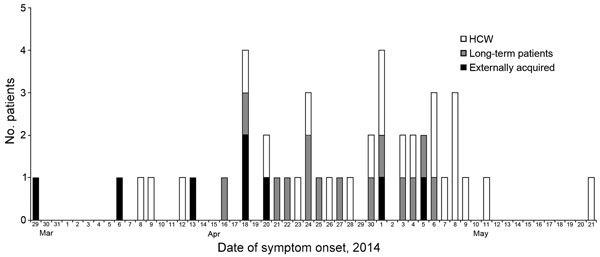
We investigated an outbreak of Middle East respiratory syndrome (MERS) at King Fahad Medical City (KFMC), Riyadh, Saudi Arabia, during March 29-May 21, 2014. This outbreak involved 45 patients: 8 infected outside KFMC, 13 long-term patients at KFMC, 23 health care workers, and 1 who had an indeterminate source of infection. Sequences of full-length MERS coronavirus (MERS-CoV) from 10 patients and a partial sequence of MERS-CoV from another patient, when compared with other MERS-CoV sequences, demonstrated that this outbreak was part of a larger outbreak that affected multiple health care facilities in Riyadh and possibly arose from a single zoonotic transmission event that occurred in December 2013 (95% highest posterior density interval November 8, 2013-February 10, 2014). This finding suggested continued health care-associated transmission for 5 months. Molecular epidemiology documented multiple external introductions in a seemingly contiguous outbreak and helped support or refute transmission pathways suspected through epidemiologic investigation.
2014年3月29日至5月21日期间,我们对沙特阿拉伯利雅得法赫德国王医疗城(KFMC)发生的中东呼吸综合征(MERS)疫情进行了调查。此次疫情涉及45名患者:8名在KFMC以外感染,13名KFMC的长期患者,23名医护人员,以及1名感染源不明的患者。将10名患者的中东呼吸综合征冠状病毒(MERS-CoV)全长序列和另一名患者的MERS-CoV部分序列与其他MERS-CoV序列进行比较后发现,此次疫情是影响利雅得多个医疗机构的更大规模疫情的一部分,可能源于2013年12月发生的一次人畜共患病传播事件(95%最高后验密度区间为2013年11月8日至2014年2月10日)。这一发现表明,医疗保健相关传播持续了5个月。分子流行病学记录了在看似连续的疫情中多次外部引入情况,并有助于支持或反驳通过流行病学调查怀疑的传播途径。


 Zotero 插件