Sada-Ovalle Isabel, Ocaña-Guzman Ranferi, Pérez-Patrigeón Santiago, Chávez-Galán Leslie, Sierra-Madero Juan, Torre-Bouscoulet Luis, Addo Marylyn M
Laboratorio de Inmunología IntegrativaInstituto Nacional de Enfermedades Respiratorias Ismael Cosío Villegas, Distrito Federal, México;
Laboratorio de Inmunología IntegrativaInstituto Nacional de Enfermedades Respiratorias Ismael Cosío Villegas, Distrito Federal, México.
J Int AIDS Soc. 2015 Oct 19;18(1):20078. doi: 10.7448/IAS.18.1.20078. eCollection 2015.
T cell immunoglobulin and mucin domain (Tim) 3 and programmed death 1 (PD-1) are co-inhibitory receptors involved in the so-called T cell exhaustion, and in vivo blockade of these molecules restores T cell dysfunction. High expression of Tim-3 and PD-1 is induced after chronic antigen-specific stimulation of T cells during HIV infection. We have previously demonstrated that the interaction of Tim-3 with its ligand galectin-9 induces macrophage activation and killing of Mycobacterium tuberculosis. Our aim in this study was to analyze the Tim-3 expression profile before and after six months of antiretroviral therapy and the impact of Tim-3 and PD-1 blocking on immunity against M. tuberculosis.
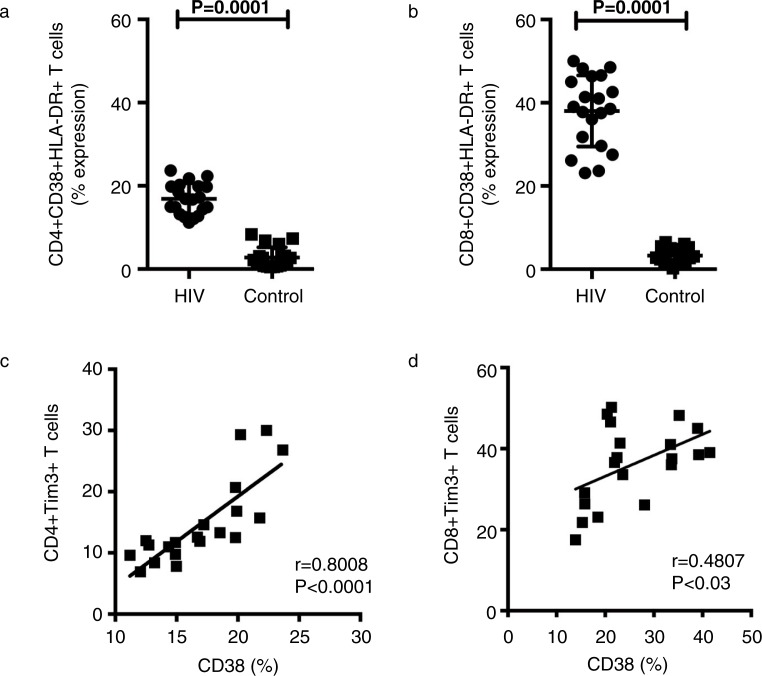
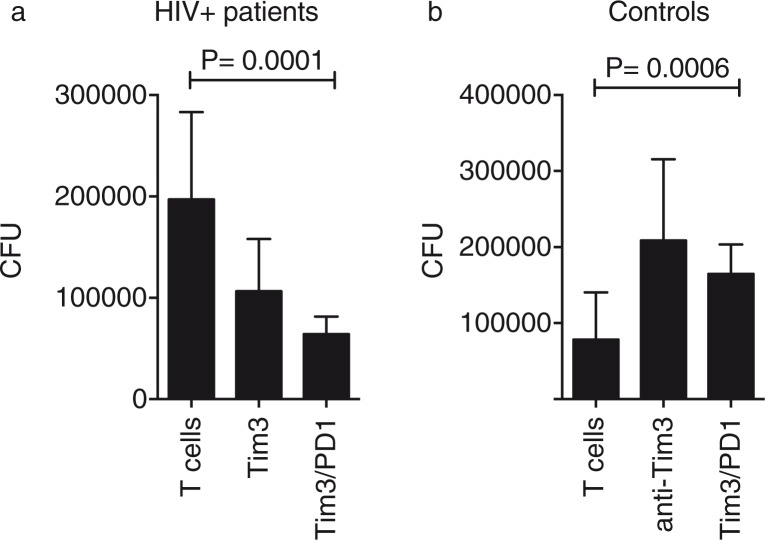
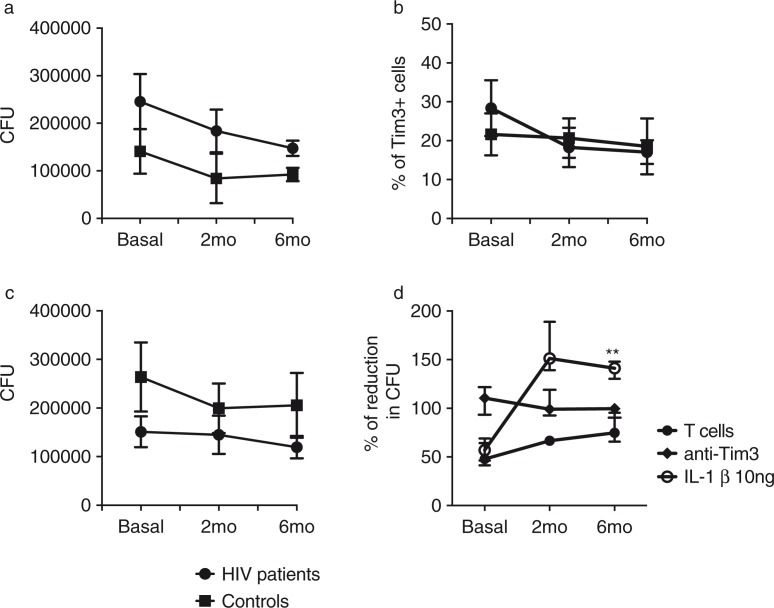
HIV+ patients naïve to anti-retroviral therapy (ART) were followed up for six months. Peripheral immune-cell phenotype (CD38/HLA-DR/galectin-9/Tim-3 and PD-1) was assessed by flow cytometry. Supernatants were analyzed with a multiplex cytokine detection system (human Th1/Th2 cytokine Cytometric Bead Array) by flow cytometry. Control of bacterial growth was evaluated by using an in vitro experimental model in which virulent M. tuberculosis-infected macrophages were cultured with T cells in the presence or absence of Tim-3 and PD-1 blocking antibodies. Interleukin-1 beta treatment of infected macrophages was evaluated by enumerating colony-forming units.
We showed that HIV+ patients had an increased expression of Tim-3 in T cells and were able to control bacterial growth before ART administration. By blocking Tim-3 and PD-1, macrophages and T cells recovered their functionality and had a higher ability to control bacterial growth; this result was partially dependent on the restitution of cytokine production.
In this study, we demonstrated that increased Tim-3 expression can limit the ability of the immune system to control the infection of intracellular bacteria such as M. tuberculosis. The use of ART and the in vitro manipulation of the Tim-3 and PD-1 molecules restored the functionality of T cells and macrophages to restrict bacterial growth. Our results provide a novel immune strategy that may be implemented in the near future in order to improve the immune responses in HIV+ patients.
T细胞免疫球蛋白和粘蛋白结构域(Tim)3和程序性死亡1(PD-1)是参与所谓T细胞耗竭的共抑制受体,在体内阻断这些分子可恢复T细胞功能障碍。在HIV感染期间,T细胞受到慢性抗原特异性刺激后会诱导Tim-3和PD-1的高表达。我们之前已经证明Tim-3与其配体半乳糖凝集素-9的相互作用可诱导巨噬细胞活化并杀死结核分枝杆菌。本研究的目的是分析抗逆转录病毒治疗六个月前后Tim-3的表达谱,以及Tim-3和PD-1阻断对结核分枝杆菌免疫的影响。
对未接受过抗逆转录病毒治疗(ART)的HIV阳性患者进行了六个月的随访。通过流式细胞术评估外周免疫细胞表型(CD38/HLA-DR/半乳糖凝集素-9/Tim-3和PD-1)。用多重细胞因子检测系统(人Th1/Th2细胞因子细胞计数微球阵列)通过流式细胞术分析上清液。通过使用体外实验模型评估细菌生长的控制情况,在该模型中,将有毒力的结核分枝杆菌感染的巨噬细胞与T细胞在存在或不存在Tim-3和PD-1阻断抗体的情况下进行培养。通过计数集落形成单位评估白细胞介素-1β对感染巨噬细胞的治疗效果。
我们发现HIV阳性患者在接受ART治疗前T细胞中Tim-3表达增加,并且能够控制细菌生长。通过阻断Tim-3和PD-1,巨噬细胞和T细胞恢复了其功能,并且具有更高的控制细菌生长的能力;这一结果部分依赖于细胞因子产生的恢复。
在本研究中,我们证明Tim-3表达增加会限制免疫系统控制细胞内细菌如结核分枝杆菌感染的能力。ART的使用以及对Tim-3和PD-1分子的体外操作恢复了T细胞和巨噬细胞限制细菌生长的功能。我们的结果提供了一种新的免疫策略,可能在不久的将来得以实施,以改善HIV阳性患者的免疫反应。