Division of Rheumatology, Immunology, and Allergy, Brigham and Women's Hospital, Harvard Medical School, Boston, MA 02115, USA.
J Exp Med. 2010 Oct 25;207(11):2343-54. doi: 10.1084/jem.20100687. Epub 2010 Oct 11.
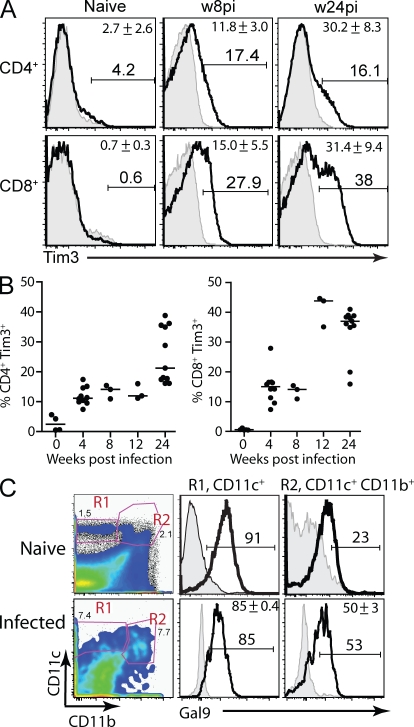
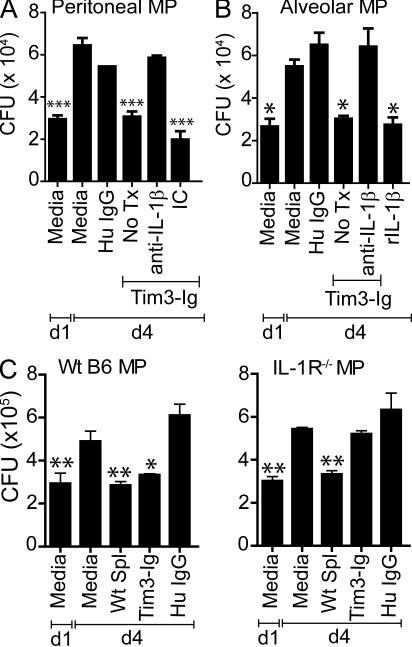
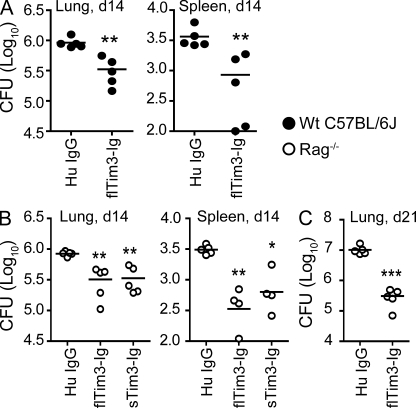
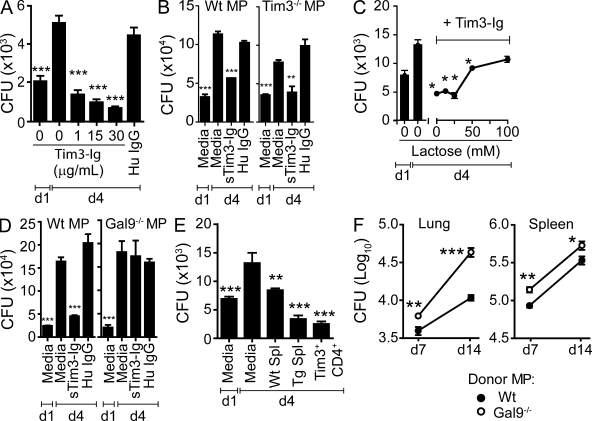
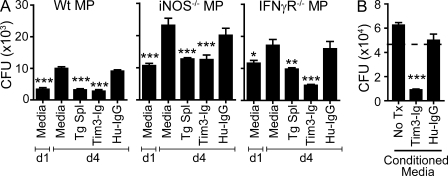
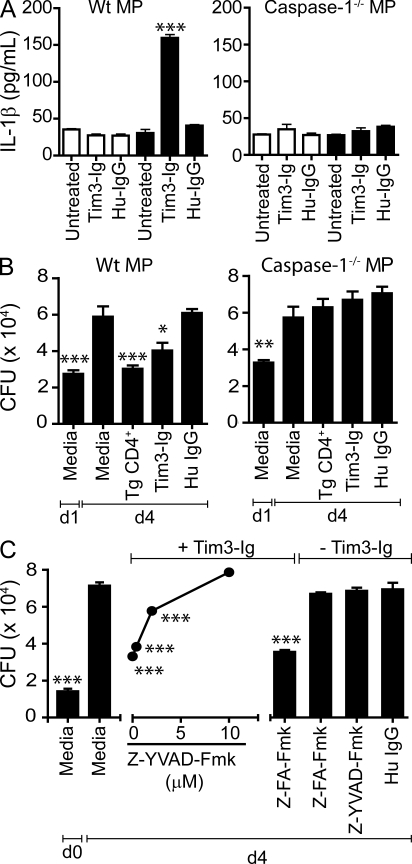
T cell immunoglobulin and mucin domain 3 (Tim3) is a negative regulatory molecule that inhibits effector T(H)1-type responses. Such inhibitory signals prevent unintended tissue inflammation, but can be detrimental if they lead to premature T cell exhaustion. Although the role of Tim3 in autoimmunity has been extensively studied, whether Tim3 regulates antimicrobial immunity has not been explored. Here, we show that Tim3 expressed on T(H)1 cells interacts with its ligand, galectin-9 (Gal9), which is expressed by Mycobacterium tuberculosis-infected macrophages to restrict intracellular bacterial growth. Tim3-Gal9 interaction leads to macrophage activation and stimulates bactericidal activity by inducing caspase-1-dependent IL-1β secretion. We propose that the T(H)1 cell surface molecule Tim3 has evolved to inhibit growth of intracellular pathogens via its ligand Gal9, which in turn inhibits expansion of effector T(H)1 cells to prevent further tissue inflammation.
T 细胞免疫球蛋白和黏蛋白结构域 3(Tim3)是一种负向调节分子,可抑制效应性 T(H)1 型应答。此类抑制性信号可防止组织炎症的发生,但如果导致 T 细胞过早衰竭,也可能带来负面影响。尽管 Tim3 在自身免疫中的作用已得到广泛研究,但 Tim3 是否调节抗菌免疫尚未得到探索。在这里,我们发现表达于 T(H)1 细胞上的 Tim3 与它的配体半乳糖凝集素-9(Gal9)相互作用,Gal9 由结核分枝杆菌感染的巨噬细胞表达,可限制细胞内细菌的生长。Tim3-Gal9 相互作用导致巨噬细胞活化,并通过诱导依赖于半胱天冬酶-1 的白细胞介素-1β分泌来刺激杀菌活性。我们提出,T(H)1 细胞表面分子 Tim3 通过其配体 Gal9 进化而来,以抑制细胞内病原体的生长,而 Gal9 反过来又抑制效应性 T(H)1 细胞的扩增,以防止进一步的组织炎症。