Goyal Sidhartha, Kim Sanggu, Chen Irvin S Y, Chou Tom
Department of Physics, University of Toronto, St George Campus, Toronto, Canada.
Department of Microbiology, Immunology, and Molecular Genetics, UCLA, Los Angeles, USA.
BMC Biol. 2015 Oct 20;13:85. doi: 10.1186/s12915-015-0191-8.
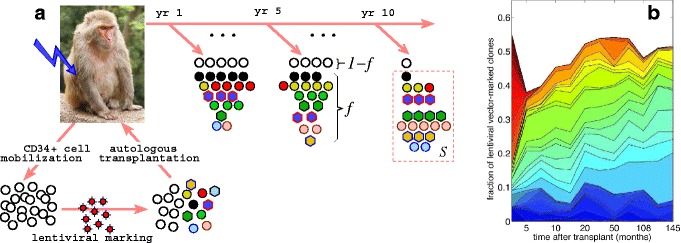
How a potentially diverse population of hematopoietic stem cells (HSCs) differentiates and proliferates to supply more than 10(11) mature blood cells every day in humans remains a key biological question. We investigated this process by quantitatively analyzing the clonal structure of peripheral blood that is generated by a population of transplanted lentivirus-marked HSCs in myeloablated rhesus macaques. Each transplanted HSC generates a clonal lineage of cells in the peripheral blood that is then detected and quantified through deep sequencing of the viral vector integration sites (VIS) common within each lineage. This approach allowed us to observe, over a period of 4-12 years, hundreds of distinct clonal lineages.
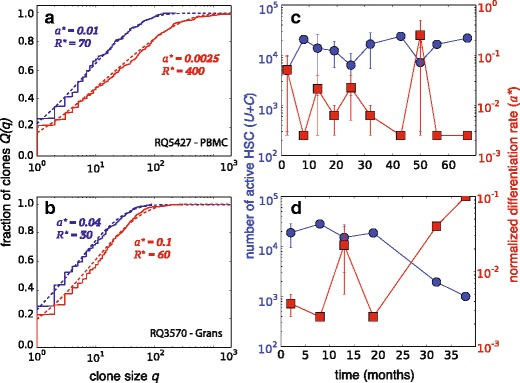
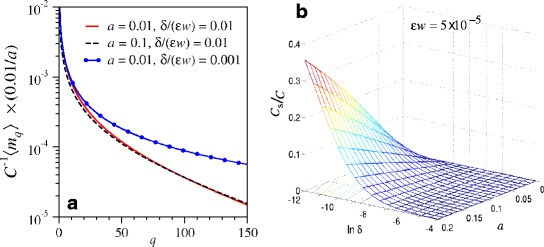
While the distinct clone sizes varied by three orders of magnitude, we found that collectively, they form a steady-state clone size-distribution with a distinctive shape. Steady-state solutions of our model show that the predicted clone size-distribution is sensitive to only two combinations of parameters. By fitting the measured clone size-distributions to our mechanistic model, we estimate both the effective HSC differentiation rate and the number of active HSCs.
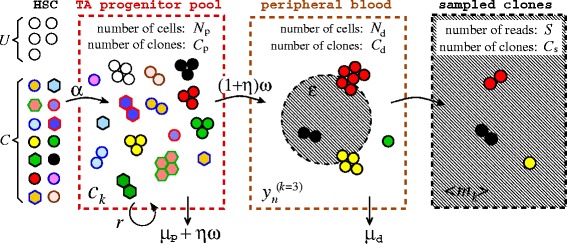
Our concise mathematical model shows how slow HSC differentiation followed by fast progenitor growth can be responsible for the observed broad clone size-distribution. Although all cells are assumed to be statistically identical, analogous to a neutral theory for the different clone lineages, our mathematical approach captures the intrinsic variability in the times to HSC differentiation after transplantation.
造血干细胞(HSC)这一潜在多样化群体如何分化和增殖,从而每天为人类提供超过10¹¹个成熟血细胞,仍然是一个关键的生物学问题。我们通过定量分析经骨髓消融的恒河猴体内移植的慢病毒标记HSC群体所产生的外周血克隆结构,来研究这一过程。每个移植的HSC在外周血中产生一个细胞克隆谱系,然后通过对每个谱系中常见的病毒载体整合位点(VIS)进行深度测序来检测和定量。这种方法使我们能够在4至12年的时间里观察到数百个不同的克隆谱系。
虽然不同克隆的大小相差三个数量级,但我们发现,总体而言,它们形成了一种具有独特形状的稳态克隆大小分布。我们模型的稳态解表明,预测的克隆大小分布仅对两种参数组合敏感。通过将测量的克隆大小分布与我们的机制模型进行拟合,我们估计了有效的HSC分化率和活跃HSC的数量。
我们简洁的数学模型表明,HSC缓慢分化随后祖细胞快速生长如何导致观察到的广泛克隆大小分布。尽管所有细胞都被假定在统计学上是相同的,类似于不同克隆谱系的中性理论,但我们的数学方法捕捉到了移植后HSC分化时间的内在变异性。