Pan Mei-Lien, Chen Li-Ru, Tsao Hsiao-Mei, Chen Kuo-Hu
Institute of Information Science, Academia Sinica, Taipei, Taiwan.
Department of Physical Medicine and Rehabilitation, Mackay Memorial Hospital, Taipei, Taiwan; Department of Mechanical Engineering, National Chiao-Tung University, Hsinchu, Taiwan.
PLoS One. 2015 Oct 21;10(10):e0140544. doi: 10.1371/journal.pone.0140544. eCollection 2015.
This nationwide population-based study aims to explore the relationship between polycystic ovarian syndrome (PCOS) and subsequent gestational diabetes mellitus (GDM).
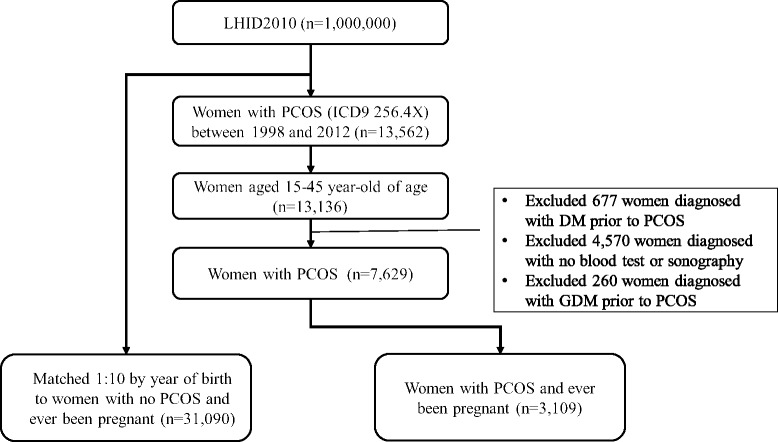
Data from 1998-2012 Taiwan National Health Insurance Research Database were used for this study. ICD9-CM codes 256.4X and 648.X were used separately for the diagnoses of PCOS and GDM, which were further confirmed by records of blood tests or ultrasonography to ensure the accuracy of the diagnoses. Women diagnosed at < 15 or > 45 years of age, and those diagnosed with overt diabetes mellitus or GDM prior to PCOS were excluded. During pregnancy, each woman with a previous diagnosis of PCOS was age-matched to 10 women without PCOS. Odds ratios (ORs) for risk of GDM were calculated by logistic regression analysis with adjustment for economic status and co-morbidities.
Among 7,629 eligible women with a valid PCOS diagnosis, 3,109 (42.87%) had subsequent pregnancies. GDM occurred frequently among women with a history of PCOS as compared to those without PCOS (20.46% vs. 10.54%, p<0.0001). Logistic regression analysis revealed that PCOS was associated with GDM (adjusted OR = 2.15; 95% CI:1.96-2.37). Among 3,109 affected patients, 1,160 (37.31%) had used medications for PCOS and 261 (8.39%) were treated with an oral hypoglycemic agent (OHA). There was no significant difference in development of GDM between the medication and no medication sub-groups (p>0.05). If not used after conception, OHAs did not reduce the risk of GDM (adjusted OR = 1.20; 95% CI:0.88-1.62).
A history of PCOS is a significant and independent risk factor for development of GDM. Medication for PCOS or pre-pregnancy use of OHAs does not reduce the risk of GDM. When at-risk women become pregnant, they require closer surveillance for maternal and fetal well-being, and should follow a strict diet and adhere to weight gain control to avoid obstetric complications due to GDM.
本项基于全国人口的研究旨在探讨多囊卵巢综合征(PCOS)与后续妊娠期糖尿病(GDM)之间的关系。
本研究使用了1998 - 2012年台湾国民健康保险研究数据库中的数据。分别使用ICD9 - CM编码256.4X和648.X来诊断PCOS和GDM,并通过血液检查或超声检查记录进一步确认,以确保诊断的准确性。排除年龄小于15岁或大于45岁以及在诊断PCOS之前已被诊断为显性糖尿病或GDM的女性。在孕期,将每位先前诊断为PCOS的女性与10位未患PCOS的女性进行年龄匹配。通过逻辑回归分析计算GDM风险的比值比(OR),并对经济状况和合并症进行调整。
在7629名有有效PCOS诊断的合格女性中,3109名(42.87%)随后怀孕。与未患PCOS的女性相比,有PCOS病史的女性中GDM更为常见(20.46%对10.54%,p<0.0001)。逻辑回归分析显示PCOS与GDM相关(调整后的OR = 2.15;95% CI:1.96 - 2.37)。在3109名受影响的患者中,1160名(37.31%)曾使用药物治疗PCOS,261名(8.39%)接受过口服降糖药(OHA)治疗。用药亚组和未用药亚组之间GDM的发生无显著差异(p>0.05)。如果在受孕后未使用,OHA并不能降低GDM的风险(调整后的OR = 1.20;95% CI:0.88 - 1.62)。
PCOS病史是GDM发生的一个重要且独立的危险因素。PCOS用药或孕前使用OHA并不能降低GDM的风险。高危女性怀孕时,需要更密切地监测母婴健康,并应遵循严格的饮食并控制体重增加,以避免因GDM导致的产科并发症。