Koo Ji Hyun, Choi Sang-Hee, Lee Seung Ah, Wang Joon Ho
Department of Radiology, Health Promotion Center, Samsung Medical Center, Sungkyunkwan University School of Medicine, Seoul, Korea.
Department of Radiology, Samsung Medical Center, Sungkyunkwan University School of Medicine, Seoul, Korea.
PLoS One. 2015 Oct 21;10(10):e0141021. doi: 10.1371/journal.pone.0141021. eCollection 2015.
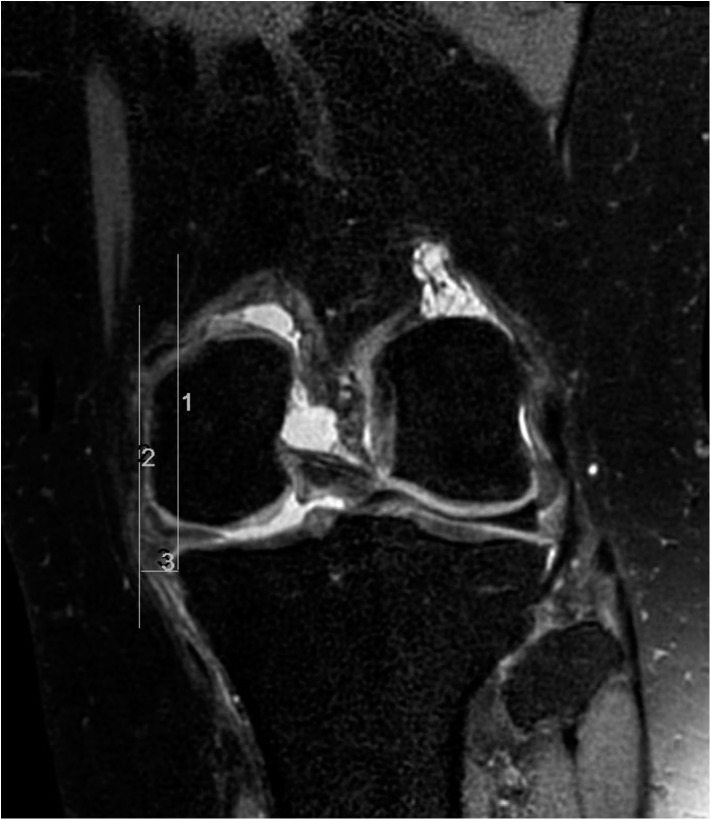
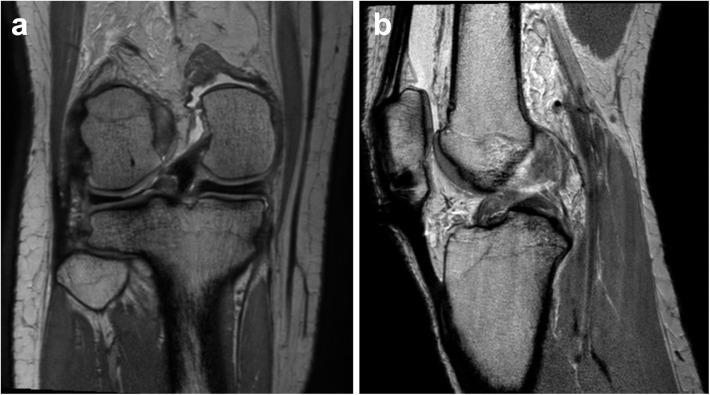
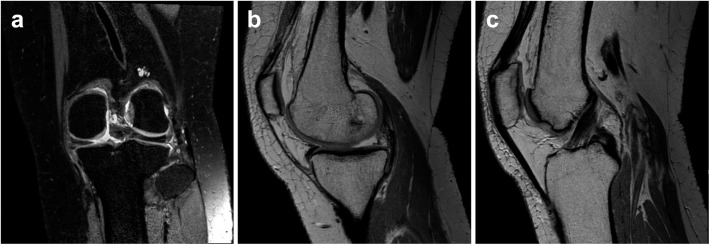
The meniscus root plays an essential role in maintaining the circumferential hoop tension and preventing meniscal displacement. Studies on meniscus root tears have investigated the relationship of osteoarthritis and an anterior cruciate ligament tear. However, few studies have directly compared the medial and lateral root tears. To assess the prevalence of meniscal extrusion and its relationship with clinical features in medial and lateral meniscus root tears, we performed a retrospective review of the magnetic resonance imaging (MRI) results of 42 knee patients who had meniscus posterior horn root tears and who had undergone arthroscopic operations. The presence of meniscal extrusion was evaluated and the exact extent was measured from the tibial margin. The results were correlated with arthroscopic findings. Clinical features including patients' ages, joint abnormalities, and previous trauma histories were evaluated. Twenty-two patients had medial meniscus root tears (MMRTs) and twenty patients had lateral meniscus root tears (LMRTs). Meniscal extrusion was present in 18 MMRT patients and one LMRT patient. The mean extent of extrusion was 4.2mm (range, 0.6 to 7.8) in the MMRT group and 0.9mm (range, -1.9 to 3.4) in the LMRT group. Five patients with MMRT had a history of trauma, while 19 patients with LMRT had a history of trauma. Three patients with MMRT had anterior cruciate ligament (ACL) tears, while 19 patients with LMRT had ACL tears. The mean age of the patients was 52 years (range: 29-71 years) and 30 years (range: 14-62 years) in the MMRT and LMRT group, respectively. There was a significant correlation between a MMRT and meniscal extrusion (p<0.0001), and between an ACL tear and LMRT (p<0.0001). A history of trauma was significantly common in LMRT (p<0.0001). LMRT patients were significantly younger than MMRT patients (p<0.0001). Kellgren-Lawrence (K-L) grade differed significantly between MMRT and LMRT group (p<0.0001). Meniscal extrusion is common in patients with MMRTs. However, it is rare in patients with LMRTs, which are more commonly associated with a history of trauma and ACL tears.
半月板根部在维持圆周环向张力和防止半月板移位方面起着至关重要的作用。关于半月板根部撕裂的研究已经探讨了骨关节炎与前交叉韧带撕裂之间的关系。然而,很少有研究直接比较内侧和外侧半月板根部撕裂。为了评估半月板挤出的发生率及其与内侧和外侧半月板根部撕裂临床特征的关系,我们对42例有半月板后角根部撕裂且接受了关节镜手术的膝关节患者的磁共振成像(MRI)结果进行了回顾性分析。评估半月板挤出的存在情况,并从胫骨边缘测量其确切程度。将结果与关节镜检查结果进行关联。评估包括患者年龄、关节异常情况和既往创伤史在内的临床特征。22例患者为内侧半月板根部撕裂(MMRT),20例患者为外侧半月板根部撕裂(LMRT)。18例MMRT患者和1例LMRT患者存在半月板挤出。MMRT组的平均挤出程度为4.2毫米(范围为0.6至7.8),LMRT组为0.9毫米(范围为 -1.9至3.4)。5例MMRT患者有创伤史,而19例LMRT患者有创伤史。3例MMRT患者有前交叉韧带(ACL)撕裂,而19例LMRT患者有ACL撕裂。MMRT组和LMRT组患者的平均年龄分别为52岁(范围:29 - 71岁)和30岁(范围:14 - 62岁)。MMRT与半月板挤出之间存在显著相关性(p<0.0001),ACL撕裂与LMRT之间也存在显著相关性(p<0.0001)。创伤史在LMRT中显著常见(p<0.0001)。LMRT患者明显比MMRT患者年轻(p<0.0001)。MMRT组和LMRT组之间的Kellgren - Lawrence(K - L)分级有显著差异(p<0.0001)。半月板挤出在MMRT患者中很常见。然而,在LMRT患者中很少见,LMRT更常与创伤史和ACL撕裂相关。