Matos Leandro Luongo, Suarez Eloah Rabello, Theodoro Thérèse Rachell, Trufelli Damila Cristina, Melo Carina Mucciolo, Garcia Larissa Ferraz, Oliveira Olivia Capela Grimaldi, Matos Maria Graciela Luongo, Kanda Jossi Ledo, Nader Helena Bonciani, Martins João Roberto Maciel, Pinhal Maria Aparecida Silva
Biochemistry Department, Faculdade de Medicina do ABC, Santo André, Brazil; Head and Neck Surgery Department, Faculdade de Medicina do ABC, Santo André, Brazil; Biochemistry Department, Universidade Federal de São Paulo, São Paulo, Brazil.
Biochemistry Department, Faculdade de Medicina do ABC, Santo André, Brazil; Biochemistry Department, Universidade Federal de São Paulo, São Paulo, Brazil.
PLoS One. 2015 Oct 21;10(10):e0141139. doi: 10.1371/journal.pone.0141139. eCollection 2015.
The search for a specific marker that could help to distinguish between differentiated thyroid carcinoma and benign lesions remains elusive in clinical practice. Heparanase (HPSE) is an endo-beta-glucoronidase implicated in the process of tumor invasion, and the heparanase-2 (HPSE2) modulates HPSE activity. The aim of this study was to evaluate the role of heparanases in the development and differential diagnosis of follicular pattern thyroid lesions.
HPSE and HPSE2 expression by qRT-PCR, immunohistochemistry evaluation, western blot analysis and HPSE enzymatic activity were evaluated.
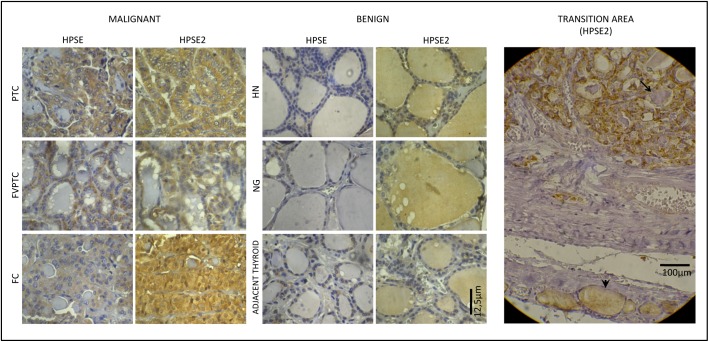
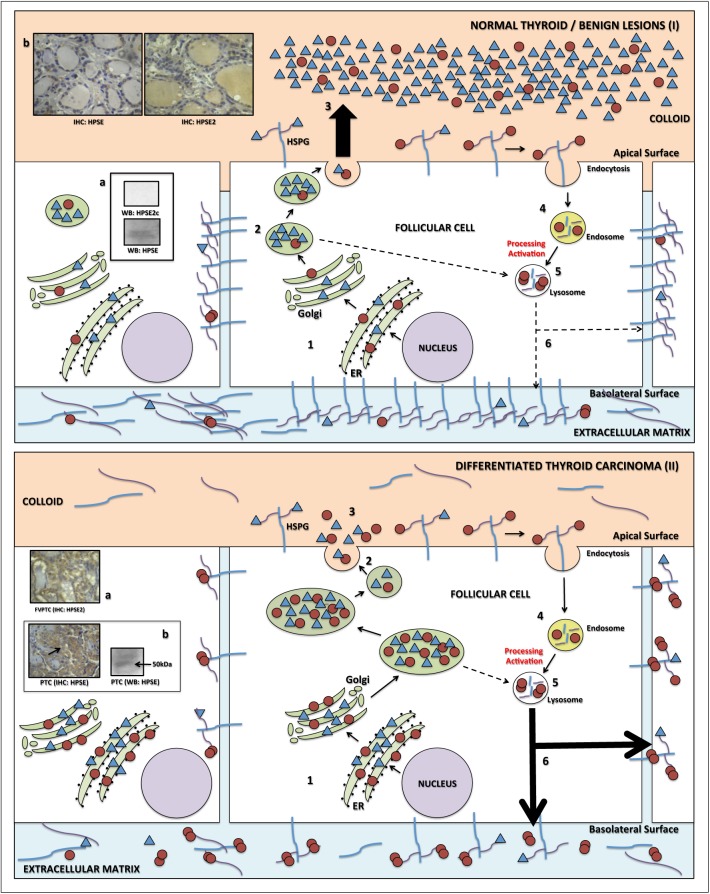
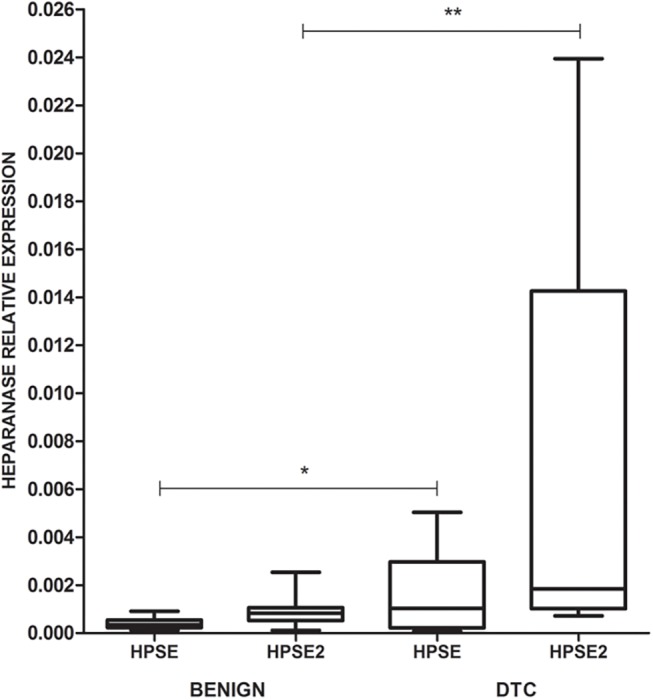
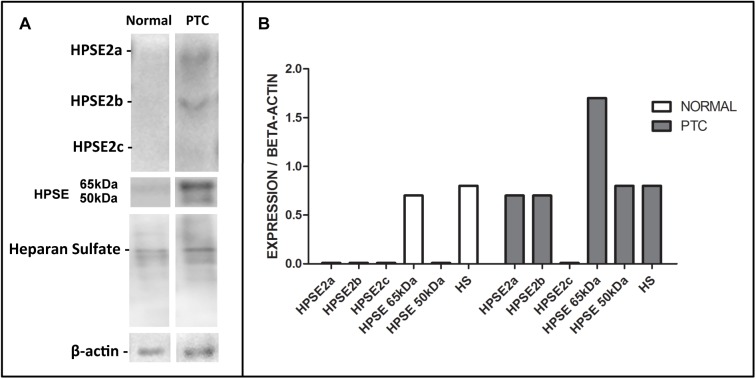
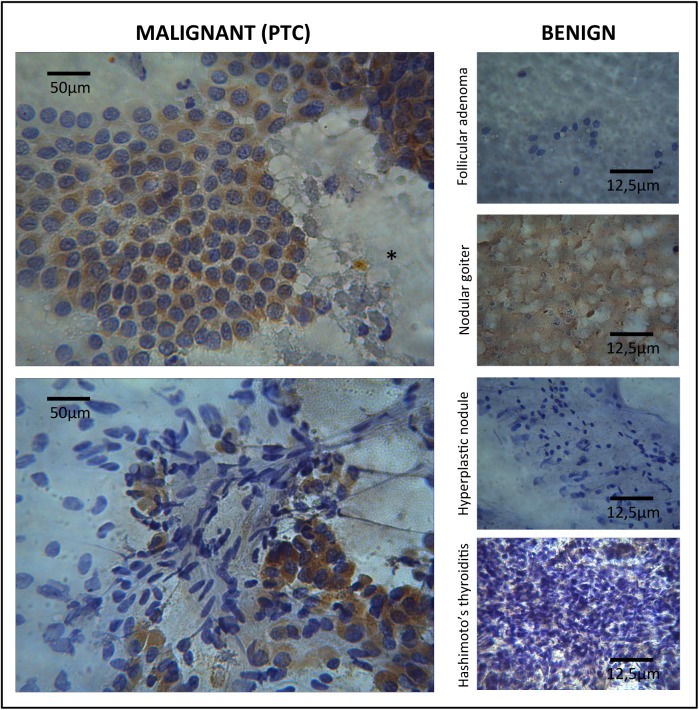
The expression of heparanases by qRT-PCR showed an increase of HPSE2 in thyroid carcinoma (P = 0.001). HPSE activity was found to be higher in the malignant neoplasms than in the benign tumors (P<0.0001). On Western blot analysis, HPSE2 isoforms were detected only in malignant tumors. The immunohistochemical assay allowed us to establish a distinct pattern for malignant and benign tumors. Carcinomas showed a typical combination of positive labeling for neoplastic cells and negative immunostaining in colloid, when compared to benign tumors (P<0.0001). The proposed diagnostic test presents sensitivity and negative predictive value of around 100%, showing itself to be an accurate test for distinguishing between malignant and benign lesions.
This study shows, for the first time, a distinct profile of HPSE expression in thyroid carcinoma suggesting its role in carcinogenesis.
在临床实践中,寻找一种有助于区分分化型甲状腺癌和良性病变的特异性标志物仍然难以实现。乙酰肝素酶(HPSE)是一种参与肿瘤侵袭过程的内切β - 葡萄糖醛酸酶,而乙酰肝素酶 - 2(HPSE2)调节HPSE的活性。本研究的目的是评估乙酰肝素酶在滤泡型甲状腺病变发生发展及鉴别诊断中的作用。
通过qRT - PCR、免疫组织化学评估、蛋白质免疫印迹分析以及HPSE酶活性测定来评估HPSE和HPSE2的表达。
qRT - PCR检测的乙酰肝素酶表达显示甲状腺癌中HPSE2表达增加(P = 0.001)。发现恶性肿瘤中的HPSE活性高于良性肿瘤(P<0.0001)。蛋白质免疫印迹分析仅在恶性肿瘤中检测到HPSE2亚型。免疫组织化学检测使我们能够确定恶性和良性肿瘤的不同模式。与良性肿瘤相比,癌组织中肿瘤细胞呈典型的阳性标记,胶体呈阴性免疫染色(P<0.0001)。所提出的诊断测试的敏感性和阴性预测值约为100%,表明其是区分恶性和良性病变的准确测试。
本研究首次表明甲状腺癌中HPSE表达具有独特特征,提示其在致癌过程中的作用。