
CRISPR/Cas9介导的自闭症基因CHD8杂合敲除及其在神经发育中的转录网络特征
CRISPR/Cas9-mediated heterozygous knockout of the autism gene CHD8 and characterization of its transcriptional networks in neurodevelopment.
作者信息
Wang Ping, Lin Mingyan, Pedrosa Erika, Hrabovsky Anastasia, Zhang Zheng, Guo Wenjun, Lachman Herbert M, Zheng Deyou
机构信息
Department of Neurology, Albert Einstein College of Medicine, 1300 Morris Park Ave, Bronx, NY 10461 USA.
Department of Genetics, Albert Einstein College of Medicine, 1300 Morris Park Ave, Bronx, NY 10461 USA.
出版信息
Mol Autism. 2015 Oct 19;6:55. doi: 10.1186/s13229-015-0048-6. eCollection 2015.
BACKGROUND
Disruptive mutation in the CHD8 gene is one of the top genetic risk factors in autism spectrum disorders (ASDs). Previous analyses of genome-wide CHD8 occupancy and reduced expression of CHD8 by shRNA knockdown in committed neural cells showed that CHD8 regulates multiple cell processes critical for neural functions, and its targets are enriched with ASD-associated genes.
METHODS
To further understand the molecular links between CHD8 functions and ASD, we have applied the CRISPR/Cas9 technology to knockout one copy of CHD8 in induced pluripotent stem cells (iPSCs) to better mimic the loss-of-function status that would exist in the developing human embryo prior to neuronal differentiation. We then carried out transcriptomic and bioinformatic analyses of neural progenitors and neurons derived from the CHD8 mutant iPSCs.
RESULTS
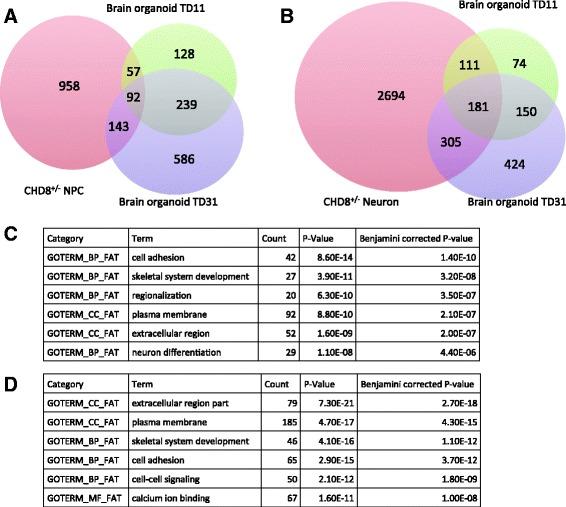
Transcriptome profiling revealed that CHD8 hemizygosity (CHD8 (+/-)) affected the expression of several thousands of genes in neural progenitors and early differentiating neurons. The differentially expressed genes were enriched for functions of neural development, β-catenin/Wnt signaling, extracellular matrix, and skeletal system development. They also exhibited significant overlap with genes previously associated with autism and schizophrenia, as well as the downstream transcriptional targets of multiple genes implicated in autism. Providing important insight into how CHD8 mutations might give rise to macrocephaly, we found that seven of the twelve genes associated with human brain volume or head size by genome-wide association studies (e.g., HGMA2) were dysregulated in CHD8 (+/-) neural progenitors or neurons.
CONCLUSIONS
We have established a renewable source of CHD8 (+/-) iPSC lines that would be valuable for investigating the molecular and cellular functions of CHD8. Transcriptomic profiling showed that CHD8 regulates multiple genes implicated in ASD pathogenesis and genes associated with brain volume.
背景
CHD8基因的破坏性突变是自闭症谱系障碍(ASD)中最重要的遗传风险因素之一。先前对全基因组CHD8占据情况的分析以及在定向神经细胞中通过短发夹RNA敲低CHD8表达的研究表明,CHD8调节对神经功能至关重要的多个细胞过程,其靶标富含与ASD相关的基因。
方法
为了进一步了解CHD8功能与ASD之间的分子联系,我们应用CRISPR/Cas9技术在诱导多能干细胞(iPSC)中敲除一个拷贝的CHD8,以更好地模拟神经元分化之前发育中的人类胚胎中存在的功能丧失状态。然后,我们对源自CHD8突变iPSC的神经祖细胞和神经元进行了转录组学和生物信息学分析。
结果
转录组分析显示,CHD8半合子(CHD8(+/-))影响神经祖细胞和早期分化神经元中数千个基因的表达。差异表达的基因在神经发育、β-连环蛋白/Wnt信号传导、细胞外基质和骨骼系统发育的功能方面富集。它们还与先前与自闭症和精神分裂症相关的基因以及多个与自闭症相关的基因的下游转录靶标有显著重叠。通过全基因组关联研究发现与人类脑容量或头围相关的十二个基因中的七个(例如HGMA2)在CHD8(+/-)神经祖细胞或神经元中表达失调,这为CHD8突变如何导致巨头畸形提供了重要见解。
结论
我们建立了可再生的CHD8(+/-)iPSC系,这对于研究CHD8的分子和细胞功能具有重要价值。转录组分析表明,CHD8调节多个与ASD发病机制相关的基因以及与脑容量相关的基因。


 Zotero 插件