Rose Gail L, Ferraro Tonya A, Skelly Joan M, Badger Gary J, MacLean Charles D, Fazzino Tera L, Helzer John E
Department of Psychiatry, the University of Vermont, Burlington, VT, USA.
Office of Research Administrative Services, Harvard University, Cambridge, MA, USA.
BMC Fam Pract. 2015 Oct 23;16:150. doi: 10.1186/s12875-015-0368-9.
Screening of primary care patients for unhealthy behaviors and mental health issues is recommended by numerous governing bodies internationally, yet evidence suggests that provider-initiated screening is not routine practice. The objective of this study was to implement systematic pre-screening of primary care patients for common preventive health issues on a large scale.
Patients registered for non-acute visits to one of 40 primary care providers from eight clinics in an Academic Medical Center health care network in the United States from May, 2012 to May, 2014 were contacted one- to three-days prior to their visit. Patients were invited to complete a questionnaire using an Interactive Voice Response (IVR) system. Six items assessed pain, smoking, alcohol use, physical activity, concern about weight, and mood.
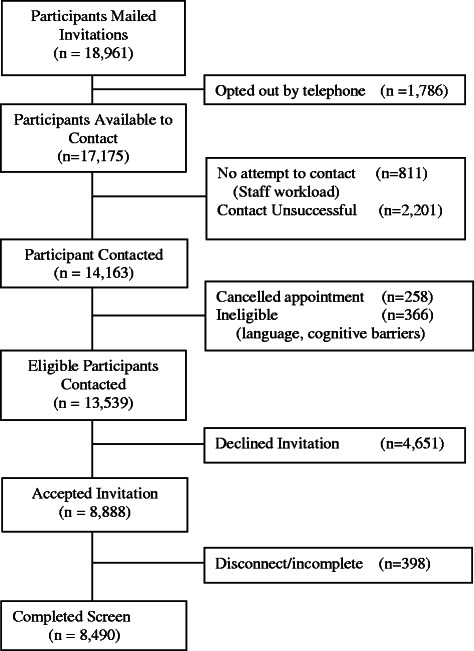
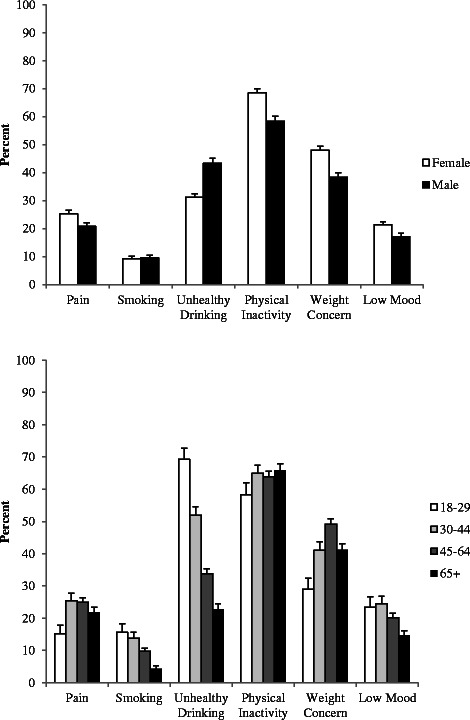
The acceptance rate among eligible patients reached by phone was 65.6 %, of which 95.5 % completed the IVR-Screen (N = 8,490; mean age 57; 57 % female). Sample demographics were representative of the overall primary care population from which participants were drawn on gender, race, and insurance status, but participants were slightly older and more likely to be married. Eighty-seven percent of patients screened positive on at least one item, and 59 % endorsed multiple problems. The majority of respondents (64.2 %) reported being never or only somewhat physically active. Weight concern was reported by 43.9 % of respondents, 36.4 % met criteria for unhealthy alcohol use, 23.4 % reported current pain, 19.6 % reported low mood, and 9.4 % reported smoking.
The percent endorsement for each behavioral health concern was generally consistent with studies of screening using other methods, and contrasts starkly with the reported low rates of screening and intervention for such concerns in typical PC practice. Results support the feasibility of IVR-based, large-scale pre-appointment behavioral health/ lifestyle risk factor screening of primary care patients. Pre-screening in this population facilitated participation in a controlled trial of brief treatment for unhealthy drinking, and also could be valuable clinically because it allows for case identification and management during routine care.
国际上众多管理机构都建议对初级保健患者进行不健康行为和心理健康问题筛查,但有证据表明,由医疗服务提供者发起的筛查并非常规做法。本研究的目的是大规模地对初级保健患者进行常见预防性健康问题的系统预筛查。
2012年5月至2014年5月期间,在美国一家学术医疗中心医疗网络的8家诊所中,向在40家初级保健机构之一进行非急性就诊登记的患者,在就诊前1至3天进行了联系。邀请患者使用交互式语音应答(IVR)系统完成一份问卷。其中6个项目评估疼痛、吸烟、饮酒、体育活动、体重担忧和情绪。
通过电话联系到的符合条件患者的接受率为65.6%,其中95.5%完成了IVR筛查(N = 8490;平均年龄57岁;57%为女性)。样本人口统计学特征在性别、种族和保险状况方面代表了从中抽取参与者的总体初级保健人群,但参与者年龄稍大且更有可能已婚。87%的患者至少有一项筛查呈阳性,59%的患者认可存在多个问题。大多数受访者(64.2%)报告从不或只是偶尔进行体育活动。43.9%的受访者表示担心体重,36.4%符合不健康饮酒标准,23.4%报告目前有疼痛,19.6%报告情绪低落,9.4%报告吸烟。
对每个行为健康问题的认可百分比总体上与使用其他方法进行筛查的研究一致,与典型初级保健实践中报道的此类问题的低筛查率和低干预率形成鲜明对比。结果支持了对初级保健患者进行基于IVR的大规模预约前行为健康/生活方式风险因素筛查的可行性。对该人群进行预筛查有助于参与不健康饮酒简短治疗的对照试验,并且在临床上也可能有价值,因为它允许在常规护理期间进行病例识别和管理。