de Moraes Rego Mariana Ribeiro, Torres Marcelo Ferreira, Santiago Luiz Carlos, Lira-Junior Ronaldo, Lourenço Eduardo José Veras, de Moraes Telles Daniel, Figueredo Carlos Marcelo
Department of Prosthodontics, Faculty of Odontology, Rio de Janeiro State University, Rio de Janeiro, Brazil.
Department of Prosthodontics and Dental Materials, Federal University of Rio de Janeiro, Rio de Janeiro, Brazil.
J Oral Microbiol. 2015 Oct 23;7:27685. doi: 10.3402/jom.v7.27685. eCollection 2015.
This study aimed at evaluating the bacterial colonization in dental implants inserted in the crestal or supracrestal position and correlated it to radiographic bone measurements.
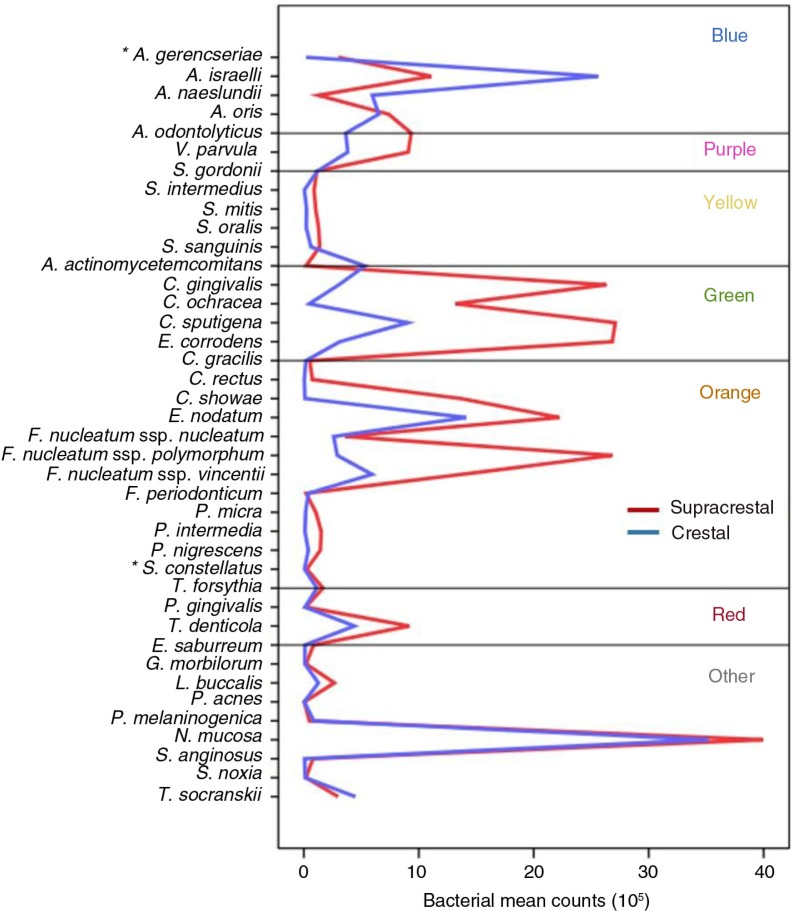
Thirty-five implants with regular platform in nine patients (mean age 62.4±11.2 years) were inserted either at the bone crest level (control group) or at a suprecrestal level (test group). Radiographic examination was performed at baseline (implant installation) and after 6 months. Clinical and microbiological data were collected after 6 months. Digital radiography was used to assess bone remodeling (marginal bone loss and optical alveolar density). Bacterial profile was analyzed by checkerboard DNA-DNA hybridization, including a panel of 40 bacterial species.
After 6 months, there were significantly higher counts of Actinomyces gerencseriae (p=0.009) and Streptococcus constellatus (p=0.05) in the test group. No significant differences between test and control groups were observed for marginal bone loss (p=0.725) and optical alveolar density (p=0.975). Probing depth was similar in both groups.
Significantly higher counts of A. gerencseriae and S. constellatus were found in implants placed at the supracrestal level compared to the ones placed at the bone level. No relation was found between the installation level of dental implants and peri-implant bone remodeling.
本研究旨在评估植入嵴顶或嵴上位置的牙种植体的细菌定植情况,并将其与影像学骨测量结果相关联。
在9名患者(平均年龄62.4±11.2岁)中植入35颗具有常规平台的种植体,分别植入牙槽嵴顶水平(对照组)或嵴上水平(试验组)。在基线(种植体植入时)和6个月后进行影像学检查。6个月后收集临床和微生物学数据。使用数字放射摄影评估骨重塑(边缘骨丢失和牙槽骨密度)。通过棋盘式DNA-DNA杂交分析细菌谱,包括一组40种细菌。
6个月后,试验组中杰氏放线菌(p=0.009)和星座链球菌(p=0.05)的计数显著更高。试验组和对照组在边缘骨丢失(p=0.725)和牙槽骨密度(p=0.975)方面未观察到显著差异。两组的探诊深度相似。
与植入牙槽骨水平的种植体相比,植入嵴上水平的种植体中杰氏放线菌和星座链球菌的计数显著更高。未发现牙种植体的植入水平与种植体周围骨重塑之间存在关联。