Ramírez-Moreno José M, Alonso-González Rafael, Peral-Pacheco Diego, Millán-Núñez María Victoria, Aguirre-Sánchez José J
Department of Neurology, Hospital Universitario Infanta Cristina, Avda de Elvas s/n, 06080, Badajoz, Spain.
Department of Biomedical Sciences, University of Extremadura, Badajoz, Spain.
BMC Res Notes. 2015 Oct 24;8:604. doi: 10.1186/s13104-015-1582-1.
Public health is increasingly concerned with recognising factors that lead to sex differences in stroke. We conducted a study to determine the effect of sex on knowledge of stroke risk factors and warning signs, and how both are perceived, in a representative sample of adults.
A representative sample of the population of Extremadura, Spain was selected using a double randomisation technique. Previously trained medical students carried out face-to-face interviews using a structured questionnaire.
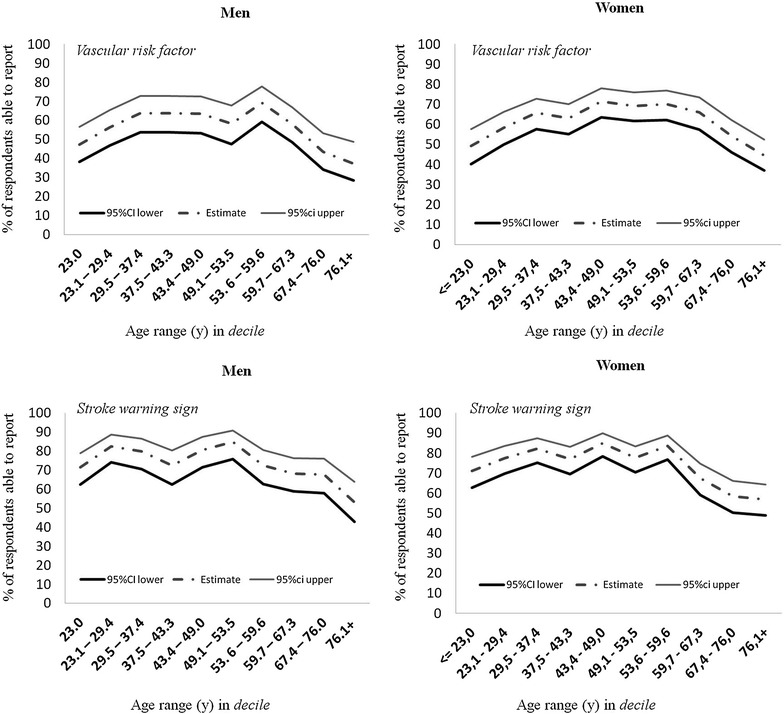
2409 subjects were interviewed [59.9 % women; mean age (SD) 49.0 (18.7) years]. Seventy-three percent of all subjects reported at least one correct warning sign of stroke (OR: 1.01; 95 % CI: 0.84-1.21). The most frequently mentioned warning signs were sudden weakness, dizziness, and headache. There were no sex differences regarding the types of warning symptoms that respondents listed. Women displayed better knowledge of risk factors than men (OR: 1.23; 95 % CI: 1.05-1.46). Women were more likely to name hypertension as a risk factor for stroke whereas men more frequently listed smoking, alcohol consumption and a sedentary lifestyle as risk factors. In response to stroke, women were significantly less likely than men to choose to call an ambulance or to go immediately to hospital (OR: 0.69; 95 % CI: 0.60-0.85).
Stroke knowledge is suboptimal in both men and women. We detected better knowledge of stroke risk factors in women, as well as differences in the type of risk factors listed by men and women. There were significant sex differences regarding response to stroke or to its warning signs.
公共卫生领域越来越关注识别导致中风性别差异的因素。我们开展了一项研究,以确定性别对中风危险因素和警示信号知识的影响,以及在具有代表性的成年样本中人们对二者的认知情况。
采用双重随机化技术选取西班牙埃斯特雷马杜拉地区具有代表性的人群样本。经过预培训的医学生使用结构化问卷进行面对面访谈。
共访谈了2409名受试者[女性占59.9%;平均年龄(标准差)为49.0(18.7)岁]。73%的受试者报告了至少一种正确的中风警示信号(比值比:1.01;95%置信区间:0.84 - 1.21)。最常提及的警示信号是突然虚弱、头晕和头痛。受访者列出的警示症状类型不存在性别差异。女性对危险因素的了解优于男性(比值比:1.23;95%置信区间:1.05 - 1.46)。女性更有可能将高血压列为中风的危险因素,而男性更常将吸烟、饮酒和久坐不动的生活方式列为危险因素。在中风发作时,女性比男性选择呼叫救护车或立即前往医院的可能性显著更低(比值比:0.69;95%置信区间:0.60 - 0.85)。
男性和女性对中风的了解都不尽人意。我们发现女性对中风危险因素的了解更好,以及男性和女性列出的危险因素类型存在差异。在对中风或其警示信号的反应方面存在显著的性别差异。