Lade Julie M, To Elaine E, Hendrix Craig W, Bumpus Namandjé N
Department of Pharmacology & Molecular Sciences, Johns Hopkins University School of Medicine, 725 North Wolfe Street, Biophysics 307, Baltimore, MD 21205, USA ; Department of Medicine (Division of Clinical Pharmacology), Johns Hopkins University School of Medicine, 725 North Wolfe Street, Biophysics 307, Baltimore, MD 21205, USA.
Department of Pharmacology & Molecular Sciences, Johns Hopkins University School of Medicine, 600 North Wolfe Street, Blalock 569, Baltimore, MD 21287, USA ; Department of Medicine (Division of Clinical Pharmacology), Johns Hopkins University School of Medicine, 600 North Wolfe Street, Blalock 569, Baltimore, MD 21287, USA.
EBioMedicine. 2015 Jul 9;2(9):1145-52. doi: 10.1016/j.ebiom.2015.07.008. eCollection 2015 Sep.
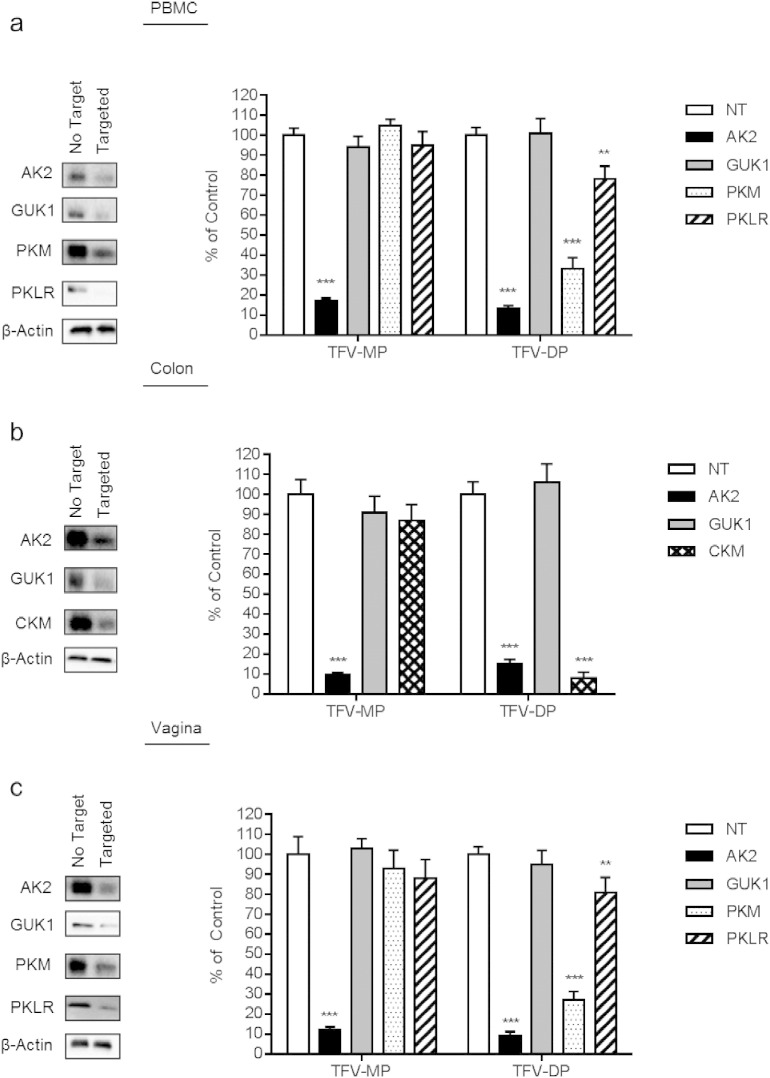
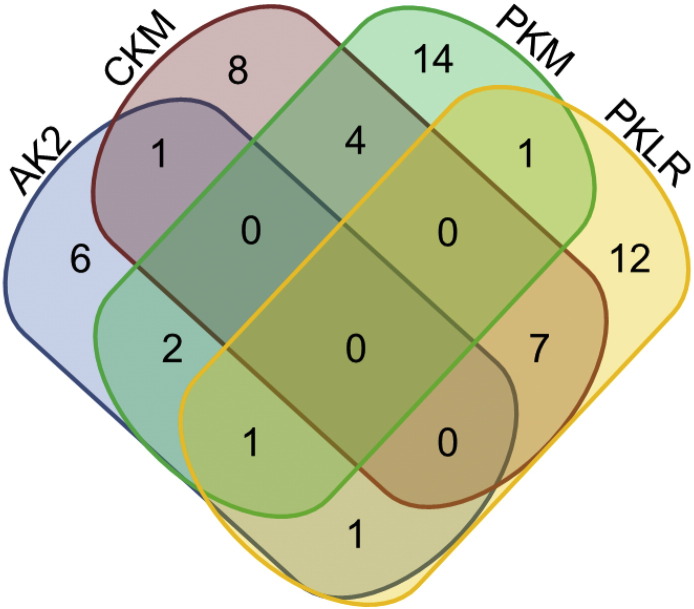
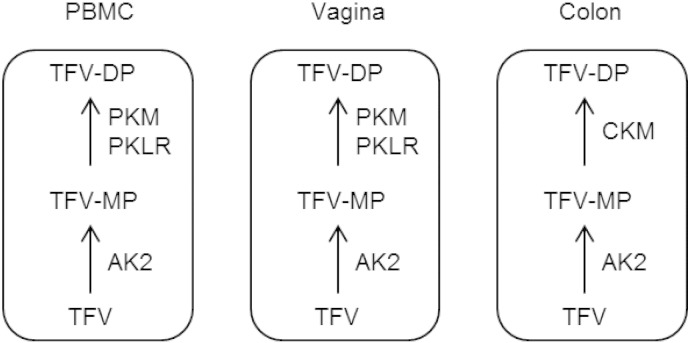
Tenofovir (TFV) is used in combination with other antiretroviral drugs for human immunodeficiency virus (HIV) treatment and prevention. TFV requires two phosphorylation steps to become pharmacologically active; however, the kinases that activate TFV in cells and tissues susceptible to HIV infection have yet to be identified. Peripheral blood mononuclear cells (PBMC), vaginal, and colorectal tissues were transfected with siRNA targeting nucleotide kinases, incubated with TFV, and TFV-monophosphate (TFV-MP) and TFV-diphosphate (TFV-DP) were measured using mass spectrometry-liquid chromatography. Adenylate kinase 2 (AK2) performed the first TFV phosphorylation step in PBMC, vaginal, and colorectal tissues. Interestingly, both pyruvate kinase isozymes, muscle (PKM) or liver and red blood cell (PKLR), were able to phosphorylate TFV-MP to TFV-DP in PBMC and vaginal tissue, while creatine kinase, muscle (CKM) catalyzed this conversion in colorectal tissue. In addition, next-generation sequencing of the Microbicide Trials Network MTN-001 clinical samples detected 71 previously unreported genetic variants in the genes encoding these kinases. In conclusion, our results demonstrate that TFV is activated in a compartment-specific manner. Further, genetic variants have been identified that could negatively impact TFV activation, thereby compromising TFV efficacy in HIV treatment and prevention.
替诺福韦(TFV)与其他抗逆转录病毒药物联合用于人类免疫缺陷病毒(HIV)的治疗和预防。TFV需要两个磷酸化步骤才能具有药理活性;然而,在易受HIV感染的细胞和组织中激活TFV的激酶尚未确定。用靶向核苷酸激酶的小干扰RNA(siRNA)转染外周血单核细胞(PBMC)、阴道组织和结肠直肠组织,与TFV一起孵育,然后使用质谱-液相色谱法测量单磷酸替诺福韦(TFV-MP)和二磷酸替诺福韦(TFV-DP)。腺苷酸激酶2(AK2)在PBMC、阴道组织和结肠直肠组织中执行TFV的第一步磷酸化。有趣的是,两种丙酮酸激酶同工酶,肌肉型(PKM)或肝和红细胞型(PKLR),都能够在PBMC和阴道组织中将TFV-MP磷酸化为TFV-DP,而肌酸激酶,肌肉型(CKM)在结肠直肠组织中催化这种转化。此外,杀微生物剂试验网络MTN-001临床样本的下一代测序在编码这些激酶的基因中检测到71个以前未报告的基因变异。总之,我们的结果表明TFV是以区室特异性方式被激活的。此外,已经鉴定出可能会对TFV激活产生负面影响的基因变异,从而损害TFV在HIV治疗和预防中的疗效。