Kratochvil Michael J, Tal-Gan Yftah, Yang Tian, Blackwell Helen E, Lynn David M
Department of Chemistry, 1101 University Avenue, University of Wisconsin - Madison , Madison, Wisconsin 53706, United States.
Department of Chemistry, 1101 University Avenue, University of Wisconsin - Madison , Madison, Wisconsin 53706, United States ; Department of Chemical and Biological Engineering, 1415 Engineering Drive, University of Wisconsin - Madison , Madison, Wisconsin 53706, United States.
ACS Biomater Sci Eng. 2015 Oct 12;1(10):1039-1049. doi: 10.1021/acsbiomaterials.5b00313. Epub 2015 Aug 26.
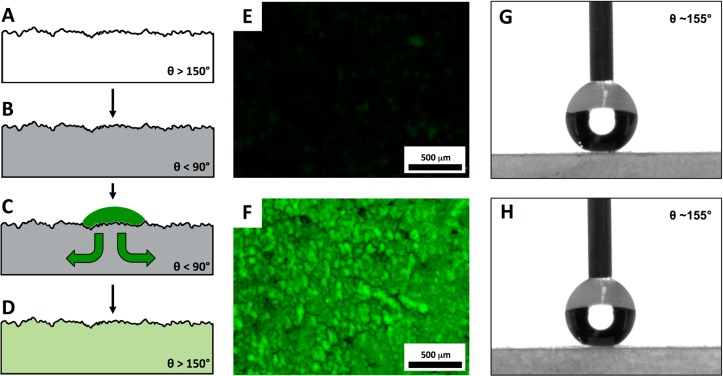
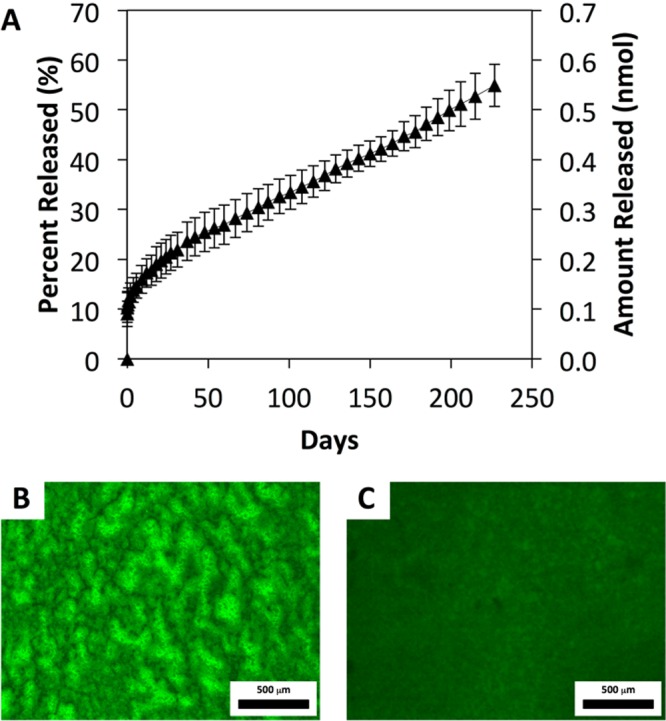
Materials and coatings that inhibit bacterial colonization are of interest in a broad range of biomedical, environmental, and industrial applications. In view of the rapid increase in bacterial resistance to conventional antibiotics, the development of new strategies that target nonessential pathways in bacterial pathogens-and that thereby limit growth and reduce virulence through nonbiocidal means-has attracted considerable attention. Bacterial quorum sensing (QS) represents one such target, and is intimately connected to virulence in many human pathogens. Here, we demonstrate that the properties of nanoporous, polymer-based superhydrophobic coatings can be exploited to host and subsequently sustain the extended release of potent and water-labile peptide-based inhibitors of QS (QSIs) in . Our results demonstrate that these peptidic QSIs can be released into surrounding media for periods of at least 8 months, and that they strongly inhibit agr-based QS in for at least 40 days. These results also suggest that these extremely nonwetting coatings can confer protection against the rapid hydrolysis of these water-labile peptides, thereby extending their useful lifetimes. Finally, we demonstrate that these peptide-loaded superhydrophobic coatings can strongly modulate the QS-controlled formation of biofilm in wild-type . These nanoporous superhydrophobic films provide a new, useful, and nonbiocidal approach to the design of coatings that attenuate bacterial virulence. This approach has the potential to be general, and could prove suitable for the encapsulation, protection, and release of other classes of water-sensitive agents. We anticipate that the materials, strategies, and concepts reported here will enable new approaches to the long-term attenuation of QS and associated bacterial phenotypes in a range of basic research and applied contexts.
抑制细菌定植的材料和涂层在广泛的生物医学、环境和工业应用中备受关注。鉴于细菌对传统抗生素的耐药性迅速增加,开发针对细菌病原体中非必需途径的新策略——从而通过非杀菌手段限制生长并降低毒力——已引起了相当大的关注。细菌群体感应(QS)就是这样一个靶点,并且在许多人类病原体中与毒力密切相关。在此,我们证明了基于聚合物的纳米多孔超疏水涂层的特性可被利用来容纳并随后持续缓释强效且对水不稳定的基于肽的群体感应抑制剂(QSIs)。我们的结果表明,这些肽类QSIs可以释放到周围介质中至少8个月,并且它们在至少40天内强烈抑制金黄色葡萄球菌中基于agr的群体感应。这些结果还表明,这些极度不润湿的涂层可以防止这些对水不稳定的肽快速水解,从而延长它们的使用寿命。最后,我们证明这些负载肽的超疏水涂层可以强烈调节野生型金黄色葡萄球菌中群体感应控制的生物膜形成。这些纳米多孔超疏水膜为设计减弱细菌毒力的涂层提供了一种新的、有用的且非杀菌的方法。这种方法有可能具有通用性,并且可能适用于其他类别的水敏感剂的封装、保护和释放。我们预计,本文报道的材料、策略和概念将为在一系列基础研究和应用背景下长期减弱群体感应及相关细菌表型提供新方法。