Li Yiwei, Sarkar Fazlul H
Department of Pathology, Barbara Ann Karmanos Cancer Institute, Wayne State University School of Medicine, Detroit, Mich., USA.
Med Princ Pract. 2016;25 Suppl 2(Suppl 2):11-7. doi: 10.1159/000439307. Epub 2015 Oct 27.
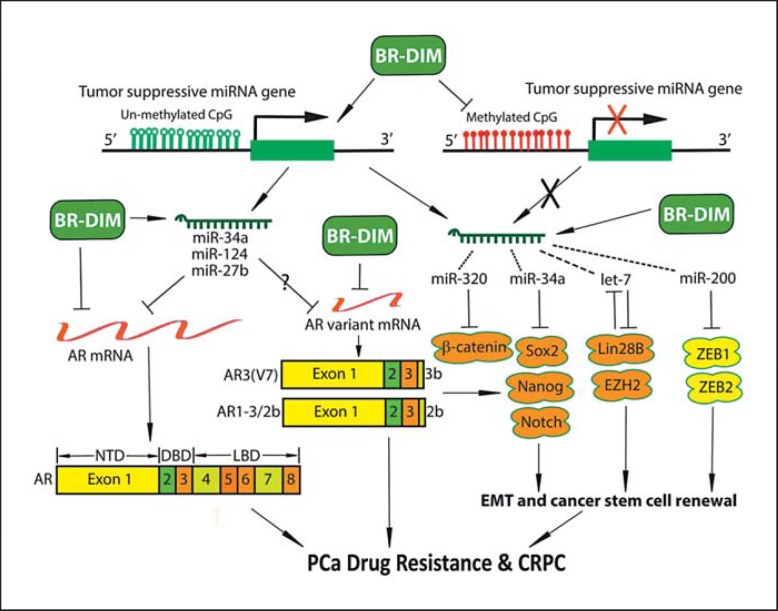
Castration-resistant prostate cancer (CRPC) progression after androgen deprivation therapy shows upregulated expression of androgen receptor (AR) splice variants, induced epithelial-to-mesenchymal transition phenotypes and enhanced stem cell characteristics, all of which are associated with resistance to enzalutamide. Since there is no curative treatment for CRPC, innovative treatments are urgently needed. In our recent study, we found that resistance to enzalutamide was partly due to deregulated expression of microRNAs such as miR-34a, miR-124, miR-27b, miR-320 and let-7, which play important roles in regulating AR and stem cell marker gene expression that appears to be linked with resistance to enzalutamide. Importantly, we found that BioResponse 3,3'-diindolylmethane (BR-DIM) treatment in vitro and in vivo caused downregulation in the expression of wild-type AR. The AR splice variants, Lin28B and EZH2, appear to be deregulated through the re-expression of let-7, miR-27b, miR-320 and miR-34a in human prostate cancer (PCa). BR-DIM administered in clinical trials was well tolerated, and 93% of patients had detectable prostatic DIM levels. The inhibitory effects of BR-DIM on AR and AR target gene such as prostate-specific antigen were also observed in the clinical trial. Our preclinical and clinical studies provide the scientific basis for a 'proof-of-concept' clinical trial in CRPC patients treated with enzalutamide in combination with BR-DIM. This strategy could be expanded in future clinical trials in patients with PCa to determine whether or not they could achieve a better treatment outcome which could be partly mediated by delaying or preventing the development of CRPC.
雄激素剥夺治疗后出现的去势抵抗性前列腺癌(CRPC)进展表现为雄激素受体(AR)剪接变体的表达上调、诱导的上皮-间质转化表型以及增强的干细胞特性,所有这些都与对恩杂鲁胺的耐药性相关。由于CRPC尚无治愈性治疗方法,因此迫切需要创新疗法。在我们最近的研究中,我们发现对恩杂鲁胺的耐药性部分归因于microRNA(如miR-34a、miR-124、miR-27b、miR-320和let-7)的表达失调,这些microRNA在调节AR和干细胞标记基因表达中起重要作用,而这似乎与对恩杂鲁胺的耐药性有关。重要的是,我们发现体外和体内的生物反应3,3'-二吲哚甲烷(BR-DIM)处理导致野生型AR的表达下调。在人类前列腺癌(PCa)中,AR剪接变体、Lin28B和EZH2似乎通过let-7、miR-27b、miR-320和miR-34a的重新表达而失调。在临床试验中给予的BR-DIM耐受性良好,93%的患者前列腺DIM水平可检测到。在临床试验中也观察到了BR-DIM对AR和AR靶基因(如前列腺特异性抗原)的抑制作用。我们的临床前和临床研究为恩杂鲁胺联合BR-DIM治疗CRPC患者的“概念验证”临床试验提供了科学依据。这种策略可在未来PCa患者的临床试验中扩展,以确定他们是否能获得更好的治疗结果,这可能部分通过延迟或预防CRPC的发展来介导。