• 文献检索
  • 文档翻译
  • 深度研究
  • 学术资讯
  • Suppr Zotero 插件Zotero 插件
  • 邀请有礼
  • 套餐&价格
  • 历史记录
应用&插件
Suppr Zotero 插件Zotero 插件浏览器插件Mac 客户端Windows 客户端微信小程序
定价
高级版会员购买积分包购买API积分包
服务
文献检索文档翻译深度研究API 文档MCP 服务
关于我们
关于 Suppr公司介绍联系我们用户协议隐私条款
关注我们

Suppr 超能文献

核心技术专利:CN118964589B侵权必究
粤ICP备2023148730 号-1Suppr @ 2026

文献检索

告别复杂PubMed语法,用中文像聊天一样搜索,搜遍4000万医学文献。AI智能推荐,让科研检索更轻松。

立即免费搜索

文件翻译

保留排版,准确专业,支持PDF/Word/PPT等文件格式,支持 12+语言互译。

免费翻译文档

深度研究

AI帮你快速写综述,25分钟生成高质量综述,智能提取关键信息,辅助科研写作。

立即免费体验

电子饮食摄入评估(e-DIA):手机数字录入应用程序与 24 小时膳食回顾用于膳食数据收集的比较。

Electronic Dietary Intake Assessment (e-DIA): Comparison of a Mobile Phone Digital Entry App for Dietary Data Collection With 24-Hour Dietary Recalls.

机构信息

School of Molecular Bioscience, Charles Perkins Centre, University of Sydney, Camperdown, Australia.

出版信息

JMIR Mhealth Uhealth. 2015 Oct 27;3(4):e98. doi: 10.2196/mhealth.4613.

DOI:10.2196/mhealth.4613
PMID:26508282
原文链接:https://pmc.ncbi.nlm.nih.gov/articles/PMC4704908/
Abstract

BACKGROUND

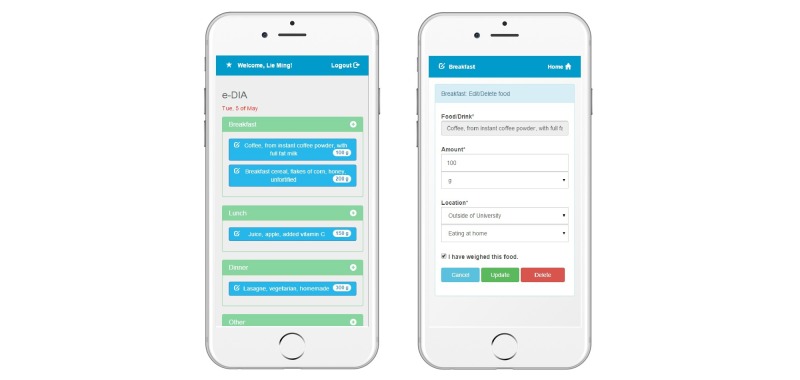
The electronic Dietary Intake Assessment (e-DIA), a digital entry food record mobile phone app, was developed to measure energy and nutrient intake prospectively. This can be used in monitoring population intakes or intervention studies in young adults.

OBJECTIVE

The objective was to assess the relative validity of e-DIA as a dietary assessment tool for energy and nutrient intakes using the 24-hour dietary recall as a reference method.

METHODS

University students aged 19 to 24 years recorded their food and drink intake on the e-DIA for five days consecutively and completed 24-hour dietary recalls on three random days during this 5-day study period. Mean differences in energy, macro-, and micronutrient intakes were evaluated between the methods using paired t tests or Wilcoxon signed-rank tests, and correlation coefficients were calculated on unadjusted, energy-adjusted, and deattenuated values. Bland-Altman plots and cross-classification into quartiles were used to assess agreement between the two methods.

RESULTS

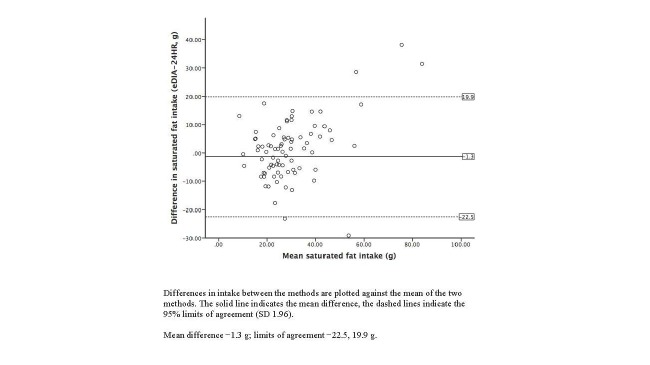
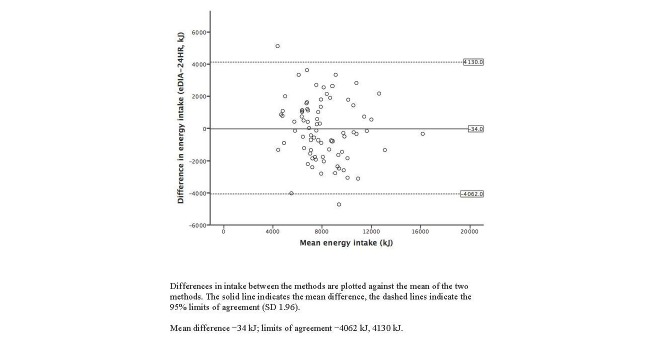
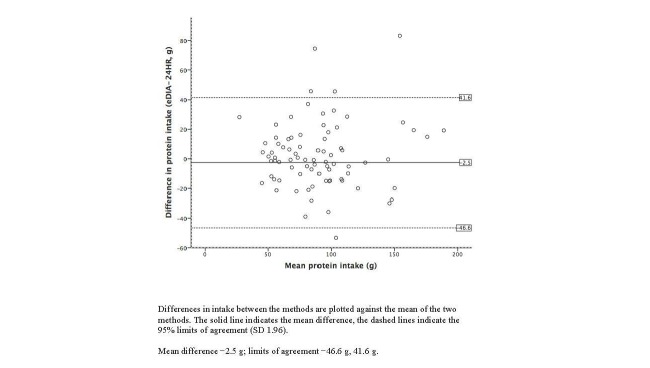
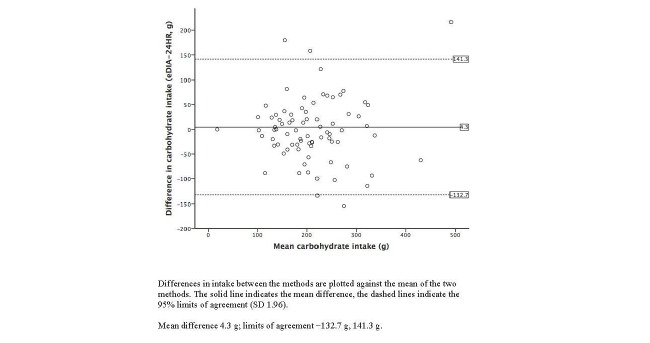
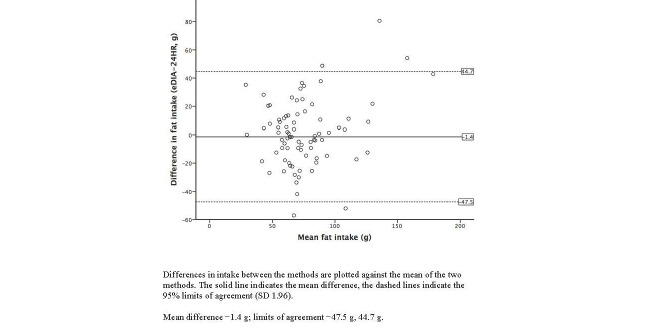
Eighty participants completed the study (38% male). No significant differences were found between the two methods for mean intakes of energy or nutrients. Deattenuated correlation coefficients ranged from 0.55 to 0.79 (mean 0.68). Bland-Altman plots showed wide limits of agreement between the methods but without obvious bias. Cross-classification into same or adjacent quartiles ranged from 75% to 93% (mean 85%).

CONCLUSIONS

The e-DIA shows potential as a dietary intake assessment tool at a group level with good ranking agreement for energy and all nutrients.

摘要

背景

电子膳食摄入评估(e-DIA)是一种数字录入食物记录的手机应用程序,旨在前瞻性地测量能量和营养素摄入。它可用于监测人群摄入量或年轻人的干预研究。

目的

本研究旨在评估 e-DIA 作为膳食评估工具测量能量和营养素摄入的相对有效性,以 24 小时膳食回顾作为参考方法。

方法

19-24 岁的大学生连续 5 天使用 e-DIA 记录食物和饮料摄入量,并在 5 天研究期间的 3 天内随机完成 24 小时膳食回顾。使用配对 t 检验或 Wilcoxon 符号秩检验评估两种方法之间能量、宏量和微量营养素摄入的平均差异,并计算未调整、能量调整和去权重值的相关系数。Bland-Altman 图和四分位交叉分类用于评估两种方法之间的一致性。

结果

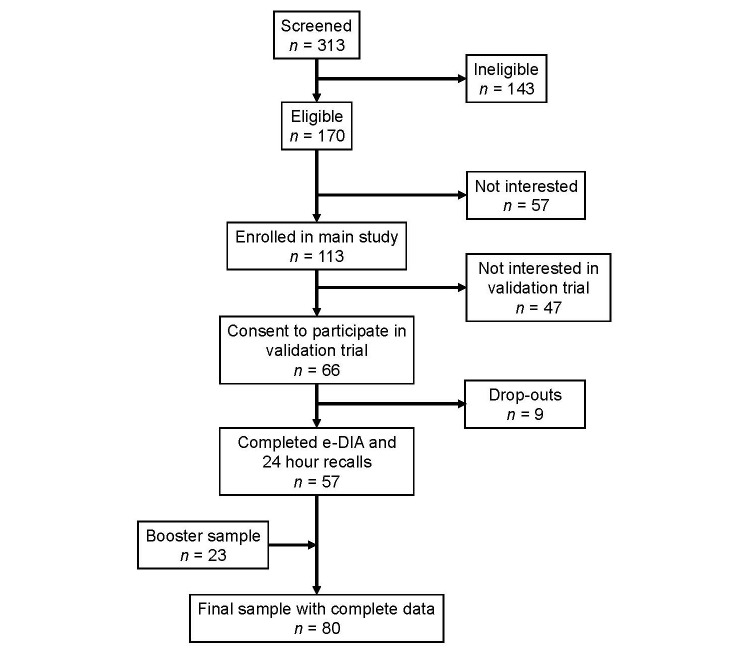
80 名参与者完成了研究(38%为男性)。两种方法的能量或营养素平均摄入量无显著差异。去权重相关系数范围为 0.55 至 0.79(平均值为 0.68)。Bland-Altman 图显示两种方法之间的一致性界限较宽,但没有明显的偏差。相同或相邻四分位交叉分类的范围为 75%至 93%(平均值为 85%)。

结论

e-DIA 作为一种膳食摄入评估工具,在群组水平上具有良好的能量和所有营养素的排名一致性,具有一定潜力。
https://cdn.ncbi.nlm.nih.gov/pmc/blobs/70b2/4704908/f9ac39720cad/mhealth_v3i4e98_fig7.jpg
https://cdn.ncbi.nlm.nih.gov/pmc/blobs/70b2/4704908/0d4d2f5085dd/mhealth_v3i4e98_fig1.jpg
https://cdn.ncbi.nlm.nih.gov/pmc/blobs/70b2/4704908/1878579dc58a/mhealth_v3i4e98_fig2.jpg
https://cdn.ncbi.nlm.nih.gov/pmc/blobs/70b2/4704908/ced3d0d730cc/mhealth_v3i4e98_fig3.jpg
https://cdn.ncbi.nlm.nih.gov/pmc/blobs/70b2/4704908/f2df2a172a61/mhealth_v3i4e98_fig4.jpg
https://cdn.ncbi.nlm.nih.gov/pmc/blobs/70b2/4704908/af9cebd99edd/mhealth_v3i4e98_fig5.jpg
https://cdn.ncbi.nlm.nih.gov/pmc/blobs/70b2/4704908/375c18a5efdc/mhealth_v3i4e98_fig6.jpg
https://cdn.ncbi.nlm.nih.gov/pmc/blobs/70b2/4704908/f9ac39720cad/mhealth_v3i4e98_fig7.jpg
https://cdn.ncbi.nlm.nih.gov/pmc/blobs/70b2/4704908/0d4d2f5085dd/mhealth_v3i4e98_fig1.jpg
https://cdn.ncbi.nlm.nih.gov/pmc/blobs/70b2/4704908/1878579dc58a/mhealth_v3i4e98_fig2.jpg
https://cdn.ncbi.nlm.nih.gov/pmc/blobs/70b2/4704908/ced3d0d730cc/mhealth_v3i4e98_fig3.jpg
https://cdn.ncbi.nlm.nih.gov/pmc/blobs/70b2/4704908/f2df2a172a61/mhealth_v3i4e98_fig4.jpg
https://cdn.ncbi.nlm.nih.gov/pmc/blobs/70b2/4704908/af9cebd99edd/mhealth_v3i4e98_fig5.jpg
https://cdn.ncbi.nlm.nih.gov/pmc/blobs/70b2/4704908/375c18a5efdc/mhealth_v3i4e98_fig6.jpg
https://cdn.ncbi.nlm.nih.gov/pmc/blobs/70b2/4704908/f9ac39720cad/mhealth_v3i4e98_fig7.jpg

相似文献

1
Electronic Dietary Intake Assessment (e-DIA): Comparison of a Mobile Phone Digital Entry App for Dietary Data Collection With 24-Hour Dietary Recalls.电子饮食摄入评估(e-DIA):手机数字录入应用程序与 24 小时膳食回顾用于膳食数据收集的比较。
JMIR Mhealth Uhealth. 2015 Oct 27;3(4):e98. doi: 10.2196/mhealth.4613.
2
Electronic Dietary Intake Assessment (e-DIA): relative validity of a mobile phone application to measure intake of food groups.电子膳食摄入量评估(e-DIA):一款用于测量食物组摄入量的手机应用程序的相对效度。
Br J Nutr. 2016 Jun;115(12):2219-26. doi: 10.1017/S0007114516001525. Epub 2016 Apr 28.
3
A Smartphone Food Record App Developed for the Dutch National Food Consumption Survey: Relative Validity Study.一款专为荷兰国家食物消费调查开发的智能手机食物记录应用:相对有效性研究。
JMIR Mhealth Uhealth. 2024 Feb 9;12:e50196. doi: 10.2196/50196.
4
Web-Based Dietary Intake Estimation to Assess the Reproducibility and Relative Validity of the EatWellQ8 Food Frequency Questionnaire: Validation Study.基于网络的膳食摄入量估计,以评估EatWellQ8食物频率问卷的可重复性和相对有效性:验证研究。
JMIR Form Res. 2021 Mar 2;5(3):e13591. doi: 10.2196/13591.
5
Electronic 12-Hour Dietary Recall (e-12HR): Comparison of a Mobile Phone App for Dietary Intake Assessment With a Food Frequency Questionnaire and Four Dietary Records.电子12小时膳食回顾(e-12HR):用于膳食摄入量评估的手机应用程序与食物频率问卷及四份膳食记录的比较
JMIR Mhealth Uhealth. 2018 Jun 15;6(6):e10409. doi: 10.2196/10409.
6
Relative Validation of an Artificial Intelligence-Enhanced, Image-Assisted Mobile App for Dietary Assessment in Adults: Randomized Crossover Study.人工智能增强型图像辅助移动应用程序用于成人膳食评估的相对有效性验证:随机交叉研究。
J Med Internet Res. 2022 Nov 21;24(11):e40449. doi: 10.2196/40449.
7
Relative validity of a 2-day 24-hour dietary recall compared with a 2-day weighed dietary record among adults in South China.在中国南方成年人中,将两日24小时膳食回顾法与两日称重膳食记录法相比较的相对效度。
Nutr Diet. 2017 Jul;74(3):298-307. doi: 10.1111/1747-0080.12315. Epub 2016 Oct 10.
8
Relative Validity and Reproducibility of a New 44-Item Diet and Food Frequency Questionnaire Among Adults: Online Assessment.成人中一份新的44项饮食与食物频率问卷的相对效度及可重复性:在线评估
J Med Internet Res. 2018 Jul 5;20(7):e227. doi: 10.2196/jmir.9113.
9
Relative Validity of the Eat and Track (EaT) Smartphone App for Collection of Dietary Intake Data in 18-to-30-Year Olds.18 至 30 岁人群中使用 Eat and Track(EaT)智能手机应用程序收集膳食摄入量数据的相对有效性。
Nutrients. 2019 Mar 14;11(3):621. doi: 10.3390/nu11030621.
10
Vitamin D intake among young Canadian adults: validation of a mobile vitamin D calculator app.加拿大年轻成年人的维生素D摄入量:一款移动维生素D计算器应用程序的验证
J Nutr Educ Behav. 2015 May-Jun;47(3):242-7. doi: 10.1016/j.jneb.2014.11.006.

引用本文的文献

1
Reliability Issues of Mobile Nutrition Apps for Cardiovascular Disease Prevention: Comparative Study.移动营养应用程序在心血管疾病预防中的可靠性问题:比较研究。
JMIR Mhealth Uhealth. 2024 Sep 4;12:e54509. doi: 10.2196/54509.
2
Feasibility of Using an Artificial Intelligence-based Telephone Application for Dietary Assessment and Nudging to Improve the Quality of Food Choices of Female Adolescents in Vietnam: Evidence from a Randomized Pilot Study.基于人工智能的电话应用程序用于越南女性青少年饮食评估及推动改善食物选择质量的可行性:一项随机试点研究的证据
Curr Dev Nutr. 2023 Dec 13;8(6):102063. doi: 10.1016/j.cdnut.2023.102063. eCollection 2024 Jun.
3

本文引用的文献

1
A Novel Dietary Assessment Method to Measure a Healthy and Sustainable Diet Using the Mobile Food Record: Protocol and Methodology.一种使用移动食物记录测量健康可持续饮食的新型膳食评估方法:方案与方法
Nutrients. 2015 Jul 3;7(7):5375-95. doi: 10.3390/nu7075226.
2
Evaluation of a Mobile Phone Image-Based Dietary Assessment Method in Adults with Type 2 Diabetes.基于手机图像的2型糖尿病成年患者饮食评估方法的评价
Nutrients. 2015 Jun 17;7(6):4897-910. doi: 10.3390/nu7064897.
3
How willing are adolescents to record their dietary intake? The mobile food record.
A systematic review of dietary data collection methodologies for diet diversity indicators.
饮食多样性指标膳食数据收集方法的系统评价
Front Nutr. 2024 Mar 21;11:1195799. doi: 10.3389/fnut.2024.1195799. eCollection 2024.
4
Awareness and level of digital literacy among students receiving health-based education.接受健康教育的学生的数字素养意识和水平。
BMC Med Educ. 2024 Jan 8;24(1):38. doi: 10.1186/s12909-024-05025-w.
5
Surveying Nutrient Assessment with Photographs of Meals (SNAPMe): A Benchmark Dataset of Food Photos for Dietary Assessment.膳食照片中的营养评估调查 (SNAPMe):用于膳食评估的食物照片基准数据集。
Nutrients. 2023 Nov 30;15(23):4972. doi: 10.3390/nu15234972.
6
Association between Dietary Habits and Sarcopenia in Patients with Liver Cirrhosis.肝硬化患者饮食习惯与肌肉减少症之间的关联
J Clin Med. 2023 Jul 14;12(14):4693. doi: 10.3390/jcm12144693.
7
Design and Development of 'Diet DQ Tracker': A Smartphone Application for Augmenting Dietary Assessment.“饮食 DQ 追踪器”的设计与开发:一款用于增强饮食评估的智能手机应用程序。
Nutrients. 2023 Jun 27;15(13):2901. doi: 10.3390/nu15132901.
8
Recent Advances in Pancreatic Ductal Adenocarcinoma: Strategies to Optimise the Perioperative Nutritional Status in Pancreatoduodenectomy Patients.胰腺导管腺癌的最新进展:优化胰十二指肠切除术患者围手术期营养状况的策略
Cancers (Basel). 2023 Apr 25;15(9):2466. doi: 10.3390/cancers15092466.
9
Validation of Dietary Intake Estimated by Web-Based Dietary Assessment Methods and Usability Using Dietary Records or 24-h Dietary Recalls: A Scoping Review.基于网络的膳食评估方法估计的膳食摄入量的验证及使用膳食记录或 24 小时膳食回忆的可用性:范围综述。
Nutrients. 2023 Apr 8;15(8):1816. doi: 10.3390/nu15081816.
10
The Effectiveness of Wearable Devices in Non-Communicable Diseases to Manage Physical Activity and Nutrition: Where We Are?可穿戴设备在非传染性疾病管理中的有效性:我们在哪里?
Nutrients. 2023 Feb 11;15(4):913. doi: 10.3390/nu15040913.
青少年愿意记录自己的饮食摄入吗?移动食物记录法。
JMIR Mhealth Uhealth. 2015 May 29;3(2):e47. doi: 10.2196/mhealth.4087.
4
Multiple hypotheses image segmentation and classification with application to dietary assessment.用于饮食评估的多假设图像分割与分类
IEEE J Biomed Health Inform. 2015 Jan;19(1):377-88. doi: 10.1109/JBHI.2014.2304925.
5
Image-assisted dietary assessment: a systematic review of the evidence.图像辅助膳食评估:证据的系统评价
J Acad Nutr Diet. 2015 Jan;115(1):64-77. doi: 10.1016/j.jand.2014.09.015. Epub 2014 Nov 11.
6
Self-monitoring of dietary intake by young women: online food records completed on computer or smartphone are as accurate as paper-based food records but more acceptable.年轻女性的饮食摄入自我监测:在电脑或智能手机上完成的在线食物记录与纸质食物记录一样准确,但更易被接受。
J Acad Nutr Diet. 2015 Jan;115(1):87-94. doi: 10.1016/j.jand.2014.07.036. Epub 2014 Sep 26.
7
Feasibility and validity of mobile phones to assess dietary intake.使用手机评估饮食摄入量的可行性和有效性。
Nutrition. 2014 Nov-Dec;30(11-12):1257-66. doi: 10.1016/j.nut.2014.02.020. Epub 2014 Mar 13.
8
Measuring food intake with digital photography.利用数码摄影测量食物摄入量。
J Hum Nutr Diet. 2014 Jan;27 Suppl 1(0 1):72-81. doi: 10.1111/jhn.12014. Epub 2013 Jul 15.
9
Adherence to a smartphone application for weight loss compared to website and paper diary: pilot randomized controlled trial.与网站和纸质日记相比,使用智能手机应用程序进行减肥的依从性:试点随机对照试验。
J Med Internet Res. 2013 Apr 15;15(4):e32. doi: 10.2196/jmir.2283.
10
'My Meal Mate' (MMM): validation of the diet measures captured on a smartphone application to facilitate weight loss.“我的用餐伴侣”(MMM):验证智能手机应用程序中记录的饮食测量数据,以促进减肥。
Br J Nutr. 2013 Feb 14;109(3):539-46. doi: 10.1017/S0007114512001353. Epub 2012 May 3.