Tse Andy C Y, Wong Thomson W L, Lee Paul H
Department of Health and Physical Education, Hong Kong Institute of Education, Tai Po, Hong Kong, China.
Institute of Human Performance, The University of Hong Kong, Pokfulam, Hong Kong, China.
Sports Med Open. 2015;1(1):37. doi: 10.1186/s40798-015-0034-8. Epub 2015 Oct 20.
It is well known that physical exercise is important to promote physical and cognitive health in older population. However, inconsistent research findings were shown regarding exercise intensity, particularly on whether low-intensity exercise (1.5 metabolic equivalent tasks (METs) to 3.0 METs) can improve physical and cognitive health of older adults. This systematic review aimed to fill this research gap. The objective of this study is to conduct a systematic review of the effectiveness of low-intensity exercise interventions on physical and cognitive health of older adults.
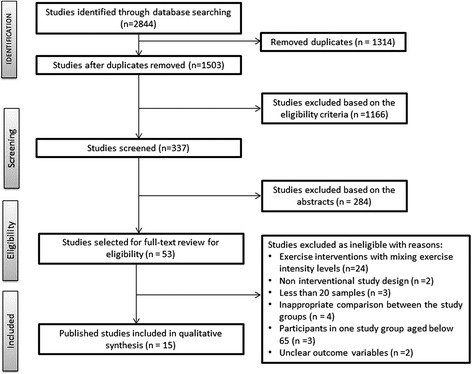
Published research was identified in various databases including CINAHL, MEDLINE, PEDro, PubMed, Science Direct, SPORTDiscus, and Web of Science. Research studies published from January 01, 1994 to February 01, 2015 were selected for examination. Studies were included if they were published in an academic peer-reviewed journal, published in English, conducted as randomized controlled trial (RCT) or quasi-experimental studies with appropriate comparison groups, targeted participants aged 65 or above, and prescribed with low-intensity exercise in at least one study arm. Two reviewers independently extracted the data (study, design, participants, intervention, and results) and assessed the quality of the selected studies. Fifteen studies met the inclusion criteria. Quality index ranged from 15 to 18 mean = 18.3 with a full score of 28, indicating a moderate quality. Most of the outcomes reported in these studied were lower limb muscle strength ( = 9), balancing ( = 7), flexibility ( = 4), and depressive symptoms ( = 3).
Out of the 15 selected studies, 11 reported improvement in flexibility, balancing, lower limb muscle strength, or depressive symptoms by low-intensity exercises.
The current literature suggests the effectiveness of low-intensity exercise on improved physical and cognitive health for older adults. It may be a desired intensity level in promoting health among older adults with better compliance, lower risk of injuries, and long-term sustainability.
众所周知,体育锻炼对于促进老年人群的身体健康和认知健康至关重要。然而,关于运动强度的研究结果并不一致,尤其是低强度运动(1.5代谢当量任务(METs)至3.0 METs)是否能改善老年人的身体和认知健康。本系统评价旨在填补这一研究空白。本研究的目的是对低强度运动干预对老年人身体和认知健康的有效性进行系统评价。
在多个数据库中检索已发表的研究,包括CINAHL、MEDLINE、PEDro、PubMed、Science Direct、SPORTDiscus和Web of Science。选取1994年1月1日至2015年2月1日发表的研究进行审查。纳入标准为:发表在学术同行评审期刊上、以英文发表、作为随机对照试验(RCT)或有适当对照组的准实验研究、目标参与者年龄在65岁及以上、且至少一个研究组规定了低强度运动。两名评审员独立提取数据(研究、设计、参与者、干预和结果)并评估所选研究的质量。15项研究符合纳入标准。质量指数范围为15至18,平均为18.3,满分28分,表明质量中等。这些研究中报告的大多数结果是下肢肌肉力量(n = 9)、平衡(n = 7)、柔韧性(n = 4)和抑郁症状(n = 3)。
在15项所选研究中,11项报告低强度运动可改善柔韧性、平衡能力、下肢肌肉力量或抑郁症状。
当前文献表明低强度运动对改善老年人的身体和认知健康有效。在促进老年人健康方面,它可能是一个理想的强度水平,具有更好的依从性、更低的受伤风险和长期可持续性。