Herbert Cornelia
Applied Emotion and Motivation Psychology, Institute of Psychology and Education, Faculty of Engineering, Computer Science and Psychology, Ulm University, 89081 Ulm, Germany.
Healthcare (Basel). 2025 Feb 10;13(4):368. doi: 10.3390/healthcare13040368.
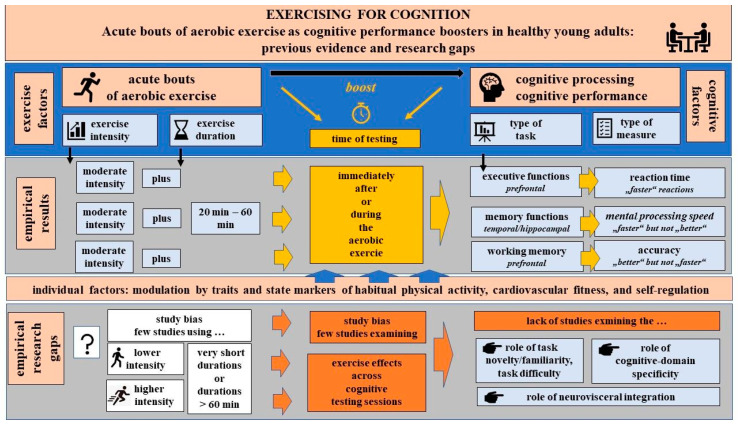
Regular physical activity (PA) and regular exercise (RE) are essential for an active and healthy lifestyle. Additionally, the short-term effects have been investigated to understand how an acute bout of exercise impacts cognitive processing, an important aspect of mental health and well-being. Previous studies have confirmed positive effects. However, several exercise factors and human factors can influence this relationship. This perspective paper has three main objectives: firstly, discussing the exercise and human factors that influence exercise-cognition effects significantly across studies according to previous reviews and meta-analytic studies and how this influence could be explained theoretically; secondly, highlighting important knowledge gaps and research questions for future research; and thirdly, discussing what conclusion can be drawn for cognitive health promotion. A particular focus is given to the effects of acute bouts of aerobic exercise and healthy adults as an important target group for primary health prevention. The summary of previous findings shows that the effects of an acute bout of aerobic exercise on cognitive performance in healthy adults depend on (a) exercise factors such as the duration and intensity of the acute bout of exercise, (b) cognitive factors such as the type of cognitive task and domain of cognitive functions, and (c) individual factors such as the physical activity of the individuals. Still, open questions concern the ideal duration, intensity and timing of the acute bout of exercise. In particular, more research is needed to determine whether and how aerobic exercises of short duration and an intensity above and especially below moderate intensity improve cognitive functions in healthy adults. Methodologically, these factors should be addressed by multimethod designs that consider intra- and interindividual comparisons and different response levels (self-report, behavioral, psychophysiological). In conclusion, answering these questions could pave the way for recommendations on how healthcare professionals should prescribe brief aerobic exercise as a cognitive health booster in healthy young adults. To this end, concepts of extended arousal and neurovisceral integration are useful framework models to include individual factors, like self-regulatory abilities of the individual and how these influence exercise-cognition interactions and exercise motivation during, pre-to-post and across testing sessions.
规律的身体活动(PA)和规律的锻炼(RE)对于积极健康的生活方式至关重要。此外,人们还研究了短期影响,以了解一次急性运动发作如何影响认知加工,这是心理健康和幸福的一个重要方面。先前的研究已经证实了积极影响。然而,几个运动因素和个体因素会影响这种关系。这篇观点性论文有三个主要目标:第一,根据先前的综述和荟萃分析研究,讨论在各项研究中显著影响运动与认知效果的运动和个体因素,以及如何从理论上解释这种影响;第二,突出未来研究的重要知识空白和研究问题;第三,讨论对于促进认知健康可以得出什么结论。特别关注急性有氧运动发作的影响以及健康成年人作为初级卫生预防的重要目标群体。先前研究结果的总结表明,一次急性有氧运动发作对健康成年人认知表现的影响取决于:(a)运动因素,如急性运动发作的持续时间和强度;(b)认知因素,如认知任务的类型和认知功能的领域;(c)个体因素,如个体的身体活动情况。不过,关于急性运动发作的理想持续时间、强度和时间安排仍存在未解决的问题。特别是,需要更多研究来确定短时间且强度高于尤其是低于中等强度的有氧运动是否以及如何改善健康成年人的认知功能。在方法上,这些因素应通过多方法设计来解决,该设计要考虑个体内和个体间的比较以及不同的反应水平(自我报告、行为、心理生理)。总之,回答这些问题可为医疗保健专业人员如何为健康的年轻人开具简短有氧运动处方以增强认知健康提供建议铺平道路。为此,扩展唤醒和神经内脏整合的概念是有用的框架模型,可纳入个体因素,如个体的自我调节能力以及这些能力如何在测试期间、测试前到测试后以及跨测试阶段影响运动与认知的相互作用和运动动机。