Jordán Ferenc, Lauria Mario, Scotti Marco, Nguyen Thanh-Phuong, Praveen Paurush, Morine Melissa, Priami Corrado
The Microsoft Research - University of Trento Centre for Computational and Systems Biology, Piazza Manifattura 1, Rovereto, TN, 38068, Italy.
MTA Centre for Ecological Research, Karolina út 29, 1113, Budapest, Hungary.
Sci Rep. 2015 Oct 30;5:15920. doi: 10.1038/srep15920.
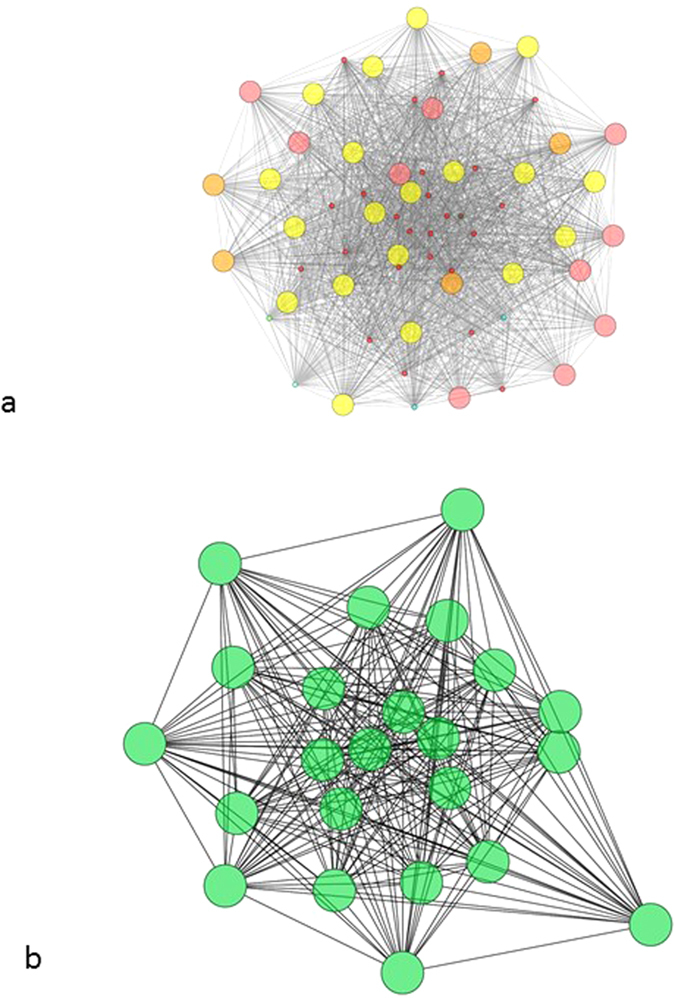
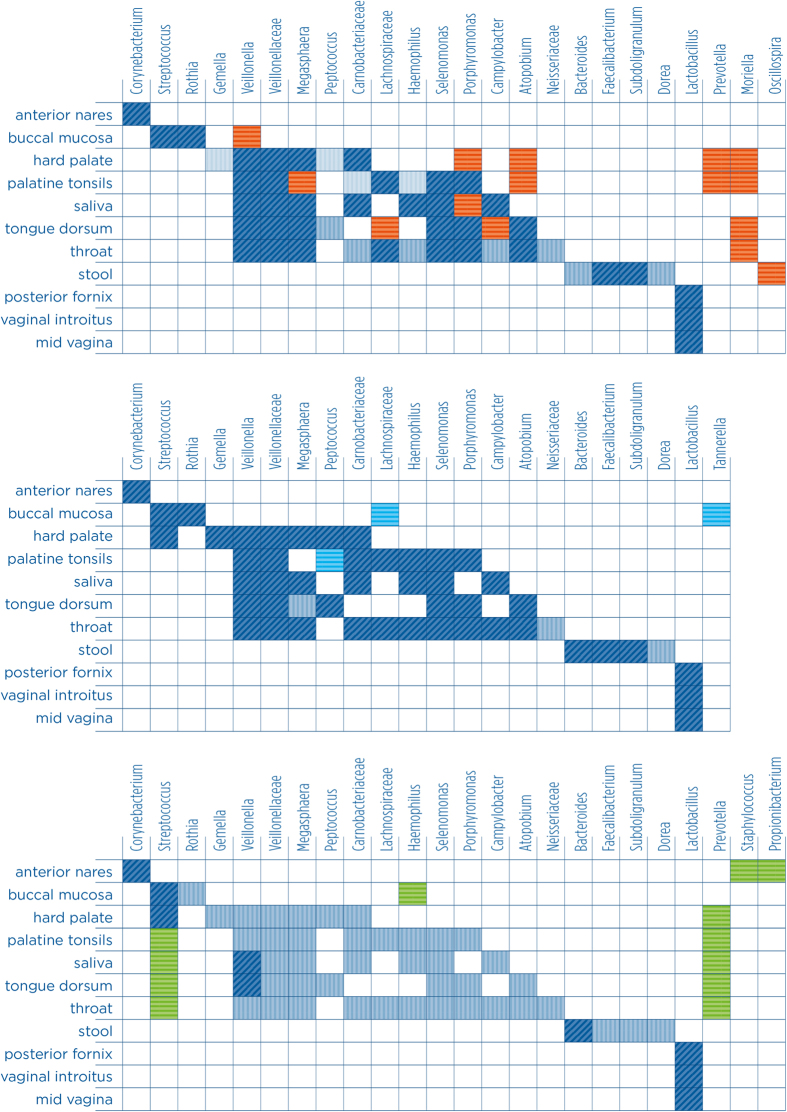
Coexisting bacteria form various microbial communities in human body parts. In these ecosystems they interact in various ways and the properties of the interaction network can be related to the stability and functional diversity of the local bacterial community. In this study, we analyze the interaction network among bacterial OTUs in 11 locations of the human body. These belong to two major groups. One is the digestive system and the other is the female genital tract. In each local ecosystem we determine the key species, both the ones being in key positions in the interaction network and the ones that dominate by frequency. Beyond identifying the key players and discussing their biological relevance, we also quantify and compare the properties of the 11 networks. The interaction networks of the female genital system and the digestive system show totally different architecture. Both the topological properties and the identity of the key groups differ. Key groups represent four phyla of prokaryotes. Some groups appear in key positions in several locations, while others are assigned only to a single body part. The key groups of the digestive and the genital tracts are totally different.
共生细菌在人体各部位形成了各种微生物群落。在这些生态系统中,它们以各种方式相互作用,而相互作用网络的特性可能与局部细菌群落的稳定性和功能多样性有关。在本研究中,我们分析了人体11个部位细菌操作分类单元(OTU)之间的相互作用网络。这些部位分属两个主要类别。一类是消化系统,另一类是女性生殖道。在每个局部生态系统中,我们确定关键物种,包括在相互作用网络中处于关键位置的物种以及在频率上占主导地位的物种。除了识别关键参与者并讨论它们的生物学相关性外,我们还对这11个网络的特性进行了量化和比较。女性生殖系统和消化系统的相互作用网络显示出完全不同的结构。拓扑特性和关键类群的身份都有所不同。关键类群代表原核生物的四个门。一些类群在几个部位处于关键位置,而另一些类群仅存在于单个身体部位。消化道和生殖道的关键类群完全不同。