Division of Microbial Ecology, Department of Microbiology and Ecosystem Science, University of Vienna Vienna, Austria.
CUBE-Division of Computational Systems Biology, Department of Microbiology and Ecosystem Science, University of Vienna Vienna, Austria.
Front Microbiol. 2014 May 20;5:219. doi: 10.3389/fmicb.2014.00219. eCollection 2014.
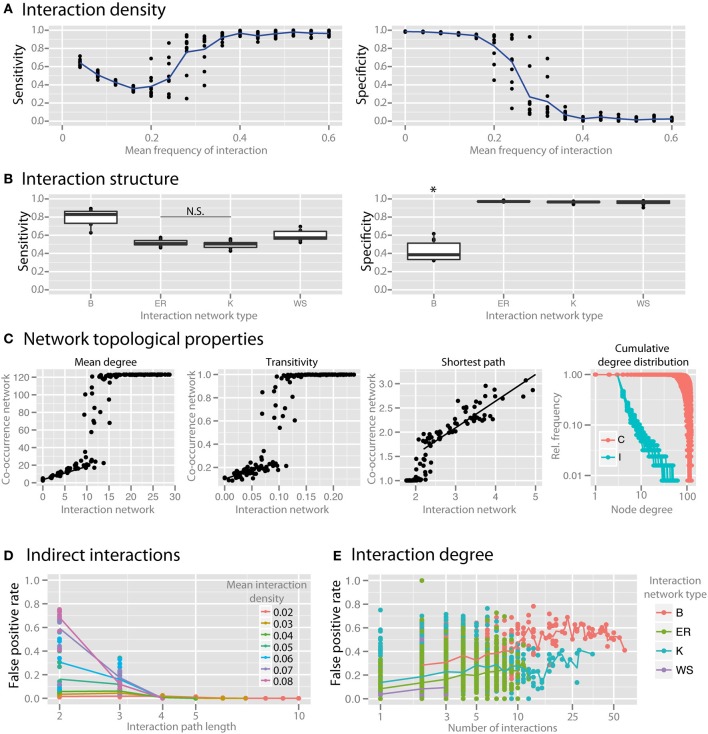
Co-occurrence networks produced from microbial survey sequencing data are frequently used to identify interactions between community members. While this approach has potential to reveal ecological processes, it has been insufficiently validated due to the technical limitations inherent in studying complex microbial ecosystems. Here, we simulate multi-species microbial communities with known interaction patterns using generalized Lotka-Volterra dynamics. We then construct co-occurrence networks and evaluate how well networks reveal the underlying interactions and how experimental and ecological parameters can affect network inference and interpretation. We find that co-occurrence networks can recapitulate interaction networks under certain conditions, but that they lose interpretability when the effects of habitat filtering become significant. We demonstrate that networks suffer from local hot spots of spurious correlation in the neighborhood of hub species that engage in many interactions. We also identify topological features associated with keystone species in co-occurrence networks. This study provides a substantiated framework to guide environmental microbiologists in the construction and interpretation of co-occurrence networks from microbial survey datasets.
共生网络是从微生物调查测序数据中产生的,常用于识别群落成员之间的相互作用。虽然这种方法具有揭示生态过程的潜力,但由于研究复杂微生物生态系统所固有的技术限制,其验证还不够充分。在这里,我们使用广义Lotka-Volterra 动力学模拟具有已知相互作用模式的多物种微生物群落。然后,我们构建共生网络,并评估网络在多大程度上揭示了潜在的相互作用,以及实验和生态参数如何影响网络推断和解释。我们发现,在某些条件下,共生网络可以再现相互作用网络,但当栖息地过滤的影响变得显著时,网络的可解释性就会丧失。我们证明,当参与许多相互作用的枢纽物种附近出现虚假相关性的局部热点时,网络会受到影响。我们还确定了共生网络中与关键种相关的拓扑特征。这项研究为环境微生物学家从微生物调查数据集构建和解释共生网络提供了一个有依据的框架。