Wei Jin-Huan, Haddad Ahmed, Wu Kai-Jie, Zhao Hong-Wei, Kapur Payal, Zhang Zhi-Ling, Zhao Liang-Yun, Chen Zhen-Hua, Zhou Yun-Yun, Zhou Jian-Cheng, Wang Bin, Yu Yan-Hong, Cai Mu-Yan, Xie Dan, Liao Bing, Li Cai-Xia, Li Pei-Xing, Wang Zong-Ren, Zhou Fang-Jian, Shi Lei, Liu Qing-Zuo, Gao Zhen-Li, He Da-Lin, Chen Wei, Hsieh Jer-Tsong, Li Quan-Zhen, Margulis Vitaly, Luo Jun-Hang
Department of Urology, First Affiliated Hospital, Sun Yat-sen University, No. 58, ZhongShan Second Road, Guangdong 510080, China.
Department of Urology, University of Texas Southwestern Medical Center at Dallas, Dallas, Texas 75390, USA.
Nat Commun. 2015 Oct 30;6:8699. doi: 10.1038/ncomms9699.
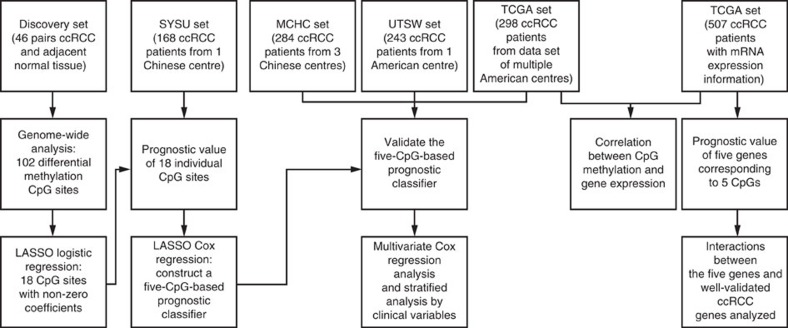
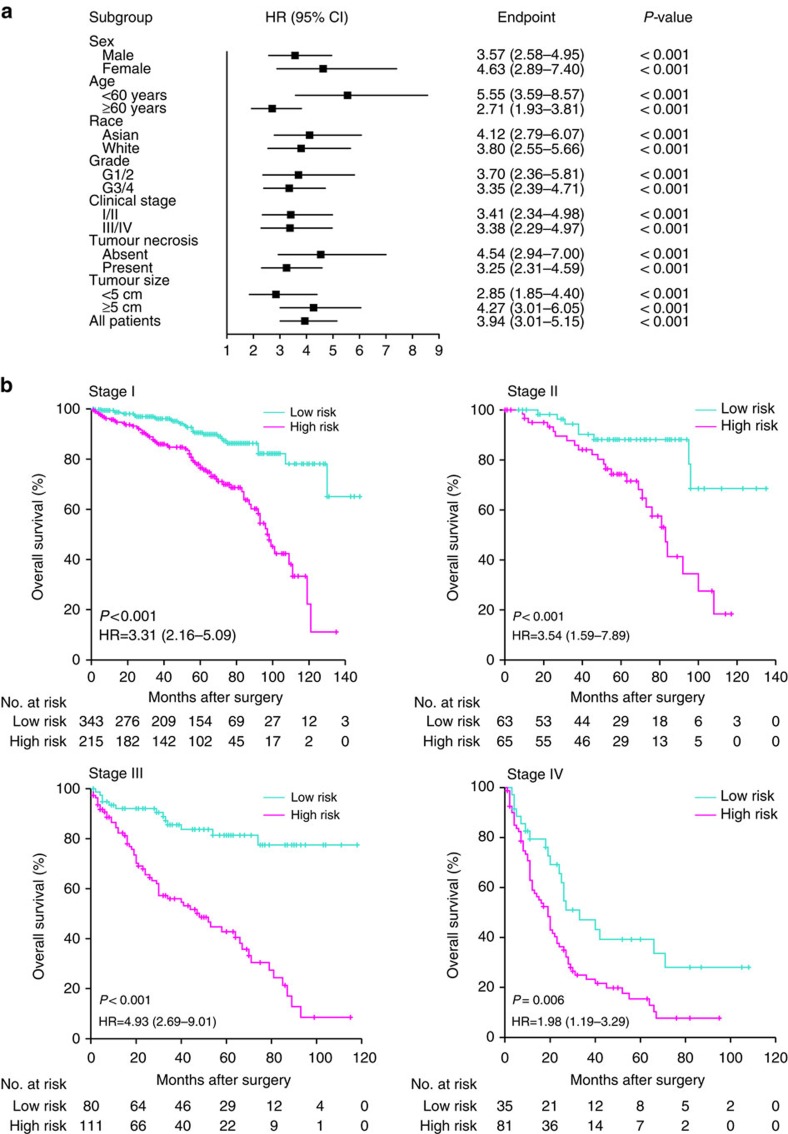
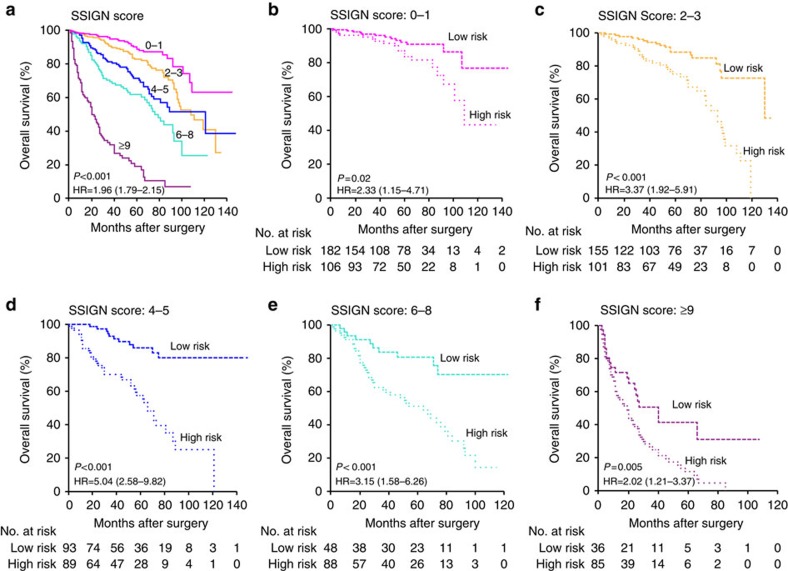
Clear cell renal cell carcinomas (ccRCCs) display divergent clinical behaviours. Molecular markers might improve risk stratification of ccRCC. Here we use, based on genome-wide CpG methylation profiling, a LASSO model to develop a five-CpG-based assay for ccRCC prognosis that can be used with formalin-fixed paraffin-embedded specimens. The five-CpG-based classifier was validated in three independent sets from China, United States and the Cancer Genome Atlas data set. The classifier predicts the overall survival of ccRCC patients (hazard ratio=2.96-4.82; P=3.9 × 10(-6)-2.2 × 10(-9)), independent of standard clinical prognostic factors. The five-CpG-based classifier successfully categorizes patients into high-risk and low-risk groups, with significant differences of clinical outcome in respective clinical stages and individual 'stage, size, grade and necrosis' scores. Moreover, methylation at the five CpGs correlates with expression of five genes: PITX1, FOXE3, TWF2, EHBP1L1 and RIN1. Our five-CpG-based classifier is a practical and reliable prognostic tool for ccRCC that can add prognostic value to the staging system.
透明细胞肾细胞癌(ccRCC)表现出不同的临床行为。分子标志物可能会改善ccRCC的风险分层。在此,我们基于全基因组CpG甲基化谱,使用套索(LASSO)模型开发了一种基于五个CpG的ccRCC预后检测方法,该方法可用于福尔马林固定石蜡包埋标本。基于五个CpG的分类器在中国、美国的三个独立数据集以及癌症基因组图谱数据集中得到了验证。该分类器可预测ccRCC患者的总生存期(风险比=2.96 - 4.82;P = 3.9×10⁻⁶ - 2.2×10⁻⁹),与标准临床预后因素无关。基于五个CpG的分类器成功地将患者分为高风险和低风险组,在各自的临床分期和个体“分期、大小、分级和坏死”评分中临床结局存在显著差异。此外,这五个CpG位点的甲基化与五个基因(PITX1、FOXE3、TWF2、EHBP1L1和RIN1)的表达相关。我们基于五个CpG的分类器是一种实用且可靠的ccRCC预后工具,可为分期系统增加预后价值。