Su Ying-Jhen, Lin Wei-Hsin, Chang Yi-Wen, Wei Kuo-Chen, Liang Chi-Lung, Chen Shin-Cheh, Lee Jia-Lin
Institute of Molecular and Cellular Biology, National Tsing Hua University, Hsinchu, Taiwan.
Department of Orthopedics, National Taiwan University Hospital Hsin-Chu Branch, Hsinchu, Taiwan.
Oncotarget. 2015 Nov 10;6(35):38029-45. doi: 10.18632/oncotarget.5703.
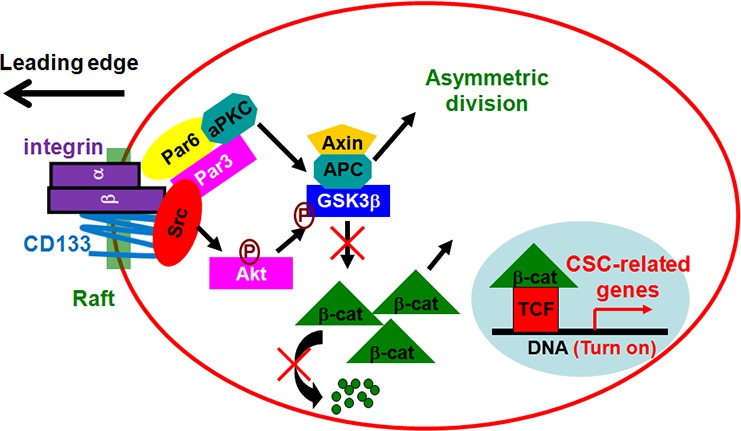
CD133 is widely used as a surface marker to isolate cancer stem cells (CSCs). Here we show that in CSCs CD133 contributes to β-catenin-mediated transcriptional activation and to the self-renewal capacity of sphere-forming and side-population (SP) cells in cell lines from brain, colon and lung cancers, but not gastric or breast cancers. In chromatin immunoprecipitation assays, β-catenin binding to the proximal promoter regions of ITGA2-4 and ITGA10-11 in brain, colon and lung cancer cell lines could be triggered by CD133, and β-catenin also bound to the proximal promoter regions of ITGB6 and ITGB8 in cell lines from gastric and breast cancers. CD133 thus induces β-catenin binding and transcriptional activation of diverse targets that are cancer type-specific. Cell migration triggered by wounding CD133+ cells cultured on ECM-coated dishes can induce polarity and lipid raft coalescence, enhancing CD133/integrin signaling and asymmetric cell division. In response to directional cues, integrins, Src and the Par complex were enriched in lipid rafts, and the assembly and activation of an integrated CD133-integrin-Par signaling complex was followed by Src/Akt/GSK3β signaling. The subsequent increase and nuclear translocation of β-catenin may be a regulatory switch to increase drug resistance and stemness properties. Collectively, these findings 1) indicate that a polarized cell migration-induced CD133/integrin/Src/Akt/GSK3β/β-catenin axis is required for maintenance of CSC properties, 2) establish a function for CD133 and 3) support the rationale for targeting CD133 in cancer treatment.
CD133被广泛用作分离癌症干细胞(CSCs)的表面标志物。在此我们表明,在癌症干细胞中,CD133有助于β-连环蛋白介导的转录激活以及脑癌、结肠癌和肺癌细胞系中球形形成细胞和侧群(SP)细胞的自我更新能力,但对胃癌或乳腺癌细胞系则无此作用。在染色质免疫沉淀试验中,脑癌、结肠癌和肺癌细胞系中,CD133可触发β-连环蛋白与ITGA2 - 4和ITGA10 - 11近端启动子区域的结合,而在胃癌和乳腺癌细胞系中,β-连环蛋白也与ITGB6和ITGB8的近端启动子区域结合。因此,CD133可诱导β-连环蛋白与多种癌症类型特异性靶点的结合及转录激活。在包被细胞外基质的培养皿上培养的CD133 + 细胞受损伤触发的细胞迁移可诱导极性和脂筏聚并,增强CD133/整合素信号传导和不对称细胞分裂。响应定向信号,整合素、Src和Par复合物在脂筏中富集,CD133 - 整合素 - Par信号复合物整合组装并激活后会引发Src/Akt/GSK3β信号传导。随后β-连环蛋白的增加和核转位可能是增加耐药性和干性特性的调节开关。总体而言,这些发现1)表明极化细胞迁移诱导的CD133/整合素/Src/Akt/GSK3β/β-连环蛋白轴是维持癌症干细胞特性所必需的,2)确立了CD133的功能,3)支持了在癌症治疗中靶向CD133的理论依据。