Nardin Alice, Schrepfer Emilie, Ziviani Elena
Department of Biology, University of Padova, via Ugo Bassi 58b, 35121, Padova, Italy.
Curr Neuropharmacol. 2016;14(3):250-9. doi: 10.2174/1570159x13666151030104414.
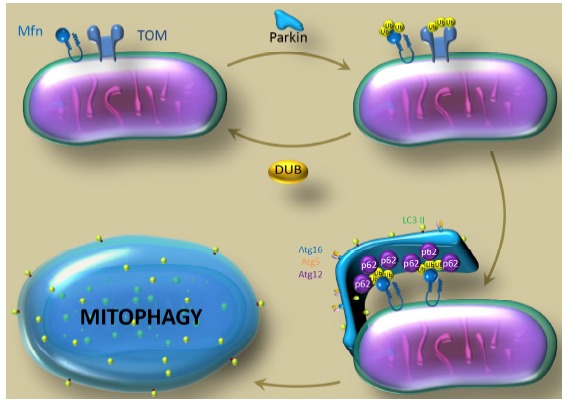
Parkinson's Disease (PD) related genes PINK1, a protein kinase [1], and Parkin, an E3 ubiquitin ligase [2], operate within the same pathway [3-5], which controls, via specific elimination of dysfunctional mitochondria, the quality of the organelle network [6]. Parkin translocates to impaired mitochondria and drives their elimination via autophagy, a process known as mitophagy [6]. PINK1 regulates Parkin translocation through a not yet completely understood mechanism [7, 8]. Mitochondrial outer membrane proteins Mitofusin (MFN), VDAC, Fis1 and TOM20 were found to be targets for Parkin mediated ubiquitination [9-11]. By adding ubiquitin molecules to its targets expressed on mitochondria, Parkin tags and selects dysfunctional mitochondria for clearance, contributing to maintain a functional and healthy mitochondrial network. Abnormal accumulation of misfolded proteins and unfunctional mitochondria is a characteristic hallmark of PD pathology. Therefore a therapeutic approach to enhance clearance of misfolded proteins and potentiate the ubiquitin-proteosome system (UPS) could be instrumental to ameliorate the progression of the disease. Recently, much effort has been put to identify specific de-ubiquitinating enzymes (DUBs) that oppose Parkin in the ubiquitination of its targets. Similar to other post-translational modifications, such as phosphorylation and acetylation, ubiquitination is also a reversible modification, mediated by a large family of DUBs [12]. DUBs inhibitors or activators can affect cellular response to stimuli that induce mitophagy via ubiquitination of mitochondrial outer membrane proteins MFN, VDAC, Fis1 and TOM20. In this respect, the identification of a Parkin-opposing DUB in the regulation of mitophagy, might be instrumental to develop specific isopeptidase inhibitors or activators that can modulate the fundamental biological process of mitochondria clearance and impact on cell survival.
帕金森病(PD)相关基因PINK1(一种蛋白激酶[1])和Parkin(一种E3泛素连接酶[2])在同一通路中发挥作用[3 - 5],该通路通过特异性清除功能失调的线粒体来控制细胞器网络的质量[6]。Parkin转位至受损线粒体,并通过自噬驱动其清除,这一过程称为线粒体自噬[6]。PINK1通过一种尚未完全明确的机制调节Parkin的转位[7, 8]。线粒体外膜蛋白线粒体融合蛋白(MFN)、电压依赖性阴离子通道(VDAC)、线粒体分裂因子1(Fis1)和转位酶外膜20(TOM20)被发现是Parkin介导的泛素化作用的靶点[9 - 11]。通过将泛素分子添加到线粒体上表达的靶点,Parkin标记并选择功能失调的线粒体进行清除,有助于维持一个功能正常且健康的线粒体网络。错误折叠蛋白和无功能线粒体的异常积累是PD病理学的一个特征性标志。因此,一种增强错误折叠蛋白清除并增强泛素 - 蛋白酶体系统(UPS)的治疗方法可能有助于改善疾病的进展。最近,人们付出了很多努力来鉴定在Parkin对其靶点的泛素化过程中起拮抗作用的特异性去泛素化酶(DUBs)。与其他翻译后修饰(如磷酸化和乙酰化)类似,泛素化也是一种可逆修饰,由一大类DUBs介导[12]。DUBs抑制剂或激活剂可以影响细胞对通过线粒体外膜蛋白MFN、VDAC、Fis1和TOM20的泛素化作用诱导线粒体自噬的刺激的反应。在这方面,鉴定一种在调节线粒体自噬中起拮抗Parkin作用的DUB,可能有助于开发能够调节线粒体清除这一基本生物学过程并影响细胞存活的特异性异肽酶抑制剂或激活剂。