Jonas Children's Vision Care, and Bernard and Shirlee Brown Glaucoma Laboratory, Columbia Stem Cell Initiative, Departments of Ophthalmology, Pathology and Cell Biology, Institute of Human Nutrition, Vagelos College of Physicians and Surgeons, Columbia University, New York, NY, USA.
Edward S. Harkness Eye Institute, New York-Presbyterian Hospital, New York, NY, USA.
Acta Neuropathol Commun. 2020 Nov 9;8(1):189. doi: 10.1186/s40478-020-01062-w.
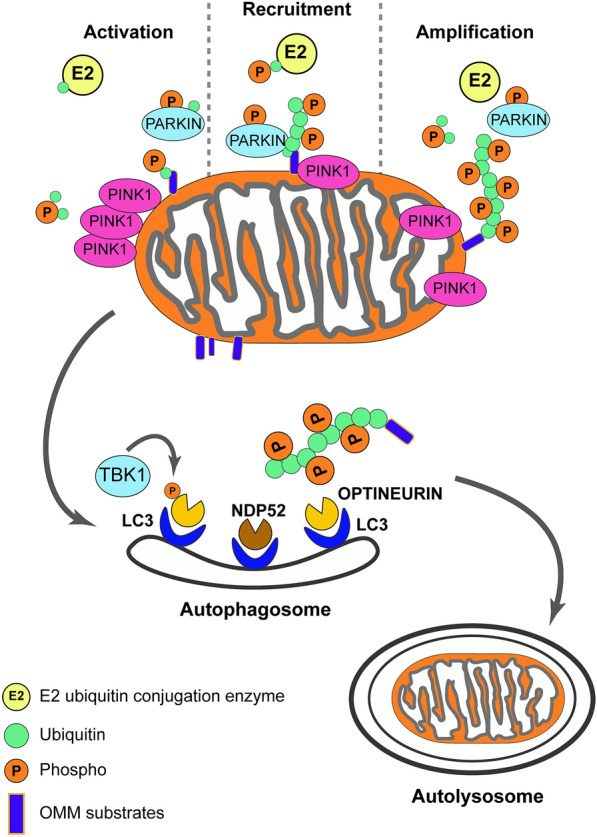
Mutations in the PTEN-induced kinase 1 (PINK1) and Parkin RBR E3 ubiquitin-protein ligase (PARKIN) genes are associated with familial forms of Parkinson's disease (PD). PINK1, a protein kinase, and PARKIN, an E3 ubiquitin ligase, control the specific elimination of dysfunctional or superfluous mitochondria, thus fine-tuning mitochondrial network and preserving energy metabolism. PINK1 regulates PARKIN translocation in impaired mitochondria and drives their removal via selective autophagy, a process known as mitophagy. As knowledge obtained using different PINK1 and PARKIN transgenic animal models is being gathered, growing evidence supports the contribution of mitophagy impairment to several human pathologies, including PD and Alzheimer's diseases (AD). Therefore, therapeutic interventions aiming to modulate PINK1/PARKIN signalling might have the potential to treat these diseases. In this review, we will start by discussing how the interplay of PINK1 and PARKIN signalling helps mediate mitochondrial physiology. We will continue by debating the role of mitochondrial dysfunction in disorders such as amyotrophic lateral sclerosis, Alzheimer's, Huntington's and Parkinson's diseases, as well as eye diseases such as age-related macular degeneration and glaucoma, and the causative factors leading to PINK1/PARKIN-mediated neurodegeneration and neuroinflammation. Finally, we will discuss PINK1/PARKIN gene augmentation possibilities with a particular focus on AD, PD and glaucoma.
PTEN 诱导的激酶 1(PINK1)和 Parkin RBR E3 泛素蛋白连接酶(PARKIN)基因突变与家族性帕金森病(PD)有关。PINK1 是一种蛋白激酶,PARKIN 是一种 E3 泛素连接酶,它们控制着功能失调或多余线粒体的特异性消除,从而微调线粒体网络并维持能量代谢。PINK1 调节受损线粒体中 PARKIN 的易位,并通过选择性自噬(一种称为线粒体自噬的过程)驱动其去除。随着使用不同的 PINK1 和 PARKIN 转基因动物模型获得的知识不断增加,越来越多的证据支持线粒体自噬功能障碍对包括 PD 和阿尔茨海默病(AD)在内的几种人类病理的贡献。因此,旨在调节 PINK1/PARKIN 信号的治疗干预可能有潜力治疗这些疾病。在这篇综述中,我们将首先讨论 PINK1 和 PARKIN 信号通路的相互作用如何有助于调节线粒体生理学。我们将继续讨论线粒体功能障碍在肌萎缩侧索硬化症、阿尔茨海默病、亨廷顿病和帕金森病等疾病以及年龄相关性黄斑变性和青光眼等眼部疾病中的作用,以及导致 PINK1/PARKIN 介导的神经退行性变和神经炎症的致病因素。最后,我们将讨论 PINK1/PARKIN 基因增强的可能性,特别关注 AD、PD 和青光眼。