Otto Marcia C de Oliveira, Padhye Nikhil S, Bertoni Alain G, Jacobs David R, Mozaffarian Dariush
Division of Epidemiology, Human Genetics and Environmental Sciences, The University of Texas Health Science Center, School of Public Health, Houston, Texas, United States of America.
Center for Nursing Research, The University of Texas Health Science Center, School of Nursing, Houston, Texas, United States of America.
PLoS One. 2015 Oct 30;10(10):e0141341. doi: 10.1371/journal.pone.0141341. eCollection 2015.
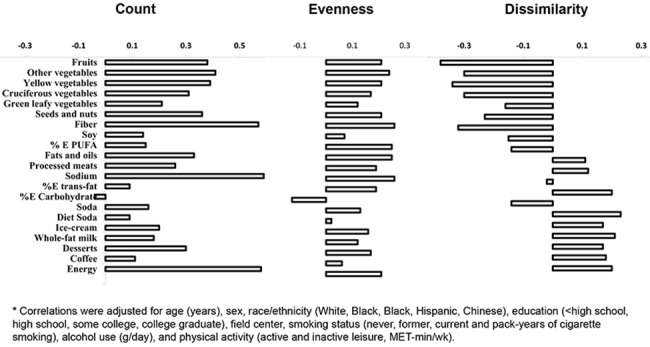
Diet guidelines recommend increasing dietary diversity. Yet, metrics for dietary diversity have neither been well-defined nor evaluated for impact on metabolic health. Also, whether diversity has effects independent of diet quality is unknown. We characterized and evaluated associations of diet diversity and quality with abdominal obesity and type II diabetes (T2D) in the Multi-Ethnic Study of Atherosclerosis. At baseline (2000-02), diet was assessed among 5,160 Whites, Hispanic, Blacks, and Chinese age 45-84 y and free of T2D, using a validated questionnaire. Three different aspects of diet diversity were characterized including count (number of different food items eaten more than once/week, a broad measure of diversity), evenness (Berry index, a measure of the spread of the diversity), and dissimilarity (Jaccard distance, a measure of the diversity of the attributes of the foods consumed). Diet quality was characterized using aHEI, DASH, and a priori pattern. Count and evenness were weakly positively correlated with diet quality (r with AHEI: 0.20, 0.04), while dissimilarity was moderately inversely correlated (r = -0.34). In multivariate models, neither count nor evenness was associated with change in waist circumference (WC) or incident T2D. Greater food dissimilarity was associated with higher gain in WC (p-trend<0.01), with 120% higher gain in participants in the highest quintile of dissimilarity scores. Diet diversity was not associated with incident T2D. Also, none of the diversity metrics were associated with change in WC or incident T2D when restricted to only healthier or less healthy foods. Higher diet quality was associated with lower risk of T2D. Our findings provide little evidence for benefits of diet diversity for either abdominal obesity or diabetes. Greater dissimilarity among foods was actually associated with gain in WC. These results do not support the notion that "eating everything in moderation" leads to greater diet quality or better metabolic health.
饮食指南建议增加饮食多样性。然而,饮食多样性的衡量标准尚未得到明确界定,也未对其对代谢健康的影响进行评估。此外,多样性是否具有独立于饮食质量的影响尚不清楚。我们在动脉粥样硬化多民族研究中,对饮食多样性和质量与腹型肥胖和2型糖尿病(T2D)之间的关联进行了特征描述和评估。在基线期(2000 - 2002年),使用经过验证的问卷,对5160名年龄在45 - 84岁且无T2D的白人、西班牙裔、黑人及华裔进行了饮食评估。对饮食多样性的三个不同方面进行了特征描述,包括计数(每周食用超过一次的不同食物种类数量,一种广泛的多样性衡量指标)、均匀度(贝里指数,一种多样性分布的衡量指标)和相异性(杰卡德距离,一种所消费食物属性多样性的衡量指标)。使用健康饮食指数(HEI)、得舒饮食(DASH)和先验模式对饮食质量进行了特征描述。计数和均匀度与饮食质量呈弱正相关(与HEI的相关系数分别为0.20、0.04),而相异性呈中度负相关(r = -0.34)。在多变量模型中,计数和均匀度均与腰围(WC)变化或新发T2D无关。食物相异性越大,WC增加越高(p趋势<0.01),相异性得分最高五分位数的参与者增加幅度高120%。饮食多样性与新发T2D无关。此外,当仅限制在更健康或不太健康的食物时,没有一个多样性指标与WC变化或新发T2D相关。更高的饮食质量与T2D风险较低相关。我们的研究结果几乎没有证据表明饮食多样性对腹型肥胖或糖尿病有益。食物之间更大的相异性实际上与WC增加有关。这些结果不支持“适度食用一切食物”会导致更高饮食质量或更好代谢健康的观点。