MRCEpidemiology Unit, Institute of Metabolic Science, Addenbrooke’s Hospital, Cambridge, U.K.
Diabetes Care. 2012 Jun;35(6):1293-300. doi: 10.2337/dc11-2388. Epub 2012 Apr 3.
The association between quantity of fruit and vegetable (F&V) intake and risk of type 2 diabetes (T2D) is not clear, and the relationship with variety of intake is unknown. The current study examined the association of both quantity and variety of F&V intake and risk of T2D.
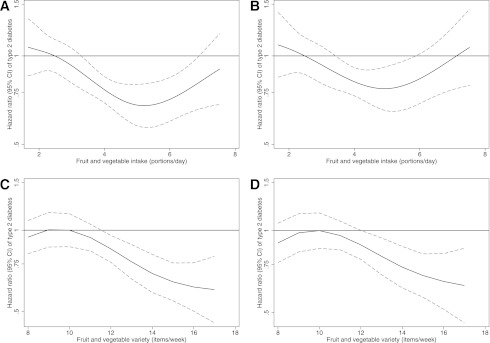
We examined the 11-year incidence of T2D in relation to quantity and variety of fruit, vegetables, and combined F&V intake in a case-cohort study of 3,704 participants (n = 653 diabetes cases) nested within the European Prospective Investigation into Cancer and Nutrition-Norfolk study, who completed 7-day prospective food diaries. Variety of intake was derived from the total number of different items consumed in a 1-week period. Multivariable, Prentice-weighted Cox regression was used to estimate hazard ratios (HRs) and 95% CIs.
A greater quantity of combined F&V intake was associated with 21% lower hazard of T2D (HR 0.79 [95% CI 0.62-1.00]) comparing extreme tertiles, in adjusted analyses including variety. Separately, quantity of vegetable intake (0.76 [0.60-0.97]), but not fruit, was inversely associated with T2D in adjusted analysis. Greater variety in fruit (0.70 [0.53-0.91]), vegetable (0.77 [0.61-0.98]), and combined F&V (0.61 [0.48-0.78]) intake was associated with a lower hazard of T2D, independent of known confounders and quantity of intake comparing extreme tertiles.
These findings suggest that a diet characterized by a greater quantity of vegetables and a greater variety of both F&V intake is associated with a reduced risk of T2D.
水果和蔬菜(F&V)摄入量与 2 型糖尿病(T2D)风险之间的关联尚不清楚,其与摄入量种类的关系也不清楚。本研究旨在探讨 F&V 摄入量的数量和种类与 T2D 风险之间的关系。
我们在欧洲癌症前瞻性调查和营养-诺福克研究中进行了一项病例-对照研究,共纳入了 3704 名参与者(n=653 例糖尿病患者),这些参与者在 11 年内随访了 T2D 的发病情况,同时还对他们水果、蔬菜和 F&V 摄入的数量和种类进行了评估。摄入量的种类是根据一周内食用的不同食物种类的总数得出的。采用多变量、Prentice 加权 Cox 回归模型来估计风险比(HR)和 95%置信区间(CI)。
在调整了种类因素的分析中,与极端三分位组相比,F&V 总摄入量较高与 T2D 风险降低 21%相关(HR 0.79 [95%CI 0.62-1.00])。单独分析时,蔬菜摄入量(0.76 [0.60-0.97])与 T2D 呈负相关,但水果摄入量与 T2D 无关联。在调整了已知混杂因素和摄入量数量后,水果(0.70 [0.53-0.91])、蔬菜(0.77 [0.61-0.98])和 F&V 总摄入量(0.61 [0.48-0.78])种类更多与 T2D 风险降低相关。
这些发现表明,富含蔬菜且 F&V 种类更多的饮食与 T2D 风险降低相关。