Barros Ana B, Dias Sonia F, Martins Maria Rosario O
Lúrio University, Rua 4250, Km 2.3, Marrere, Nampula, Mozambique.
Global Health and Tropical Medicine, Instituto de Higiene e Medicina Tropical, Universidade Nova de Lisboa, Rua da Junqueira 100, Lisbon, Portugal.
Syst Rev. 2015 Oct 30;4:141. doi: 10.1186/s13643-015-0129-9.
In public health, hard-to-reach populations are often recruited by non-probabilistic sampling methods that produce biased results. In order to overcome this, several sampling methods have been improved and developed in the last years. The aim of this systematic review was to identify all current methods used to survey most-at-risk populations of men who have sex with men and sex workers. The review also aimed to assess if there were any relations between the study populations and the sampling methods used to recruit them. Lastly, we wanted to assess if the number of publications originated in middle and low human development (MLHD) countries had been increasing in the last years.
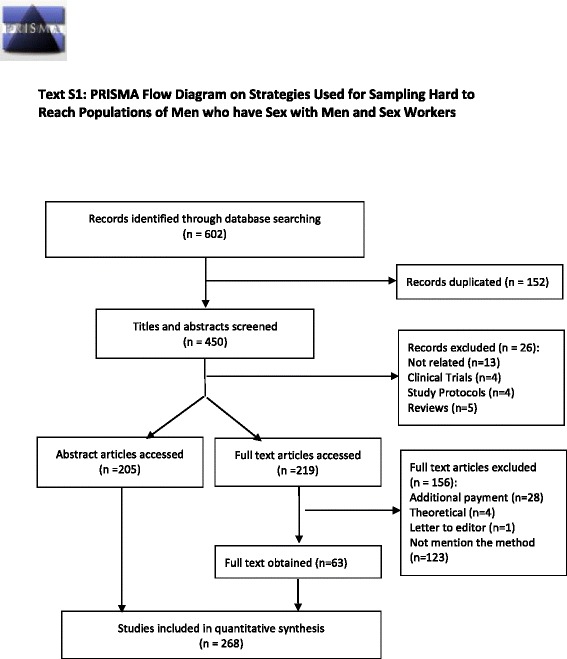
A systematic review was conducted using electronic databases and a total of 268 published studies were included in the analysis.
In this review, 11 recruitment methods were identified. Semi-probabilistic methods were used most commonly to survey men who have sex with men, and the use of the Internet was the method that gathered more respondents. We found that female sex workers were more frequently recruited through non-probabilistic methods than men who have sex with men (odds = 2.2; p < 0.05; confidence interval (CI) [1.1-4.2]). In the last 6 years, the number of studies based in middle and low human development countries increased more than the number of studies based in very high and high human development countries (odds = 2.5; p < 0.05; CI [1.3-4.9]).
This systematic literature review identified 11 methods used to sample men who have sex with men and female sex workers. There is an association between the type of sampling method and the population being studied. The number of studies based in middle and low human development countries has increased in the last 6 years of this study.
在公共卫生领域,难以接触到的人群通常采用非概率抽样方法招募,这会产生有偏差的结果。为了克服这一问题,近年来已改进和开发了几种抽样方法。本系统评价的目的是确定目前用于调查男男性行为者和性工作者等高危人群的所有方法。该评价还旨在评估研究人群与用于招募他们的抽样方法之间是否存在任何关系。最后,我们想评估过去几年中来自人类发展中低水平(MLHD)国家的出版物数量是否有所增加。
使用电子数据库进行系统评价,分析共纳入268项已发表的研究。
在本评价中,确定了11种招募方法。半概率方法最常用于调查男男性行为者,利用互联网是获得更多受访者的方法。我们发现,与男男性行为者相比,女性性工作者更常通过非概率方法招募(优势比=2.2;p<0.05;置信区间(CI)[1.1-4.2])。在过去6年中,来自人类发展中低水平国家的研究数量增长超过了来自人类发展高水平和非常高水平国家的研究数量(优势比=2.5;p<0.05;CI[1.3-4.9])。
本系统文献评价确定了11种用于对男男性行为者和女性性工作者进行抽样的方法。抽样方法的类型与所研究人群之间存在关联。在本研究的过去6年中,来自人类发展中低水平国家的研究数量有所增加。