Deng Xiaoyan, Duffy Simon P, Myrand-Lapierre Marie-Eve, Matthews Kerryn, Santoso Aline Teresa, Du Yi-Ling, Ryan Katherine S, Ma Hongshen
Department of Mechanical Engineering, University of British Columbia, 2054-6250 Applied Science Lane, Vancouver, BC, V6T 1Z4, Canada.
Department of Chemistry, University of British Columbia, Vancouver, BC, Canada.
Malar J. 2015 Oct 31;14:428. doi: 10.1186/s12936-015-0957-z.
Malaria remains a challenging and fatal infectious disease in developing nations and the urgency for the development of new drugs is even greater due to the rapid spread of anti-malarial drug resistance. While numerous parasite genetic, protein and metabolite biomarkers have been proposed for testing emerging anti-malarial compounds, they do not universally correspond with drug efficacy. The biophysical character of parasitized cells is a compelling alternative to these conventional biomarkers because parasitized erythrocytes become specifically rigidified and this effect is potentiated by anti-malarial compounds, such as chloroquine and artesunate. This biophysical biomarker is particularly relevant because of the mechanistic link between cell deformability and enhanced splenic clearance of parasitized erythrocytes.
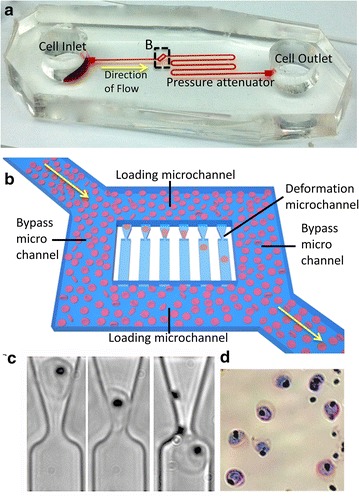
Recently a microfluidic mechanism, called the multiplexed fluidic plunger that provides sensitive and rapid measurement of single red blood cell deformability was developed. Here it was systematically used to evaluate the deformability changes of late-stage trophozoite-infected red blood cells (iRBCs) after treatment with established clinical and pre-clinical anti-malarial compounds.
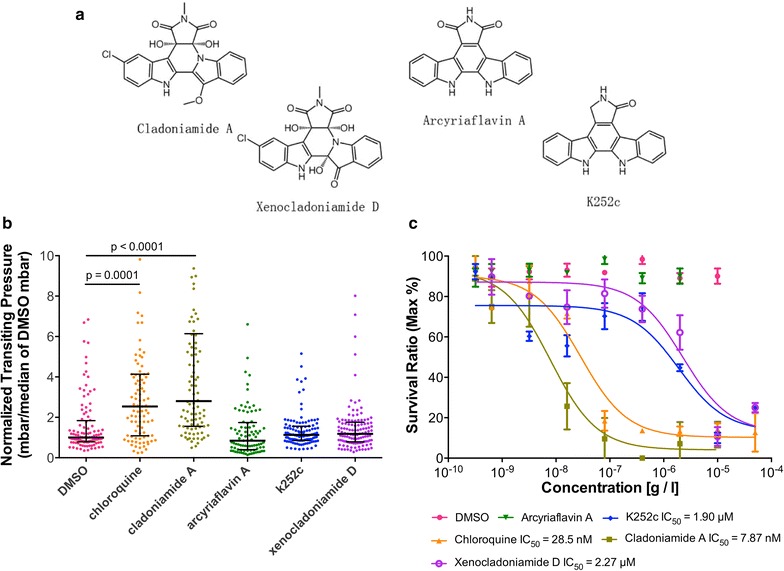
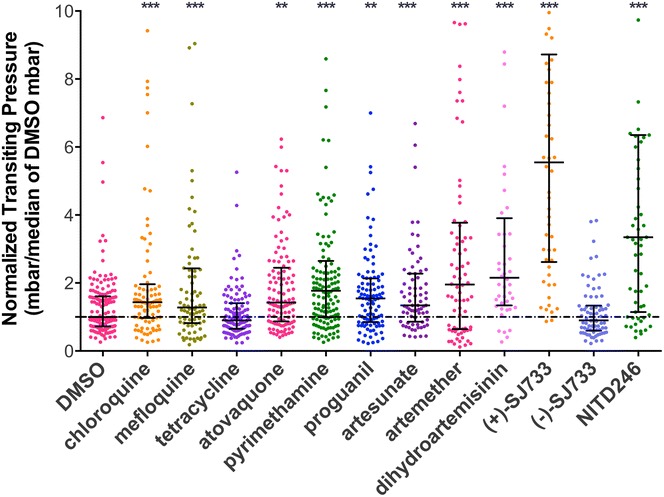
It was found that rapid and specific iRBC rigidification was a universal outcome of all but one of these drug treatments. The greatest change in iRBC rigidity was observed for (+)-SJ733 and NITD246 spiroindolone compounds, which target the Plasmodium falciparum cation-transporting ATPase ATP4. As a proof-of-principle, compounds of the bisindole alkaloid class were screened, where cladoniamide A was identified based on rigidification of iRBCs and was found to have previously unreported anti-malarial activity with an IC50 lower than chloroquine.
These results demonstrate that rigidification of iRBCs may be used as a biomarker for anti-malarial drug efficacy, as well as for new drug screening. The novel anti-malarial properties of cladoniamide A were revealed in a proof-of-principle drug screen.
疟疾在发展中国家仍然是一种具有挑战性的致命传染病,由于抗疟药物耐药性的迅速传播,开发新药的紧迫性变得更大。虽然已经提出了许多寄生虫基因、蛋白质和代谢物生物标志物来测试新型抗疟化合物,但它们与药物疗效并不普遍对应。被寄生细胞的生物物理特性是这些传统生物标志物的一个有吸引力的替代方案,因为被寄生的红细胞会特异性地变硬,并且这种效应会被氯喹和青蒿琥酯等抗疟化合物增强。这种生物物理生物标志物特别相关,因为细胞可变形性与被寄生红细胞的脾脏清除增强之间存在机制联系。
最近开发了一种微流体机制,称为多重流体柱塞,可提供对单个红细胞可变形性的灵敏且快速的测量。在此,它被系统地用于评估用已确立的临床和临床前抗疟化合物处理后晚期滋养体感染的红细胞(iRBCs)的可变形性变化。
发现除一种药物治疗外,所有这些药物治疗的普遍结果都是iRBC迅速且特异性地变硬。对于靶向恶性疟原虫阳离子转运ATP酶ATP4的(+)-SJ733和NITD246螺吲哚酮化合物,观察到iRBC硬度变化最大。作为原理验证,对双吲哚生物碱类化合物进行了筛选,其中基于iRBC的硬化鉴定出了克拉多胺A,并且发现其具有先前未报道的抗疟活性,IC50低于氯喹。
这些结果表明,iRBC的硬化可作为抗疟药物疗效的生物标志物,也可用于新药筛选。在原理验证药物筛选中揭示了克拉多胺A的新型抗疟特性。