Aaronson Emily L, Marsh Regan H, Guha Moytrayee, Schuur Jeremiah D, Rouhani Shada A
Department of Emergency Medicine, Brigham and Women's Hospital, 75 Francis Street, Boston, MA, 02115, USA.
Harvard Affiliated Emergency Medicine Residency, Brigham and Women's Hospital/Massachusetts General Hospital, Boston, MA, USA.
Int J Emerg Med. 2015 Dec;8(1):39. doi: 10.1186/s12245-015-0088-x. Epub 2015 Oct 31.
As global emergency care grows, practical and effective performance measures are needed to ensure high quality care. Our objective was to systematically catalog and classify metrics that have been used to measure the quality of emergency care in resource-limited settings.
We searched MEDLINE, Embase, CINAHL, and the gray literature using standardized terms. The references of included articles were also reviewed. Two researchers screened titles and abstracts for relevance; full text was then reviewed by three researchers. A structured data extraction tool was used to identify and classify metrics into one of six Institute of Medicine (IOM) quality domains (safe, timely, efficient, effective, equitable, patient-centered) and one of three of Donabedian's structure/process/outcome categories. A fourth expert reviewer blinded to the initial classifications re-classified all indicators, with a weighted kappa of 0.89.
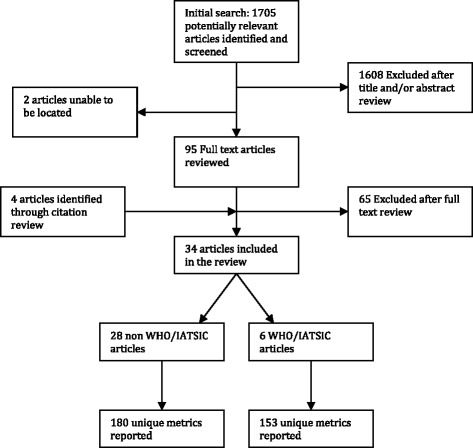
A total of 1705 articles were screened, 95 received full text review, and 34 met inclusion criteria. One hundred eighty unique metrics were identified, predominantly process (57 %) and structure measures (27 %); 16 % of metrics were related to outcomes. Most metrics evaluated the effectiveness (52 %) and timeliness (28 %) of care, with few addressing the patient centeredness (11 %), safety (4 %), resource-efficiency (3 %), or equitability (1 %) of care.
The published quality metrics in emergency care in resource-limited settings primarily focus on the effectiveness and timeliness of care. As global emergency care is built and strengthened, outcome-based measures and those focused on the safety, efficiency, and equitability of care need to be developed and studied to improve quality of care and resource utilization.
随着全球急诊护理的发展,需要实用且有效的绩效指标来确保高质量护理。我们的目标是系统地编目和分类用于衡量资源有限环境下急诊护理质量的指标。
我们使用标准化术语检索了MEDLINE、Embase、CINAHL和灰色文献。还对纳入文章的参考文献进行了审查。两名研究人员筛选标题和摘要以确定相关性;然后由三名研究人员审查全文。使用结构化数据提取工具将指标识别并分类到医学研究所(IOM)的六个质量领域(安全、及时、高效、有效、公平、以患者为中心)之一以及唐纳贝迪安的结构/过程/结果类别中的三个类别之一。第四名专家评审员在不知道初始分类的情况下对所有指标进行重新分类,加权kappa值为0.89。
共筛选了1705篇文章,95篇接受全文审查,34篇符合纳入标准。确定了180个独特的指标,主要是过程指标(57%)和结构指标(27%);16%的指标与结果相关。大多数指标评估了护理的有效性(52%)和及时性(28%),很少涉及护理的以患者为中心性(11%)、安全性(4%)、资源效率(3%)或公平性(1%)。
资源有限环境下已发表的急诊护理质量指标主要关注护理的有效性和及时性。随着全球急诊护理的建立和加强,需要制定和研究基于结果的指标以及关注护理安全性、效率和公平性的指标,以提高护理质量和资源利用。