DTU Management Engineering, Technical University of Denmark, Produktionstorvet, building 424, 2800, Kongens Lyngby, Denmark.
Scand J Trauma Resusc Emerg Med. 2013 Aug 9;21:62. doi: 10.1186/1757-7241-21-62.
Evaluation of emergency department (ED) performance remains a difficult task due to the lack of consensus on performance measures that reflects high quality, efficiency, and sustainability.
To describe, map, and critically evaluate which performance measures that the published literature regard as being most relevant in assessing overall ED performance.
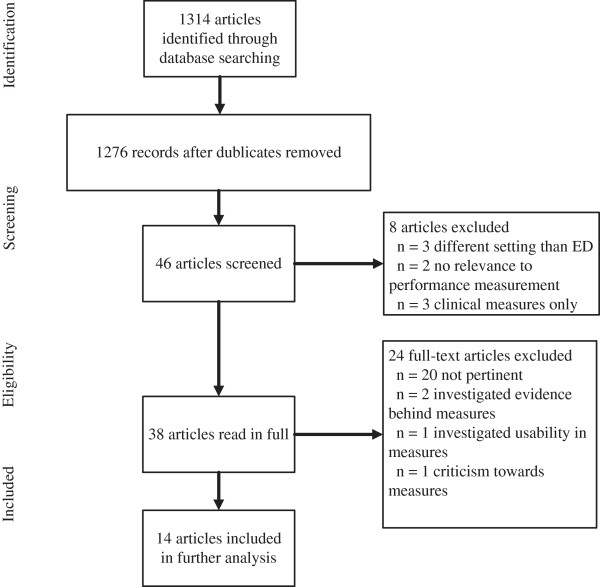
Following the PRISMA guidelines, a systematic literature review of review articles reporting accentuated ED performance measures was conducted in the databases of PubMed, Cochrane Library, and Web of Science. Study eligibility criteria includes: 1) the main purpose was to discuss, analyse, or promote performance measures best reflecting ED performance, 2) the article was a review article, and 3) the article reported macro-level performance measures, thus reflecting an overall departmental performance level.
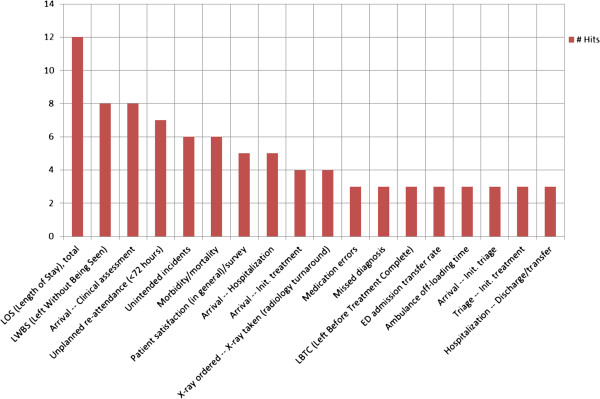
A number of articles addresses this study's objective (n = 14 of 46 unique hits). Time intervals and patient-related measures were dominant in the identified performance measures in review articles from US, UK, Sweden and Canada. Length of stay (LOS), time between patient arrival to initial clinical assessment, and time between patient arrivals to admission were highlighted by the majority of articles. Concurrently, "patients left without being seen" (LWBS), unplanned re-attendance within a maximum of 72 hours, mortality/morbidity, and number of unintended incidents were the most highlighted performance measures that related directly to the patient. Performance measures related to employees were only stated in two of the 14 included articles.
A total of 55 ED performance measures were identified. ED time intervals were the most recommended performance measures followed by patient centeredness and safety performance measures. ED employee related performance measures were rarely mentioned in the investigated literature. The study's results allow for advancement towards improved performance measurement and standardised assessment across EDs.
由于缺乏反映高质量、高效率和可持续性的绩效衡量标准,评估急诊科(ED)的绩效仍然是一项艰巨的任务。
描述、映射和批判性评估发表的文献中认为最能评估整体 ED 绩效的绩效衡量标准。
根据 PRISMA 指南,对报告强调 ED 绩效衡量标准的综述文章进行了系统的文献回顾,检索了 PubMed、Cochrane 图书馆和 Web of Science 数据库。研究纳入标准包括:1)主要目的是讨论、分析或促进最佳反映 ED 绩效的绩效衡量标准,2)文章为综述文章,3)文章报告宏观层面的绩效衡量标准,从而反映部门整体绩效水平。
有一些文章符合本研究的目标(46 篇独特文章中有 14 篇)。在美国、英国、瑞典和加拿大的综述文章中,时间间隔和患者相关的衡量标准占主导地位。停留时间(LOS)、患者到达初始临床评估之间的时间以及患者到达之间的时间是大多数文章强调的重点。同时,“患者未接受治疗就离开”(LWBS)、在最长 72 小时内无计划再次就诊、死亡率/发病率以及意外事件的数量是与患者直接相关的最突出的绩效衡量标准。与员工相关的绩效衡量标准仅在 14 篇纳入文章中的 2 篇中提到。
总共确定了 55 项 ED 绩效衡量标准。ED 时间间隔是最推荐的绩效衡量标准,其次是患者为中心和安全绩效衡量标准。ED 员工相关的绩效衡量标准在调查文献中很少提及。该研究的结果为改进 ED 之间的绩效衡量和标准化评估提供了依据。