Yoon Hai-Jeon, Kim Han-Na, Yun Yeojun, Kim Yemi, Ha Ae-Na, Kim Hyung-Lae, Kim Bom Sahn
Department of Nuclear Medicine, Ewha Womans University, School of Medicine, Seoul, Republic of Korea.
Department of Biochemistry, Ewha Womans University, School of Medicine, Seoul, Republic of Korea.
PLoS One. 2015 Nov 2;10(11):e0141473. doi: 10.1371/journal.pone.0141473. eCollection 2015.
This study investigated the relationships between background intestinal uptake on 18F-FDG PET and cardio-metabolic risk (CMR) factors.
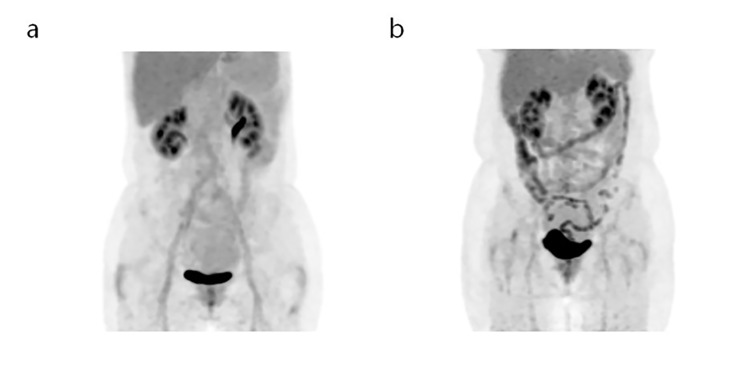
A total of 326 female patients that underwent 18F-FDG PET to determine the initial stage of breast cancer were enrolled. None of the patients had history of diabetes or hypertension. The background intestinal uptake on PET was visually graded (low vs. high uptake group) and quantitatively measured using the maximal standardized uptake value (SUVmax). SUVmax of 7 bowel segments (duodenum, jejunum, ileum, cecum, hepatic flexure, splenic flexure, and descending colon-sigmoid junction) were averaged for the total bowel (TB SUVmax). Age, body mass index (BMI), fasting blood glucose level (BST), triglyceride (TG), cholesterol, high density lipoprotein (HDL), and low density lipoprotein (LDL) were the considered CMR factors. The relationships between background intestinal 18F-FDG uptake on PET and diverse CMR factors were analyzed.
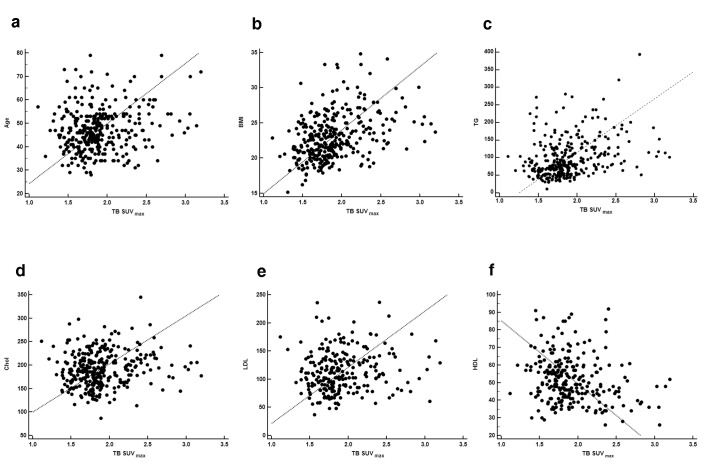
The visual grades based on background intestinal 18F-FDG uptake classified 100 (30.7%) patients into the low uptake group, while 226 (69.3%) were classified into the high uptake group. Among CMR factors, age (p = 0.004), BMI (p<0.001), and TG (p<0.001) were significantly different according to visual grade of background intestinal 18F-FDG uptake. Quantitative TB SUVmax showed significant positive correlation with age (r = 0.203, p<0.001), BMI (r = 0.373, p<0.001), TG (r = 0.338, p<0.001), cholesterol (r = 0.148, p = 0.008), and LDL (r = 0.143, p = 0.024) and significant negative correlation with HDL (r = -0.147, p = 0.022). Multivariate analysis indicated that BMI and TG were independent factors in both visually graded background intestinal 18F-FDG uptake (p = 0.027 and p = 0.023, respectively) and quantitatively measured TB SUVmax (p = 0.006 and p = 0.004, respectively).
Increased background intestinal 18F-FDG uptake on PET may suggest alteration of lipid metabolism and risk of cardio-metabolic disease in non-diabetic and non-hypertensive breast cancer patients.
本研究调查了18F-FDG PET上的肠道本底摄取与心脏代谢风险(CMR)因素之间的关系。
共纳入326例接受18F-FDG PET检查以确定乳腺癌初始阶段的女性患者。所有患者均无糖尿病或高血压病史。PET上的肠道本底摄取通过视觉分级(低摄取组与高摄取组),并使用最大标准化摄取值(SUVmax)进行定量测量。计算7个肠段(十二指肠、空肠、回肠、盲肠、肝曲、脾曲和降结肠-乙状结肠交界处)的SUVmax平均值作为全肠(TB SUVmax)。年龄、体重指数(BMI)、空腹血糖水平(BST)、甘油三酯(TG)、胆固醇、高密度脂蛋白(HDL)和低密度脂蛋白(LDL)被视为CMR因素。分析PET上肠道18F-FDG本底摄取与各种CMR因素之间的关系。
根据肠道18F-FDG本底摄取的视觉分级,100例(30.7%)患者被分类为低摄取组,226例(69.3%)被分类为高摄取组。在CMR因素中,根据肠道18F-FDG摄取的视觉分级,年龄(p = 0.004)、BMI(p<0.001)和TG(p<0.001)存在显著差异。定量的TB SUVmax与年龄(r = 0.203,p<0.001)、BMI(r = 0.373,p<0.001)、TG(r = 0.338,p<0.001)、胆固醇(r = 0.148,p = 0.008)和LDL(r = 0.143,p = 0.024)呈显著正相关,与HDL(r = -0.147,p = 0.022)呈显著负相关。多变量分析表明,BMI和TG在视觉分级的肠道18F-FDG摄取(分别为p = 0.027和p = 0.023)和定量测量的TB SUVmax(分别为p = 0.006和p = 0.004)中均为独立因素。
PET上肠道18F-FDG本底摄取增加可能提示非糖尿病和非高血压乳腺癌患者脂质代谢改变及心脏代谢疾病风险增加。