Fuchs Manuela, Geiger Madeleine, Stange Madlen, Sánchez-Villagra Marcelo R
Palaeontological Institute and Museum, University of Zurich, Karl-Schmid-Strasse 4, Zürich, 8006, Switzerland.
BMC Evol Biol. 2015 Nov 2;15:239. doi: 10.1186/s12862-015-0521-z.
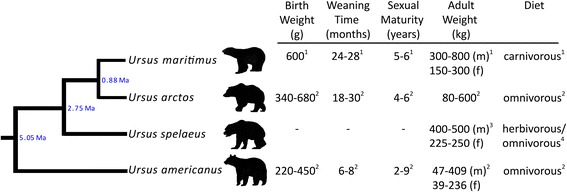
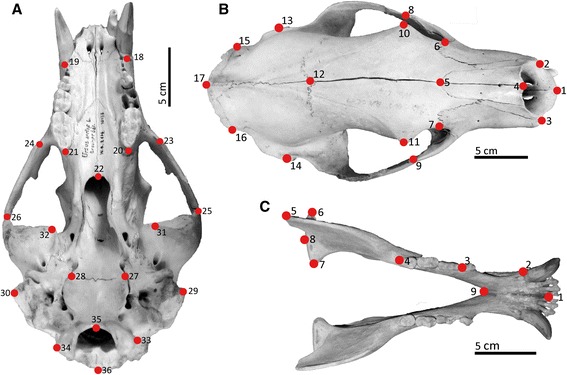
The study of postnatal ontogeny can provide insights into evolution by offering an understanding of how growth trajectories have evolved resulting in adult morphological disparity. The Ursus lineage is a good subject for studying cranial and mandibular shape and size variation in relation to postnatal ontogeny and phylogeny because it is at the same time not diverse but the species exhibit different feeding ecologies. Cranial and mandibular shapes of Ursus arctos (brown bear), U. maritimus (polar bear), U. americanus (American black bear), and the extinct U. spelaeus (cave bear) were examined, using a three-dimensional geometric morphometric approach. Additionally, ontogenetic series of crania and mandibles of U. arctos and U. spelaeus ranging from newborns to senile age were sampled.
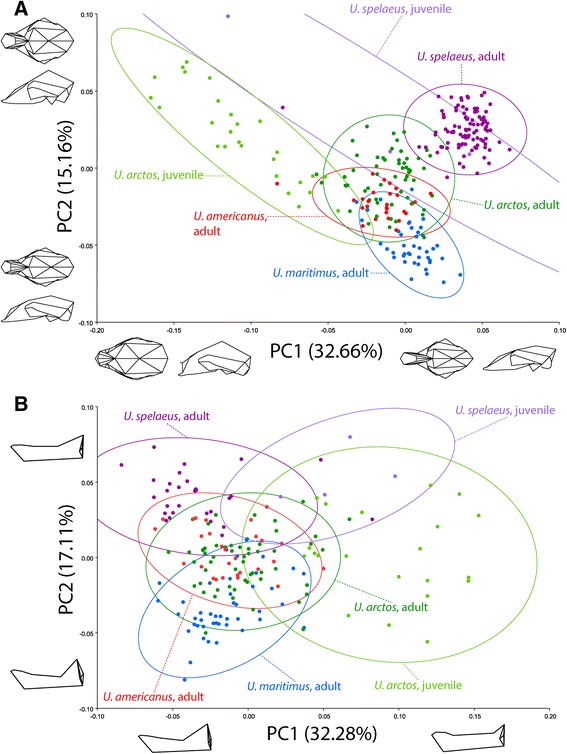
The distribution of specimens in morphospace allowed to distinguish species and age classes and the ontogenetic trajectories U. arctos and U. spelaeus were found to be more similar than expected by chance. Cranial shape changes during ontogeny are largely size related whereas the evolution of cranial shape disparity in this clade appears to be more influenced by dietary adaptation than by size and phylogeny. The different feeding ecologies are reflected in different cranial and mandibular shapes among species.
The cranial and mandibular shape disparity in the Ursus lineage appears to be more influenced by adaptation to diet than by size or phylogeny. In contrast, the cranial and mandibular shape changes during postnatal ontogeny in U. arctos and U. spelaeus are probably largely size related. The patterns of morphospace occupation of the cranium and the mandible in adults and through ontogeny are different.
产后个体发育的研究可以通过提供对生长轨迹如何演变从而导致成体形态差异的理解,为进化研究提供见解。熊类谱系是研究颅骨和下颌骨形状及大小与产后个体发育和系统发育关系的良好对象,因为它虽然种类不多,但不同物种具有不同的食性生态。本研究采用三维几何形态测量方法,对棕熊(Ursus arctos)、北极熊(U. maritimus)、美洲黑熊(U. americanus)和已灭绝的洞熊(U. spelaeus)的颅骨和下颌骨形状进行了研究。此外,还采集了棕熊和洞熊从新生儿到老年的颅骨和下颌骨个体发育系列样本。
形态空间中样本的分布能够区分物种和年龄组,并且发现棕熊和洞熊的个体发育轨迹比随机预期的更为相似。个体发育过程中颅骨形状的变化在很大程度上与大小有关,而该类群中颅骨形状差异的进化似乎更多地受饮食适应的影响,而非大小和系统发育。不同的食性生态反映在不同物种的颅骨和下颌骨形状上。
熊类谱系中颅骨和下颌骨形状差异似乎更多地受饮食适应的影响,而非大小或系统发育。相比之下,棕熊和洞熊产后个体发育过程中颅骨和下颌骨形状的变化可能在很大程度上与大小有关。成体以及个体发育过程中颅骨和下颌骨在形态空间中的占据模式是不同的。