Marler Sarah, Ferguson Bradley J, Lee Evon Batey, Peters Brittany, Williams Kent C, McDonnell Erin, Macklin Eric A, Levitt Pat, Gillespie Catherine Hagan, Anderson George M, Margolis Kara Gross, Beversdorf David Q, Veenstra-VanderWeele Jeremy
Department of Psychiatry, Vanderbilt University, Nashville, TN, USA.
Interdisciplinary Neuroscience Program, The Thompson Center for Autism and Neurodevelopmental Disorders, University of Missouri, Columbia, MO, USA.
J Autism Dev Disord. 2016 Mar;46(3):1124-30. doi: 10.1007/s10803-015-2646-8.
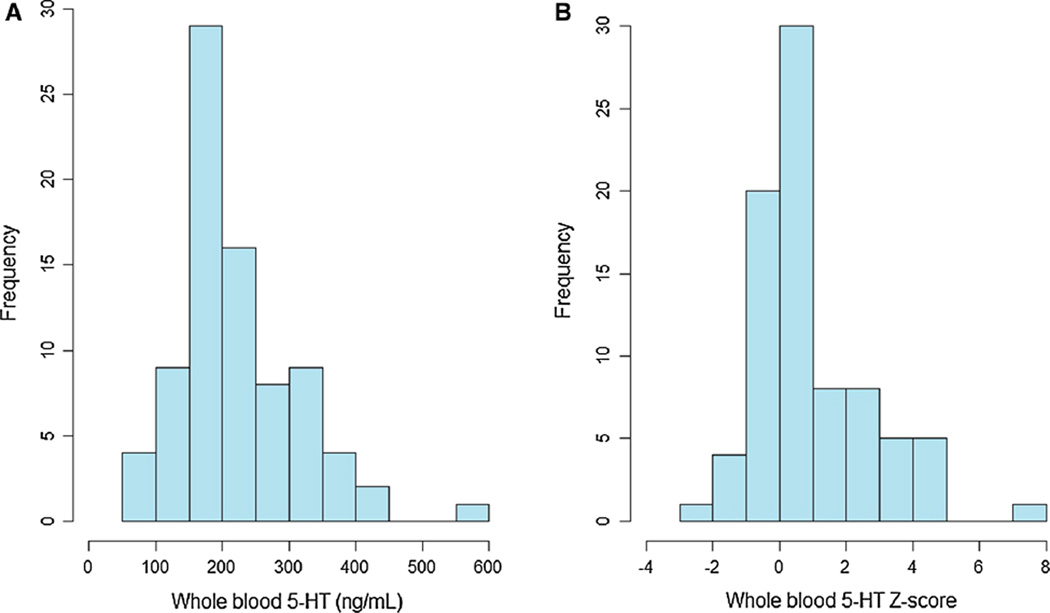
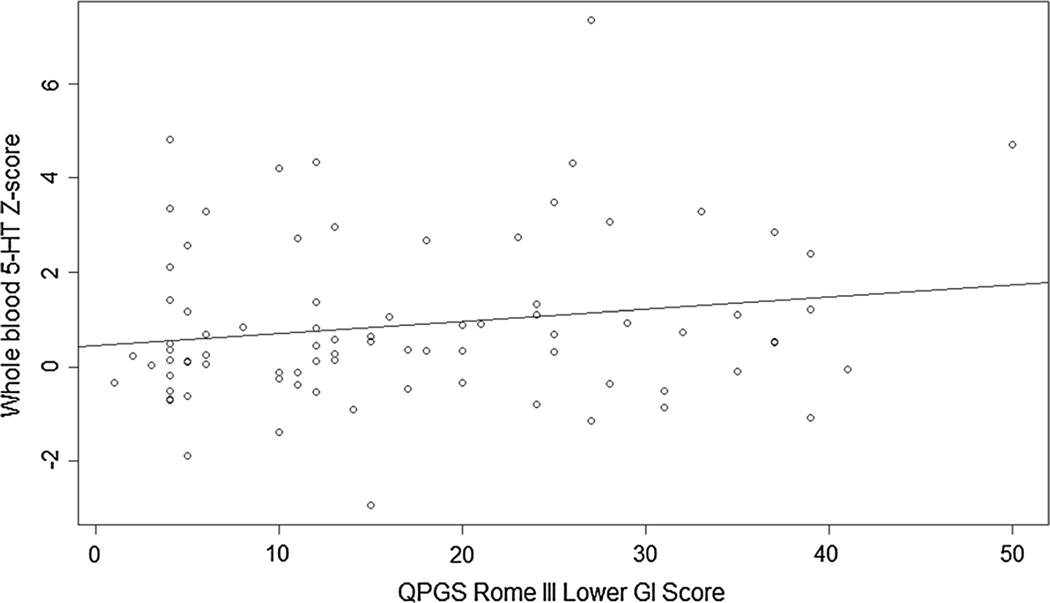
Elevated whole blood serotonin levels are observed in more than 25% of children with autism spectrum disorder (ASD). Co-occurring gastrointestinal (GI) symptoms are also common in ASD but have not previously been examined in relationship with hyperserotonemia, despite the synthesis of serotonin in the gut. In 82 children and adolescents with ASD, we observed a correlation between a quantitative measure of lower GI symptoms and whole blood serotonin levels. No significant association was seen between functional constipation diagnosis and serotonin levels in the hyperserotonemia range, suggesting that this correlation is not driven by a single subgroup. More specific assessment of gut function, including the microbiome, will be necessary to evaluate the contribution of gut physiology to serotonin levels in ASD.
在超过25%的自闭症谱系障碍(ASD)儿童中观察到全血血清素水平升高。同时出现的胃肠道(GI)症状在ASD中也很常见,但尽管血清素在肠道中合成,此前尚未对其与高血清素血症的关系进行研究。在82名患有ASD的儿童和青少年中,我们观察到下消化道症状的定量测量与全血血清素水平之间存在相关性。在高血清素血症范围内,功能性便秘诊断与血清素水平之间未发现显著关联,这表明这种相关性不是由单一亚组驱动的。需要对肠道功能进行更具体的评估,包括微生物群,以评估肠道生理对ASD患者血清素水平的影响。