Satirapoj Bancha, Jirawatsiwaporn Ketkan, Tangwonglert Theerasak, Choovichian Panbubpa
Division of Nephrology, Department of Medicine, Phramongkutklao Hospital and College of Medicine, Bangkok, Thailand.
Int J Nephrol Renovasc Dis. 2015 Oct 21;8:145-50. doi: 10.2147/IJNRD.S93866. eCollection 2015.
Glomerular filtration rate (GFR) is considered the indicator of overall kidney function, and therefore, its assessment has become an important clinical tool in the daily care of chronic glomerulonephritis (CGN) patients. Currently, practical guidelines recommend using Chronic Kidney Disease Epidemiology Collaboration (CKD-EPI) equations to assess GFR in CKD patients.
A cross-sectional study was performed in CGN patients. Standard GFR was measured using 24-hour urine creatinine clearance. GFR was estimated using the Cockcroft-Gault, Modification of Diet in Renal Disease, CKD-EPI equation based creatinine, cystatin C, and combined creatinine and cystatin C. The performance of GFR estimation equations were examined using bias, precision and accuracy and agreement between standard GFR and estimated GFR by calculating Cohen's k.
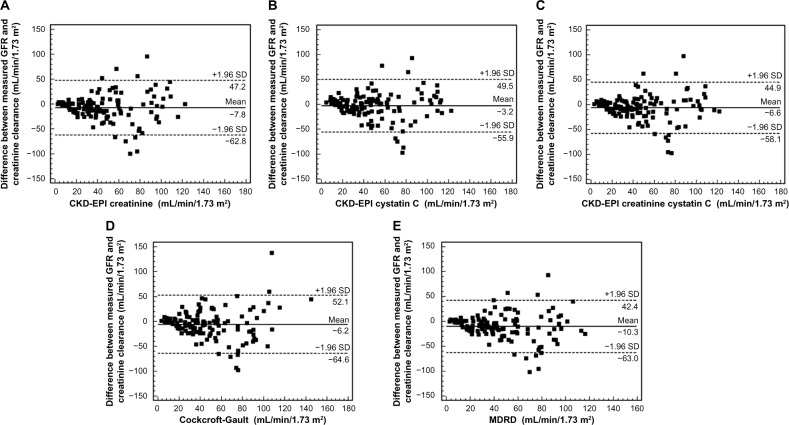
A total of 125 patients (74 male, 59.2%) with mean age 56.1±18.1 years were included. Mean standard GFR was 51.6±32.2 mL/min per 1.73 m(2). A significant correlation was found between standard GFR and all estimated GFRs (r=0.573 to 0.660, P<0.001). CKD-EPI-creatinine-cystatin C equation had the smallest absolute bias and the significantly highest accuracy, although it was not significantly different from CKD-EPI-cystatin C equation (P=0.523). CKD-EPI-creatinine-cystatin C equation had the highest accuracy to classify CKD staging (Cohen's k=0.345), but it underestimated GFR in 32% and overestimated GFR in 18% of the CGN patients.
CKD-EPI-creatinine-cystatin C equation estimated GFR with little bias, and the highest accuracy among CGN patients. This equation gave a better estimate of GFR than the equation based on serum creatinine.
肾小球滤过率(GFR)被视为整体肾功能的指标,因此,其评估已成为慢性肾小球肾炎(CGN)患者日常护理中的一项重要临床工具。目前,实用指南推荐使用慢性肾脏病流行病学协作组(CKD-EPI)方程来评估CKD患者的GFR。
对CGN患者进行了一项横断面研究。使用24小时尿肌酐清除率测量标准GFR。使用Cockcroft-Gault方程、肾脏病饮食改良方程、基于肌酐、胱抑素C以及肌酐与胱抑素C联合的CKD-EPI方程来估算GFR。通过计算偏差、精密度和准确性以及标准GFR与估算GFR之间的一致性(使用Cohen's k)来检验GFR估算方程的性能。
共纳入125例患者(74例男性,占59.2%),平均年龄56.1±18.1岁。平均标准GFR为51.6±32.2 mL/min/1.73 m²。在标准GFR与所有估算的GFR之间发现了显著相关性(r = 0.573至0.660,P < 0.001)。CKD-EPI-肌酐-胱抑素C方程的绝对偏差最小且准确性显著最高,尽管与CKD-EPI-胱抑素C方程无显著差异(P = 0.523)。CKD-EPI-肌酐-胱抑素C方程在对CKD分期进行分类时准确性最高(Cohen's k = 0.345),但在32%的CGN患者中低估了GFR,在18%的患者中高估了GFR。
CKD-EPI-肌酐-胱抑素C方程估算GFR时偏差较小,在CGN患者中准确性最高。该方程对GFR的估算比基于血清肌酐计算的方程更好。