Wen Chang Qing, Zou Jia, Li Jia Xuan, Wang Fu Jiang, Ge Hai Tao
School of Basic Medicine and Clinical Pharmacy, China Pharmaceutical University, Nanjing, Jiangsu, China.
Jiangsu Suzhong Pharmaceutical R&D Institute Co., Ltd., Nanjing, Jiangsu, China.
Front Pharmacol. 2025 Apr 28;16:1560420. doi: 10.3389/fphar.2025.1560420. eCollection 2025.
Chronic glomerulonephritis (CGN) is a common glomerular disease with multifactorial pathogenesis. Huangkui capsule (HKC), a traditional Chinese herbal formulation, demonstrates therapeutic potential in CGN; however, its molecular mechanisms remain insufficiently characterized. This study aimed to clarify the therapeutic mechanisms of HKC in CGN by integrating proteomic analysis with network pharmacology.
We employed liquid chromatography-mass spectrometry (LC-MS) to identify the active components of HKC. A CGN rat model was established and treated with HKC. Renal function parameters and serum inflammatory cytokines were assessed. Histopathological alterations and IgG deposition in kidney tissues were examined using hematoxylin-eosin (HE) staining and immunofluorescence, respectively. Proteomic profiling of renal tissue was conducted, and network pharmacology analysis was applied to identify potential therapeutic targets of HKC.
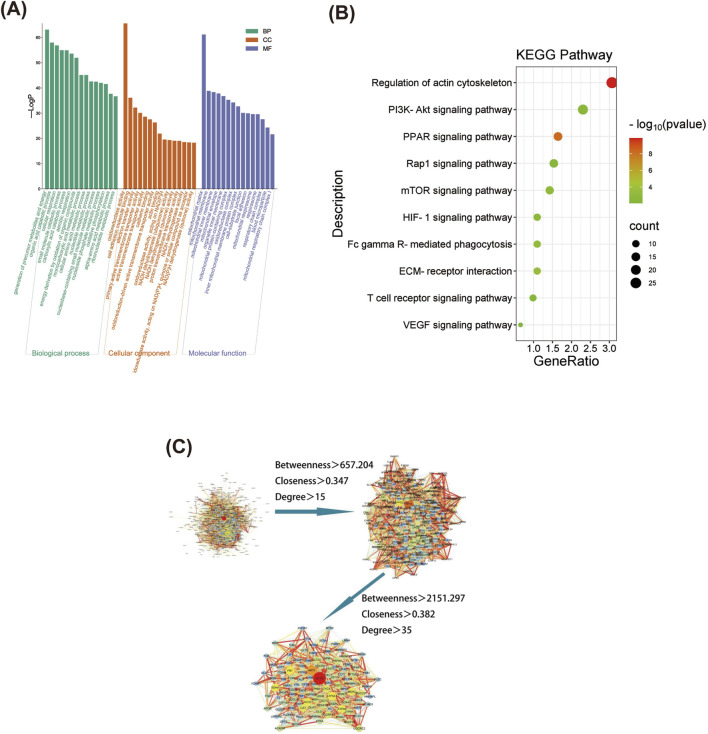
A total of 39 active compounds were identified in HKC. HKC administration significantly improved renal function and mitigated glomerular injury in CGN rats. Proteomic analysis revealed 2,079 differentially expressed proteins, predominantly associated with oxidoreductase activity. Network pharmacology identified 462 targets related to HKC and 1,835 targets associated with CGN, with 13 overlapping targets, including STAT3, PIK3R1, AKT1, HIF-1α, and VEGF, which were downregulated following HKC treatment.
HKC exerts renoprotective effects in CGN by regulating multiple signaling pathways, notably HIF-1, VEGF, PI3K-Akt, MAPK, and PPAR. Through attenuation of inflammatory and oxidative responses, HKC alleviates renal pathological damage and supports kidney function, offering mechanistic insight into its multi-target therapeutic potential.
慢性肾小球肾炎(CGN)是一种常见的肾小球疾病,其发病机制具有多因素性。黄葵胶囊(HKC)是一种传统中药制剂,在CGN中显示出治疗潜力;然而,其分子机制仍未得到充分阐明。本研究旨在通过蛋白质组学分析与网络药理学相结合,阐明HKC在CGN中的治疗机制。
我们采用液相色谱-质谱联用(LC-MS)来鉴定HKC的活性成分。建立CGN大鼠模型并用HKC进行治疗。评估肾功能参数和血清炎症细胞因子。分别使用苏木精-伊红(HE)染色和免疫荧光检查肾组织的组织病理学改变和IgG沉积。进行肾组织的蛋白质组学分析,并应用网络药理学分析来确定HKC的潜在治疗靶点。
在HKC中总共鉴定出39种活性化合物。给予HKC可显著改善CGN大鼠的肾功能并减轻肾小球损伤。蛋白质组学分析揭示了2079种差异表达蛋白,主要与氧化还原酶活性相关。网络药理学确定了462个与HKC相关的靶点和1835个与CGN相关的靶点,其中有13个重叠靶点,包括STAT3、PIK3R1、AKT1、HIF-1α和VEGF,在HKC治疗后这些靶点表达下调。
HKC通过调节多种信号通路,特别是HIF-1、VEGF、PI3K-Akt、MAPK和PPAR,在CGN中发挥肾脏保护作用。通过减轻炎症和氧化反应,HKC减轻肾脏病理损伤并维持肾功能,为其多靶点治疗潜力提供了机制性见解。