Fujiwara Takeo, Mizuki Rie, Miki Takahiro, Chemtob Claude
Department of Social Medicine, National Research Institute for Child Health and Development Tokyo, Japan ; Department of Developmental Social Medicine, Mie University Graduate School/Faculty of Medicine Tsu, Japan.
Department of Social Medicine, National Research Institute for Child Health and Development Tokyo, Japan ; Department of Psychosocial Medicine, Hospital of the National Center for Child Health and Development, National Research Institute for Child Health and Development Tokyo, Japan.
Front Psychol. 2015 Oct 13;6:1534. doi: 10.3389/fpsyg.2015.01534. eCollection 2015.
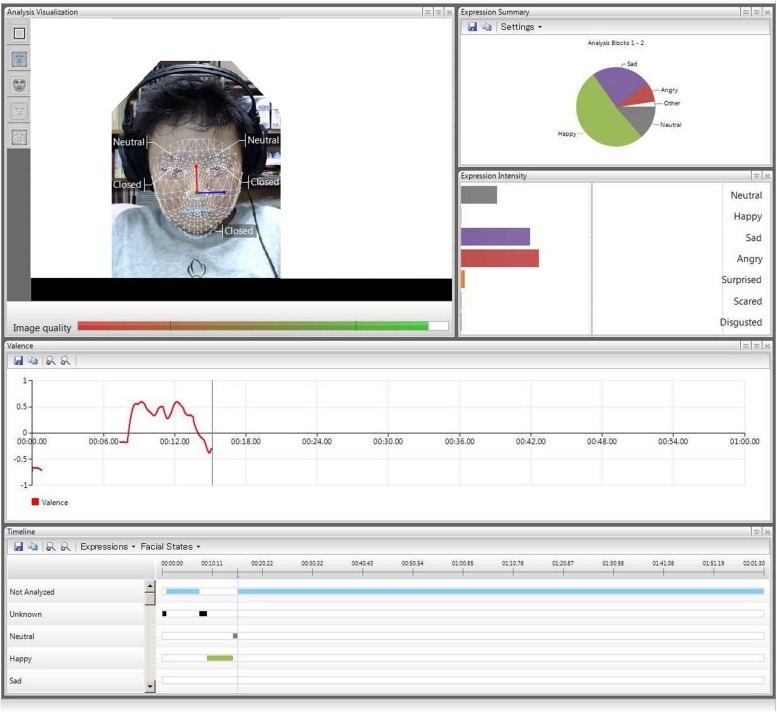
"Emotional numbing" is a symptom of post-traumatic stress disorder (PTSD) characterized by a loss of interest in usually enjoyable activities, feeling detached from others, and an inability to express a full range of emotions. Emotional numbing is usually assessed through self-report, and is particularly difficult to ascertain among young children. We conducted a pilot study to explore the use of facial expression ratings in response to a comedy video clip to assess emotional reactivity among preschool children directly exposed to the Great East Japan Earthquake. This study included 23 child participants. Child PTSD symptoms were measured using a modified version of the Parent's Report of the Child's Reaction to Stress scale. Children were filmed while watching a 2-min video compilation of natural scenes ('baseline video') followed by a 2-min video clip from a television comedy ('comedy video'). Children's facial expressions were processed the using Noldus FaceReader software, which implements the Facial Action Coding System (FACS). We investigated the association between PTSD symptom scores and facial emotion reactivity using linear regression analysis. Children with higher PTSD symptom scores showed a significantly greater proportion of neutral facial expressions, controlling for sex, age, and baseline facial expression (p < 0.05). This pilot study suggests that facial emotion reactivity, measured using facial expression recognition software, has the potential to index emotional numbing in young children. This pilot study adds to the emerging literature on using experimental psychopathology methods to characterize children's reactions to disasters.
“情感麻木”是创伤后应激障碍(PTSD)的一种症状,其特征为对通常令人愉悦的活动失去兴趣、感觉与他人疏远,以及无法表达丰富的情感。情感麻木通常通过自我报告进行评估,在幼儿中尤其难以确定。我们开展了一项试点研究,以探索使用对面部表情的评分来评估直接经历东日本大地震的学龄前儿童对喜剧视频片段的情感反应,从而评估情感麻木情况。该研究纳入了23名儿童参与者。使用儿童对压力反应的家长报告量表的修订版来测量儿童PTSD症状。在儿童观看一段2分钟的自然场景视频剪辑(“基线视频”),随后观看一段来自电视喜剧的2分钟视频片段(“喜剧视频”)时对他们进行拍摄。使用实施面部动作编码系统(FACS)的Noldus FaceReader软件处理儿童的面部表情。我们使用线性回归分析研究PTSD症状评分与面部情绪反应之间的关联。在控制了性别、年龄和基线面部表情后,PTSD症状评分较高的儿童表现出显著更高比例的中性面部表情(p < 0.05)。这项试点研究表明,使用面部表情识别软件测量的面部情绪反应有可能作为幼儿情感麻木的指标。这项试点研究为使用实验性精神病理学方法来描述儿童对灾难的反应这一新兴文献增添了内容。