Life Sciences Division, Lawrence Berkeley National Laboratories Berkeley, CA, USA ; Palo Alto Research Center (a Xerox Company) Palo Alto, CA, USA.
Departments of Oncology/Biochemistry/Surgery, Western Schulich School of Medicine, London Regional Cancer Program, Western University London, ON, Canada.
Front Cell Dev Biol. 2015 Oct 15;3:63. doi: 10.3389/fcell.2015.00063. eCollection 2015.
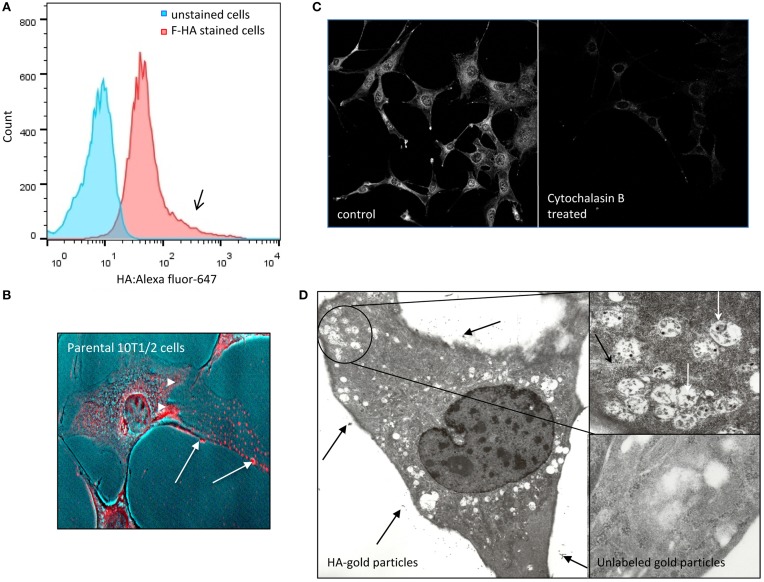
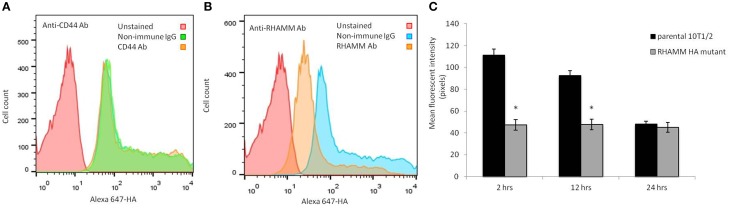
The interaction of hyaluronan (HA) with mesenchymal progenitor cells impacts trafficking and fate after tissue colonization during wound repair and these events contribute to diseases such as cancer. How this interaction occurs is poorly understood. Using 10T½ cells as a mesenchymal progenitor model and fluorescent (F-HA) or gold-labeled HA (G-HA) polymers, we studied the role of two HA receptors, RHAMM and CD44, in HA binding and uptake in non-adherent and adherent mesenchymal progenitor (10T½) cells to mimic aspects of cell trafficking and tissue colonization. We show that fluorescent labeled HA (F-HA) binding/uptake was high in non-adherent cells but dropped over time as cells became increasingly adherent. Non-adherent cells displayed both CD44 and RHAMM but only function-blocking anti-RHAMM and not anti-CD44 antibodies significantly reduced F-HA binding/uptake. Adherent cells, which also expressed CD44 and RHAMM, primarily utilized CD44 to bind to F-HA since anti-CD44 but not anti-RHAMM antibodies blocked F-HA uptake. RHAMM overexpression in adherent 10T½ cells led to increased F-HA uptake but this increased binding remained CD44 dependent. Further studies showed that RHAMM-transfection increased CD44 mRNA and protein expression while blocking RHAMM function reduced expression. Collectively, these results suggest that cellular microenvironments in which these receptors function as HA binding proteins differ significantly, and that RHAMM plays at least two roles in F-HA binding by acting as an HA receptor in non-attached cells and by regulating CD44 expression and display in attached cells. Our findings demonstrate adhesion-dependent mechanisms governing HA binding/ uptake that may impact development of new mesenchymal cell-based therapies.
透明质酸(HA)与间充质祖细胞的相互作用影响创伤修复过程中组织定殖后的迁移和命运,这些事件导致癌症等疾病的发生。这种相互作用是如何发生的还不太清楚。我们使用 10T½ 细胞作为间充质祖细胞模型,使用荧光(F-HA)或金标记的 HA(G-HA)聚合物,研究了两种 HA 受体 RHAMM 和 CD44 在非贴壁和贴壁间充质祖细胞(10T½)中结合和摄取 HA 的作用,以模拟细胞迁移和组织定殖的某些方面。我们发现,在非贴壁细胞中,荧光标记的 HA(F-HA)结合/摄取量很高,但随着细胞越来越贴壁,其结合/摄取量随时间下降。非贴壁细胞均表达 CD44 和 RHAMM,但只有功能阻断抗 RHAMM 而不是抗 CD44 抗体显著减少 F-HA 结合/摄取。表达 CD44 和 RHAMM 的贴壁细胞主要通过 CD44 结合 F-HA,因为抗 CD44 但不是抗 RHAMM 抗体阻断了 F-HA 的摄取。在贴壁 10T½ 细胞中过表达 RHAMM 导致 F-HA 摄取增加,但这种增加的结合仍然依赖于 CD44。进一步的研究表明,RHAMM 转染增加了 CD44 mRNA 和蛋白表达,而阻断 RHAMM 功能则降低了表达。总之,这些结果表明,这些受体作为 HA 结合蛋白发挥作用的细胞微环境存在显著差异,RHAMM 在非附着细胞中作为 HA 受体,以及通过调节 CD44 表达和在附着细胞中显示,在 F-HA 结合中发挥至少两种作用。我们的研究结果表明,HA 结合/摄取的黏附依赖性机制可能会影响新的基于间充质细胞的治疗方法的发展。