Wettenschwiler Patrick D, Lorenzetti Silvio, Stämpfli Rolf, Rossi René M, Ferguson Stephen J, Annaheim Simon
Empa, Swiss Federal Laboratories for Materials Science and Technology, St. Gallen, Switzerland; Institute for Biomechanics, ETH Zurich, Zurich, Switzerland.
Institute for Biomechanics, ETH Zurich, Zurich, Switzerland.
PLoS One. 2015 Nov 3;10(11):e0142004. doi: 10.1371/journal.pone.0142004. eCollection 2015.
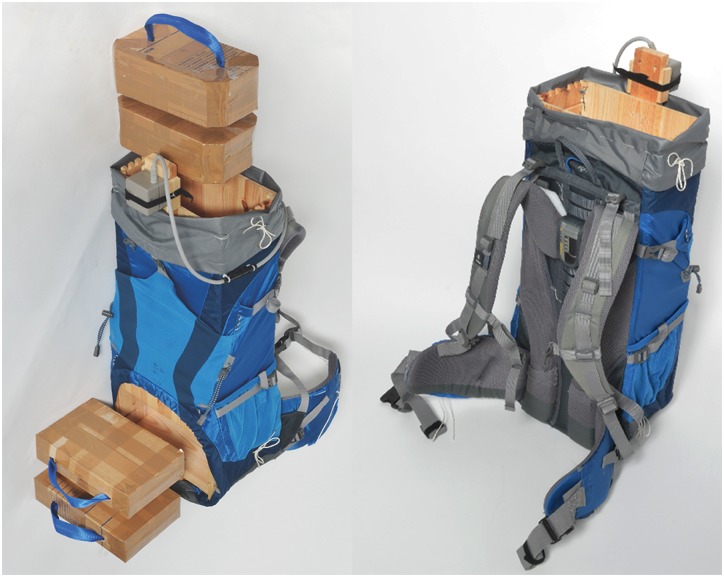
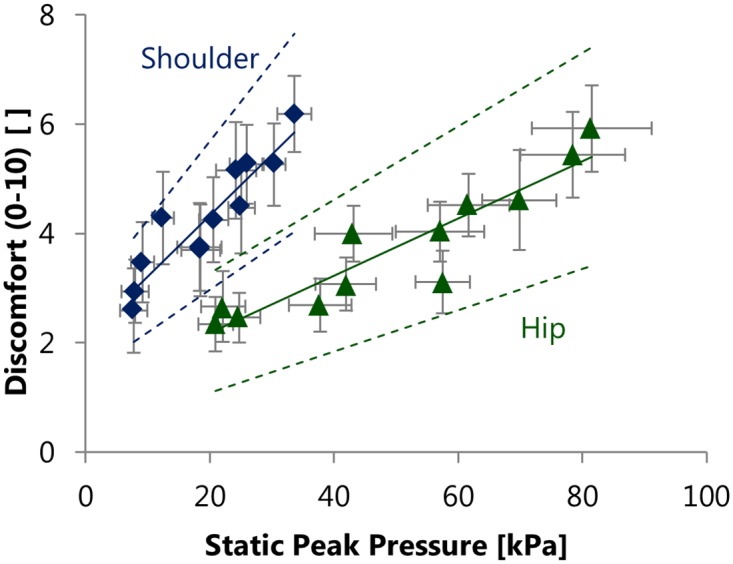
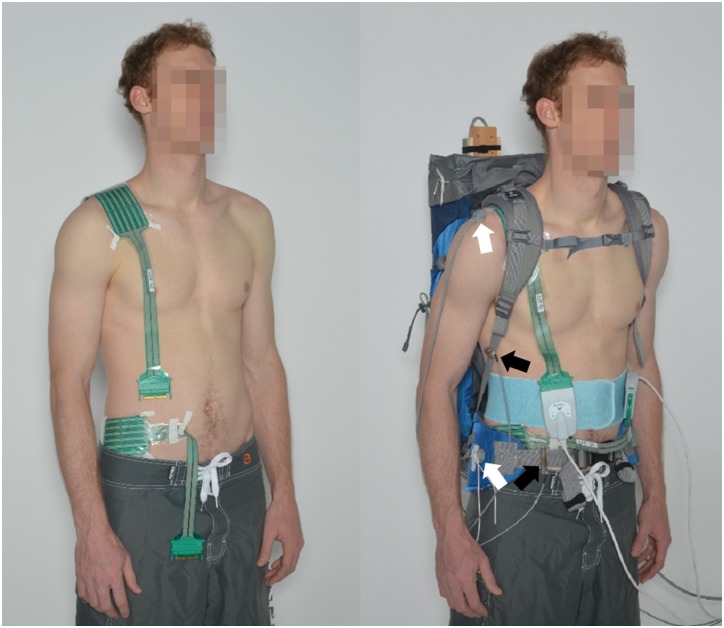
Discomfort during load carriage is a major issue for activities using backpacks (e.g. infantry maneuvers, children carrying school supplies, or outdoor sports). It is currently unclear which mechanical parameters are responsible for subjectively perceived discomfort. The aim of this study was to identify objectively measured mechanical predictors of discomfort during load carriage. We compared twelve different configurations of a typical load carriage system, a commercially available backpack with a hip belt. The pressure distribution under the hip belt and the shoulder strap, as well as the tensile force in the strap and the relative motion of the backpack were measured. Multiple linear regression analyses were conducted to investigate possible predictors of discomfort. The results demonstrate that static peak pressure, or alternatively, static strap force is a significant (p<0.001) predictor of discomfort during load carriage in the shoulder and hip region, accounting for 85% or more of the variation in discomfort. As an additional finding, we discovered that the regression coefficients of these predictors are significantly smaller for the hip than for the shoulder region. As static peak pressure is measured directly on the body, it is less dependent on the type of load carriage system than static strap force. Therefore, static peak pressure is well suited as a generally applicable, objective mechanical parameter for the optimization of load carriage system design. Alternatively, when limited to load carriage systems of the type backpack with hip belt, static strap force is the most valuable predictor of discomfort. The regionally differing regression coefficients of both predictors imply that the hip region is significantly more tolerant than the shoulder region. In order to minimize discomfort, users should be encouraged to shift load from the shoulders to the hip region wherever possible, at the same time likely decreasing the risk of low back pain or injury.
负重时的不适感是使用背包进行活动(如步兵演习、儿童携带学习用品或户外运动)的一个主要问题。目前尚不清楚哪些机械参数会导致主观感受到的不适。本研究的目的是确定负重时不适的客观测量机械预测指标。我们比较了一种典型负重系统的十二种不同配置,即一种带有腰带的市售背包。测量了腰带和肩带下方的压力分布、肩带中的拉力以及背包的相对运动。进行了多元线性回归分析以研究不适的可能预测指标。结果表明,静态峰值压力或者静态肩带力是肩部和髋部区域负重时不适的显著(p<0.001)预测指标,占不适变化的85%或更多。另外,我们发现这些预测指标的回归系数在髋部区域明显小于肩部区域。由于静态峰值压力是直接在身体上测量的,它比静态肩带力对负重系统类型的依赖性更小。因此,静态峰值压力非常适合作为优化负重系统设计的通用、客观机械参数。或者,当仅限于带有腰带的背包类型的负重系统时,静态肩带力是不适的最有价值预测指标。这两个预测指标在区域上不同的回归系数意味着髋部区域比肩部区域的耐受性明显更高。为了尽量减少不适,应鼓励使用者尽可能将负荷从肩部转移到髋部区域,同时可能降低腰痛或受伤的风险。