Vogel Markus, Kaisers Wolfgang, Wassmuth Ralf, Mayatepek Ertan
University Children's Hospital Düsseldorf, Department of General Pediatrics, Neonatology and Pediatric Cardiology, Heinrich-Heine-University, Düsseldorf, Germany.
J Med Internet Res. 2015 Nov 3;17(11):e247. doi: 10.2196/jmir.5072.
Clinical documentation has undergone a change due to the usage of electronic health records. The core element is to capture clinical findings and document therapy electronically. Health care personnel spend a significant portion of their time on the computer. Alternatives to self-typing, such as speech recognition, are currently believed to increase documentation efficiency and quality, as well as satisfaction of health professionals while accomplishing clinical documentation, but few studies in this area have been published to date.
This study describes the effects of using a Web-based medical speech recognition system for clinical documentation in a university hospital on (1) documentation speed, (2) document length, and (3) physician satisfaction.
Reports of 28 physicians were randomized to be created with (intervention) or without (control) the assistance of a Web-based system of medical automatic speech recognition (ASR) in the German language. The documentation was entered into a browser's text area and the time to complete the documentation including all necessary corrections, correction effort, number of characters, and mood of participant were stored in a database. The underlying time comprised text entering, text correction, and finalization of the documentation event. Participants self-assessed their moods on a scale of 1-3 (1=good, 2=moderate, 3=bad). Statistical analysis was done using permutation tests.
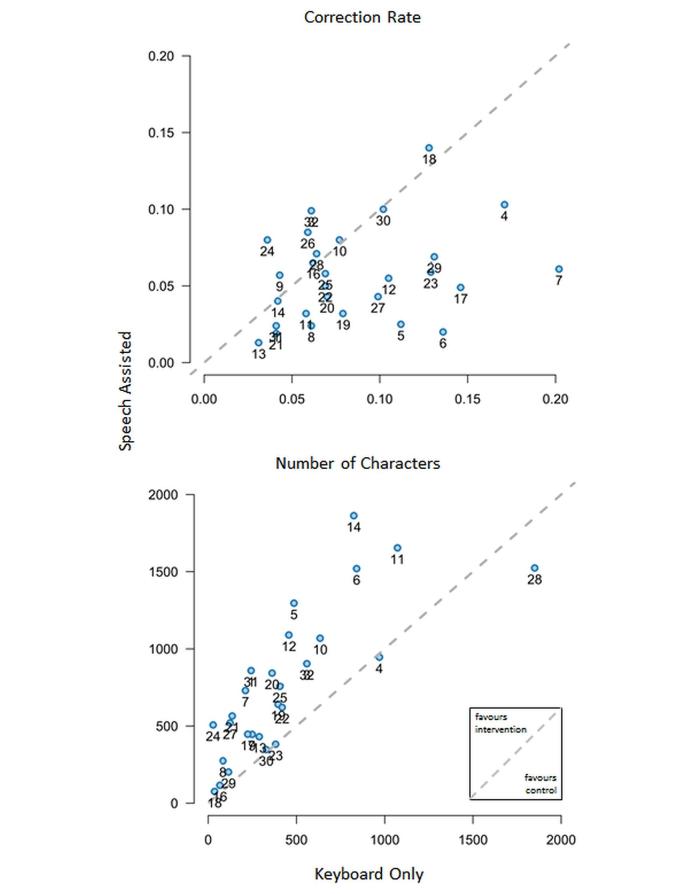
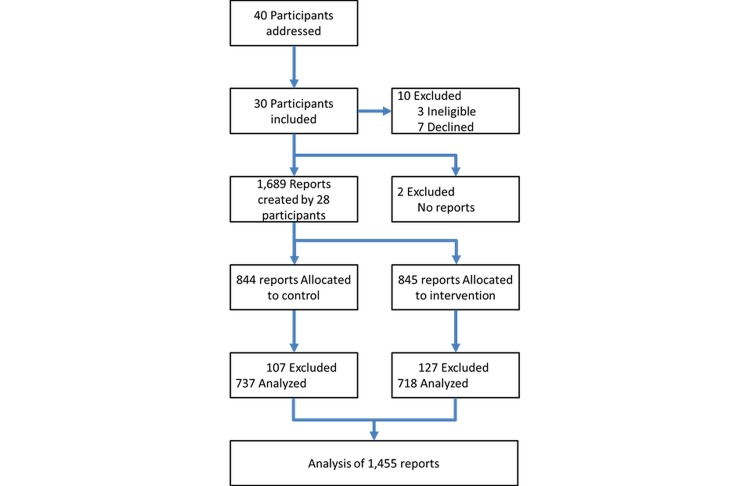
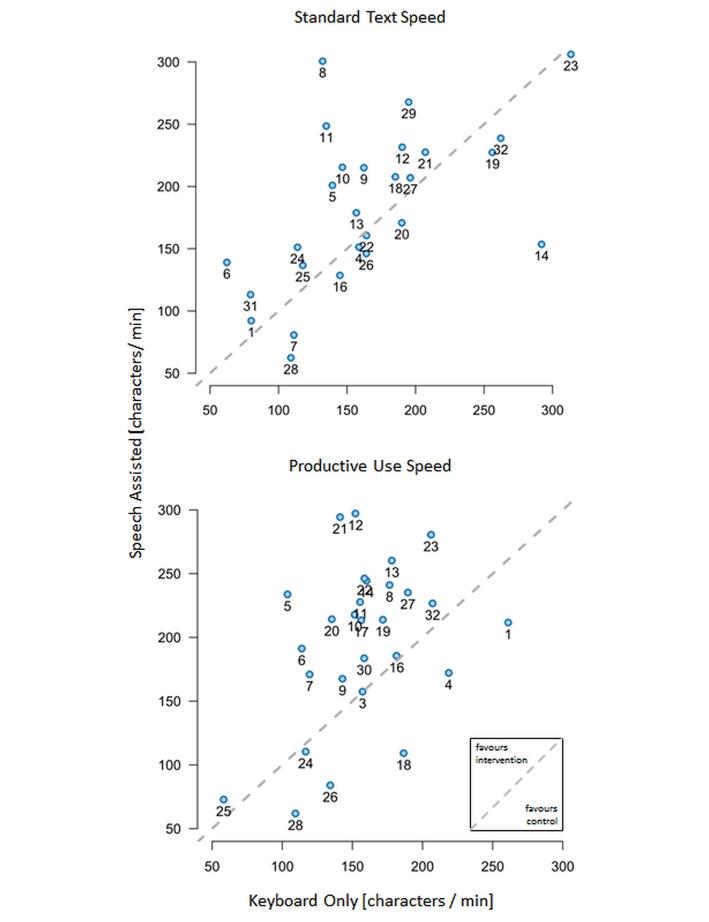
The number of clinical reports eligible for further analysis stood at 1455. Out of 1455 reports, 718 (49.35%) were assisted by ASR and 737 (50.65%) were not assisted by ASR. Average documentation speed without ASR was 173 (SD 101) characters per minute, while it was 217 (SD 120) characters per minute using ASR. The overall increase in documentation speed through Web-based ASR assistance was 26% (P=.04). Participants documented an average of 356 (SD 388) characters per report when not assisted by ASR and 649 (SD 561) characters per report when assisted by ASR. Participants' average mood rating was 1.3 (SD 0.6) using ASR assistance compared to 1.6 (SD 0.7) without ASR assistance (P<.001).
We conclude that medical documentation with the assistance of Web-based speech recognition leads to an increase in documentation speed, document length, and participant mood when compared to self-typing. Speech recognition is a meaningful and effective tool for the clinical documentation process.
由于电子健康记录的使用,临床文档发生了变化。其核心要素是电子化地记录临床发现并记录治疗情况。医护人员将大量时间花费在电脑上。目前认为,诸如语音识别等替代自行打字的方式,在完成临床文档记录时可提高记录效率和质量,以及医护人员的满意度,但迄今为止该领域发表的研究较少。
本研究描述了在大学医院使用基于网络的医学语音识别系统进行临床文档记录对(1)记录速度、(2)文档长度和(3)医生满意度的影响。
随机选取28位医生的报告,分别在有(干预组)或无(对照组)基于网络的德语医学自动语音识别(ASR)系统辅助的情况下生成。文档录入浏览器的文本区域,完成文档记录的时间(包括所有必要的修正)、修正工作量、字符数以及参与者的情绪被存储在数据库中。基础时间包括文本录入、文本修正以及文档记录事件的完成。参与者以1 - 3分的量表对自己的情绪进行自我评估(1 = 好,2 = 中等,3 = 差)。使用置换检验进行统计分析。
有1455份临床报告符合进一步分析的条件。在这1455份报告中,718份(49.35%)得到了ASR的辅助,737份(50.65%)未得到ASR的辅助。无ASR辅助时的平均记录速度为每分钟173(标准差101)个字符,而使用ASR时为每分钟217(标准差120)个字符。通过基于网络的ASR辅助,记录速度总体提高了26%(P = 0.04)。未得到ASR辅助时,参与者每份报告平均记录356(标准差388)个字符,得到ASR辅助时为每份报告649(标准差561)个字符。使用ASR辅助时参与者的平均情绪评分为1.3(标准差0.6),而未使用ASR辅助时为1.6(标准差0.7)(P < 0.001)。
我们得出结论,与自行打字相比,在基于网络的语音识别辅助下进行医学文档记录可提高记录速度、文档长度以及参与者的情绪。语音识别是临床文档记录过程中一种有意义且有效的工具。