Institute of Orthopedics and Traumatology of the Clinical Hospital, Medical School, University of São Paulo, São Paulo, Brazil.
Orthop J Sports Med. 2015 Sep 2;3(9):2325967115601031. doi: 10.1177/2325967115601031. eCollection 2015 Sep.
The tibial tubercle-trochlear groove (TT-TG) is used as the gold standard for patellofemoral malalignment.
To assess 3 patellar tendon-trochlear groove (PT-TG) angle measurement techniques and the PT-TG distance measurement (tendinous cartilaginous TT-TG) as predictors of patellar instability.
Cohort study (diagnosis); Level of evidence, 3.
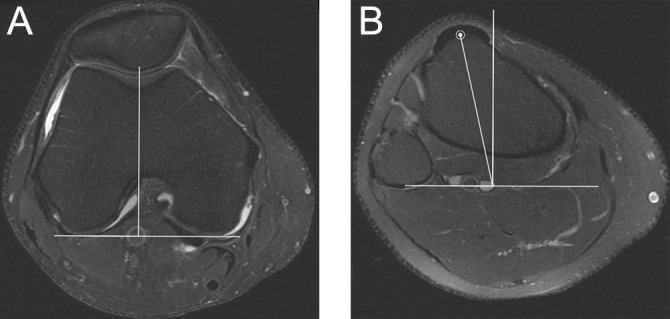
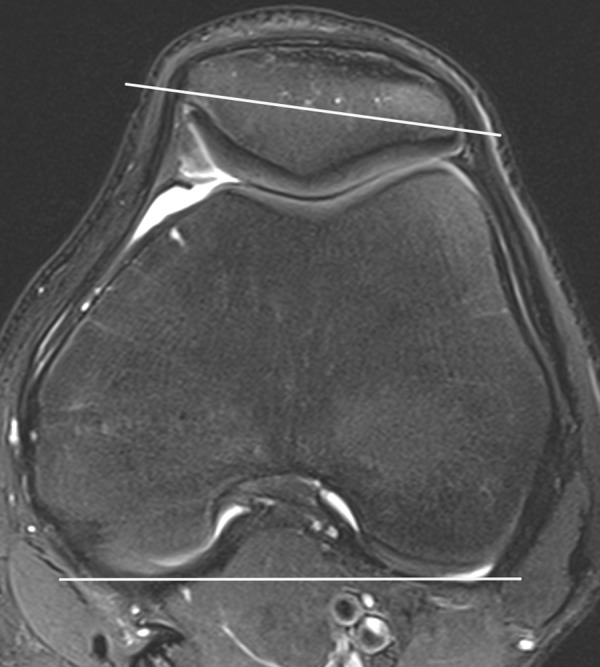
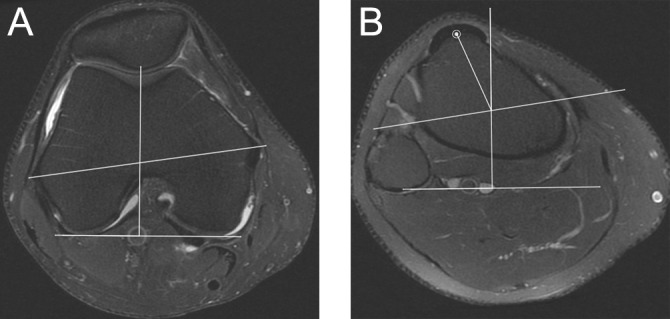
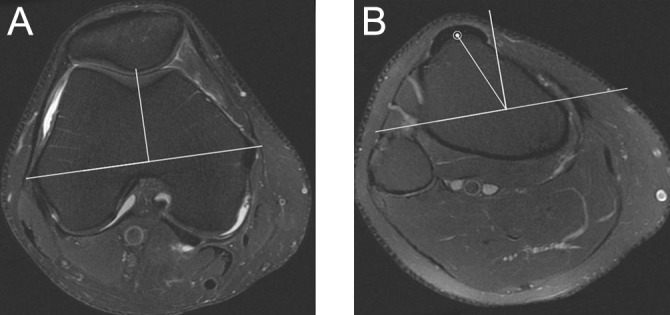
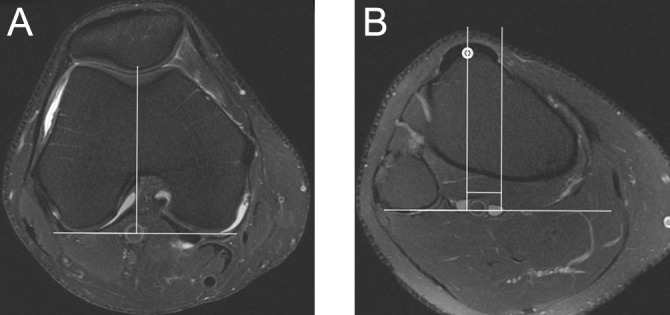
Three PT-TG angle measurements and the PT-TG distance were measured in 82 participants with patellar instability and 100 controls using magnetic resonance imaging (MRI). Measurement landmarks were the line tangent to the posterior femoral condyles, the deepest point of the trochlea, the transepicondylar line, and the patellar tendon center. All measurements were recorded once by 1 examiner, and the measurements were recorded twice by 2 examiners in a random group of 100 knees. Mean values and standard deviations (SDs) were obtained. Normality cutoff values were defined as 2 and 3 SDs above the mean in the control group. The sensitivity, specificity, and positive likelihood ratio (LR+) were calculated. Inter- and intrarater reliability were assessed based on the intraclass correlation coefficient (ICC).
The measurements from the patellar instability and control groups, respectively, for angle 1 (16.4° and 8.4°), angle 2 (31° and 15.6°), angle 3 (30.8° and 15.7°), PT-TG distance (14.5 and 8.4 mm), and patellar tilt (21.1° and 7.5°) were significantly different (P < .05). The angle measurements showed greater sensitivity, specificity, and LR+ than the PT-TG distance. Inter- and intrarater ICC values were >0.95 for all measurements.
The PT-TG angle and the PT-TG distance are reliable and are different between the patellar instability and control groups. PT-TG angles are more closely associated with patellar instability than PT-TG distance.
PT-TG angle measurements show high reliability and association with patellar instability and can aid in the assessment of extensor mechanism malalignment. A more sensitive and specific evaluation of extensor mechanism malalignment can improve patient care by preventing both redislocation and abnormal tracking of overlooked malalignment and complications of unnecessary tibial tuberosity medialization.
胫骨结节-滑车沟(TT-TG)被用作髌股对线不良的金标准。
评估 3 种髌腱-滑车沟(PT-TG)角度测量技术和髌腱-滑车沟距离测量(腱性软骨 TT-TG)作为髌股不稳定的预测指标。
队列研究(诊断);证据水平,3 级。
使用磁共振成像(MRI)对 82 例髌股不稳定患者和 100 例对照组进行 3 种 PT-TG 角度测量和 PT-TG 距离测量(肌腱软骨 TT-TG)。测量标志为:后股骨髁切线、滑车最低点、髁间线和髌腱中心。所有测量均由 1 名检查者进行 1 次记录,在 100 个膝关节的随机组中由 2 名检查者进行 2 次记录。获得平均值和标准差(SD)。以对照组中平均值加 2 和 3 个标准差定义正态截断值。计算敏感性、特异性和阳性似然比(LR+)。基于组内相关系数(ICC)评估组内和组间可靠性。
髌股不稳定组和对照组的角度 1(16.4°和 8.4°)、角度 2(31°和 15.6°)、角度 3(30.8°和 15.7°)、PT-TG 距离(14.5 和 8.4mm)和髌股倾斜角(21.1°和 7.5°)的测量值差异均有统计学意义(P <.05)。角度测量的敏感性、特异性和 LR+均大于 PT-TG 距离。所有测量的组内和组间 ICC 值均>0.95。
PT-TG 角度和 PT-TG 距离在髌股不稳定组和对照组之间可靠且不同。PT-TG 角度与髌股不稳定的关系比 PT-TG 距离更密切。
PT-TG 角度测量具有较高的可靠性和与髌股不稳定的相关性,可辅助评估伸肌机制对线不良。更敏感和特异的伸肌机制对线不良评估可以通过防止因忽略对线不良而导致的反复脱位和异常轨迹以及因不必要的胫骨结节内移化而导致的并发症,从而改善患者的治疗效果。